%2Fhttps%3A%2F%2Ftf-cmsv2-smithsonianmag-media.s3.amazonaws.com%2Ffiler_public%2Ff0%2Ffe%2Ff0fe19e4-e68b-474d-b0a4-19c5beb9d19d%2Fspeedy-star.webp)
Fastest Star Ever Found May Unlock Black Hole Secrets
Scientists discovered a star racing around our galaxy's center at 56 million miles per hour, the fastest ever recorded in the Milky Way. This cosmic speedster could finally prove Einstein's theory about spinning black holes.
A star is zooming around the supermassive black hole at the heart of our galaxy at a mind-bending 56 million miles per hour. That's 8 percent the speed of light, making it the fastest star ever spotted in the Milky Way.
Scientists discovered the stellar speed demon, called S301, using powerful telescopes in Chile that can spot extremely faint objects. They first noticed it near Sagittarius A*, our galaxy's central black hole, in spring 2023 and tracked its movements over the following years.
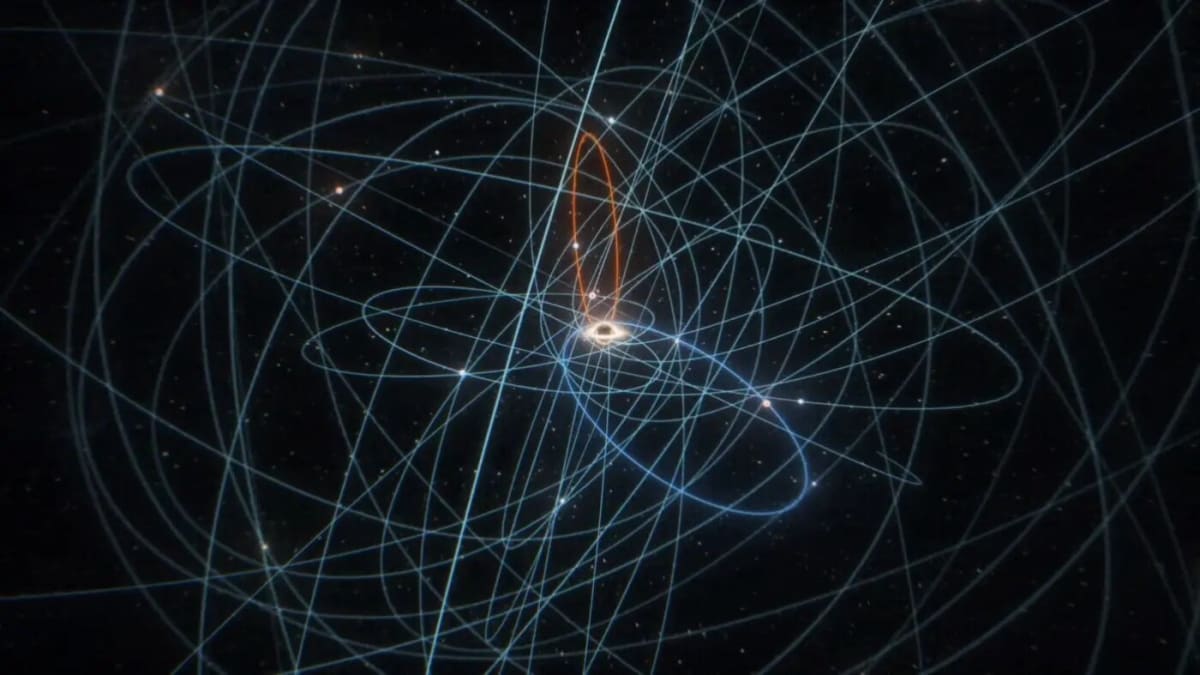
What makes this discovery especially exciting is where S301 travels. The star follows an elongated, oval path that brings it incredibly close to the black hole every 8.7 years, coming within just 12 times the distance between Earth and our sun.
"The star comes in in one direction, getting faster and faster and faster, then gets a very sharp turn around the black hole," explains Stefan Gillessen, an astronomer at the Max Planck Institute for Extraterrestrial Physics. Then it flies back out and decelerates until reaching its farthest point, as predictable as a Swiss train schedule.
Scientists believe S301 was once part of a two-star system that ventured too close to Sagittarius A*. The black hole's gravity likely tore the pair apart, capturing S301 while flinging its companion beyond our galaxy entirely.
Why This Inspires
For decades, astronomers have suspected that Sagittarius A*, a black hole 4.3 million times as massive as our sun, is spinning. But they've never been able to prove it directly.
S301 changes everything. Einstein's theory of relativity predicts that a spinning black hole twists space-time itself, which should slightly alter the orbits of nearby stars with each pass.
By watching S301 make repeated loops around the black hole over the next decade, scientists can finally measure this spin directly. "Without this star, we would need to measure the motion of other stars for several more decades to get anywhere close," says astronomer Juan Osorno.
Confirming the black hole's spin would validate Einstein's groundbreaking theory and unlock secrets about how our galaxy formed and evolved. After hunting for answers 27,000 light-years away, we finally have a cosmic helper showing us the way.
More Images
%2Fhttps%3A%2F%2Ftf-cmsv2-smithsonianmag-media.s3.amazonaws.com%2Ffiler_public%2Ff0%2Ffe%2Ff0fe19e4-e68b-474d-b0a4-19c5beb9d19d%2Fspeedy-star.webp)
%2Fhttps%3A%2F%2Ftf-cmsv2-smithsonianmag-media.s3.amazonaws.com%2Ffiler_public%2Ff0%2Ffe%2Ff0fe19e4-e68b-474d-b0a4-19c5beb9d19d%2Fspeedy-star.webp)
%2Fhttps%3A%2F%2Ftf-cmsv2-smithsonianmag-media.s3.amazonaws.com%2Ffiler_public%2F10%2Fb1%2F10b1cddf-944b-4397-9f67-d03737920d33%2Feso2612b.jpg)
%2Fhttps%3A%2F%2Ftf-cmsv2-smithsonianmag-media.s3.amazonaws.com%2Ffiler_public%2F90%2F22%2F9022b458-f650-4679-ba42-61ad416e1a00%2Feso2612d.jpg)
Based on reporting by Smithsonian
This story was written by BrightWire based on verified news reports.
Spread the positivity!
Share this good news with someone who needs it