Fiddler Crabs Break Down Microplastics in Polluted Forest
Scientists discovered that fiddler crabs in Colombia's polluted mangrove forests are breaking down microplastics at record rates, absorbing 16 times the concentration found in soil. While not a cure-all, the discovery reveals how nature adapts to human-made challenges in unexpected ways.
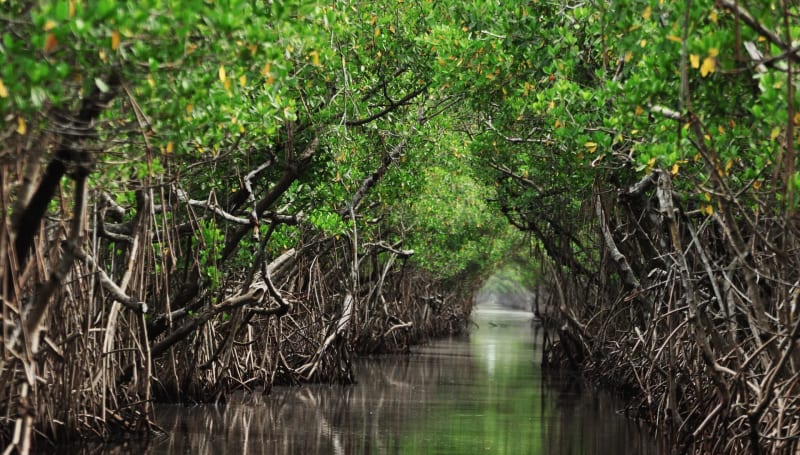
In one of the world's most polluted mangrove forests, tiny fiddler crabs are doing something scientists never expected: eating microplastics and breaking them down faster than nature alone could manage.
Researchers from the University of Exeter studied fiddler crabs along Colombia's northern coast, where plastic pollution has become a major problem. They wanted to know if these crabs would avoid the contamination or find ways to cope with it.
The team sprayed sections of the mangrove with brightly colored polyethylene microspheres to track what happened next. What they found surprised them: the crabs suctioned up microplastics at one of the highest rates ever recorded in nature.
The average crab absorbed microplastics at 16 times the concentration found in the surrounding soil. Their digestive systems then broke those particles down into even smaller pieces, speeding up decomposition that would otherwise take much longer through sunlight and friction alone.
"We know that fiddler crabs eat a wide range of food and will ingest plastic in laboratory settings," said Professor Tamara Galloway from Exeter's Department of Biosciences. "But until now, we did not know whether they avoided plastic in the natural environment or would adapt to its presence."
The discovery matters because scientists have struggled to understand how wildlife adapts to microplastic pollution. People increasingly worry about microplastics in their own bodies and the environment, but researchers know little about whether animals can evolve responses to this modern threat.
The Bright Side
This breakthrough reveals that living creatures aren't just victims of pollution. They're actively finding ways to cope with the challenges humans have created for them.
The crabs' adaptation shows nature's remarkable resilience, even in heavily contaminated environments. While mechanical processes like sun exposure can break down plastics slowly, these crabs prove that biological solutions exist too.
"Living creatures are not just passive components of the marine ecosystem but may be finding ways to cope with chronic anthropogenic pressures according to their evolutionary histories," said Daniela Díaz from Universidad de Antioquia.
The researchers caution that this isn't a solution to plastic pollution. The tiny nanoplastics remain in the crabs' bodies and could spread through the food chain as larger animals eat the crabs.
Still, understanding how animals adapt to pollution helps scientists predict the fate of plastics in ecosystems. It also offers hope that nature is more resilient than we sometimes give it credit for.
The findings, published in Global Change Biology, open new research directions into how wildlife worldwide might be developing their own responses to human pollution.
More Images


Based on reporting by Google: scientists discover
This story was written by BrightWire based on verified news reports.
Spread the positivity!
Share this good news with someone who needs it