Four Astronauts See Moon's Far Side in Historic Artemis II
For the first time in over 50 years, humans flew around the Moon and witnessed sights no one had ever seen in sunlight. Scientists watching from Earth screamed with delight as the crew shared stunning observations of green and brown hues, meteorite impacts, and a total solar eclipse from space.
When four astronauts aboard Artemis II reported seeing green and brown colors on the Moon instead of just grays, scientists in mission control let out audible screams of delight.
Reid Wiseman, Victor Glover, Christina Koch, and Jeremy Hansen spent nearly seven hours observing the Moon this week as they flew past it in their spacecraft named Integrity. Parts of the lunar far side they witnessed had never been seen by humans in sunlight before.
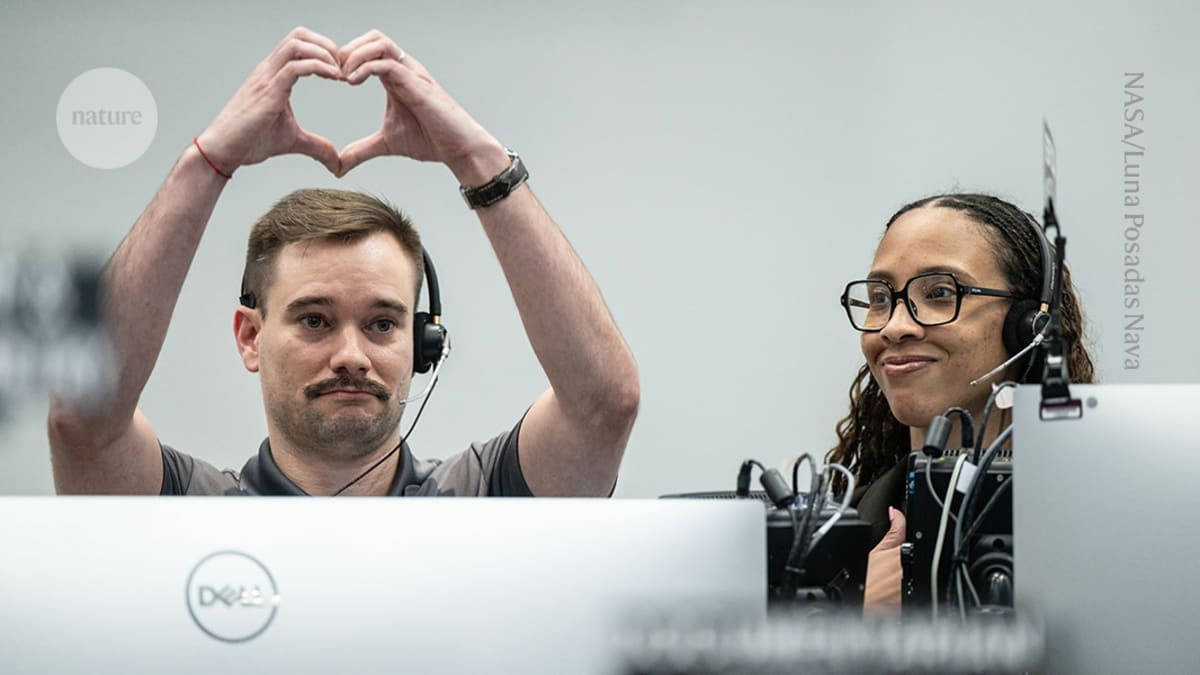
The mission's science team gathered at Johnson Space Center in Houston to monitor every moment. Deputy lunar science lead Marie Henderson polled each scientist one by one before declaring "We are go for lunar fly-by." The tension in the room immediately shot up.
What followed exceeded everyone's expectations. The astronauts, drawing on months of geology training, described mountains shaped like handprints and dinosaur footprints. They watched shadows dance along the terminator, the boundary between day and night on the Moon. They witnessed multiple impact flashes as tiny meteorites pelted the lunar surface in real time.
"There's absolutely no words to describe what we are looking at out this window," Wiseman radioed back to Earth.
The crew also experienced something most humans never will: a total solar eclipse from space that lasted nearly an hour. The images they captured show the Moon eclipsing the Sun with an ethereal glow radiating into the darkness, surrounded by planets from Mercury to Neptune like diamond chips.
NASA planetary geologist David Hollibaugh Baker arrived at the space center after working a sleep shift. When he opened the door to see the first processed images on the displays, his heart started racing. "I never felt that kind of rush before," he said.
Why This Inspires
This mission proves that human exploration still matters in an age of robots and artificial intelligence. The astronauts could distinguish between cosmic ray flashes in their vision and actual meteorite impacts, something no camera alone could verify. Their trained geological observations provided context that pure data cannot capture.
The diversity of the team also signals progress. Many of the scientists in the room were women early in their careers, working alongside astronauts that include the first woman and first Black person to orbit the Moon.
After the fly-by ended, scientists had exactly 20 minutes to ask the crew follow-up questions before their memories faded. Every second counted as they captured human observations that will help plan future lunar landings and discoveries.
Humanity just took another giant leap toward returning to the Moon.
More Images



Based on reporting by Nature News
This story was written by BrightWire based on verified news reports.
Spread the positivity!
Share this good news with someone who needs it