Frozen Air and Molten Salt Could Power the Clean Energy Grid
The biggest puzzle in clean energy isn't making power anymore. It's storing it when the sun sets and the wind stops blowing.
Solar panels work brilliantly in daylight. Wind turbines spin when the breeze picks up. But when conditions change, all that potential power simply vanishes unless someone figures out how to hold onto it.
Two strange solutions are being built at scale right now, and they don't rely on the lithium batteries we've grown used to. One freezes air until it turns liquid. The other heats industrial salt until it glows hot enough to cook metal.
In Manchester, England, construction crews are building a facility on the site of an old coal plant that will store electricity by cooling air to negative 321 degrees Fahrenheit. At that temperature, air squeezes down to one seven hundredth of its normal size and becomes liquid.
When the power grid needs electricity, the liquid warms back up, expands into gas, and spins a turbine without burning anything. The facility will power nearly half a million homes for six hours once it opens.
The advantage over lithium batteries is time. Lithium handles power gaps measured in hours. Liquid air can sit for days or weeks, ready to balance the grid through long stretches of cloudy, windless weather.
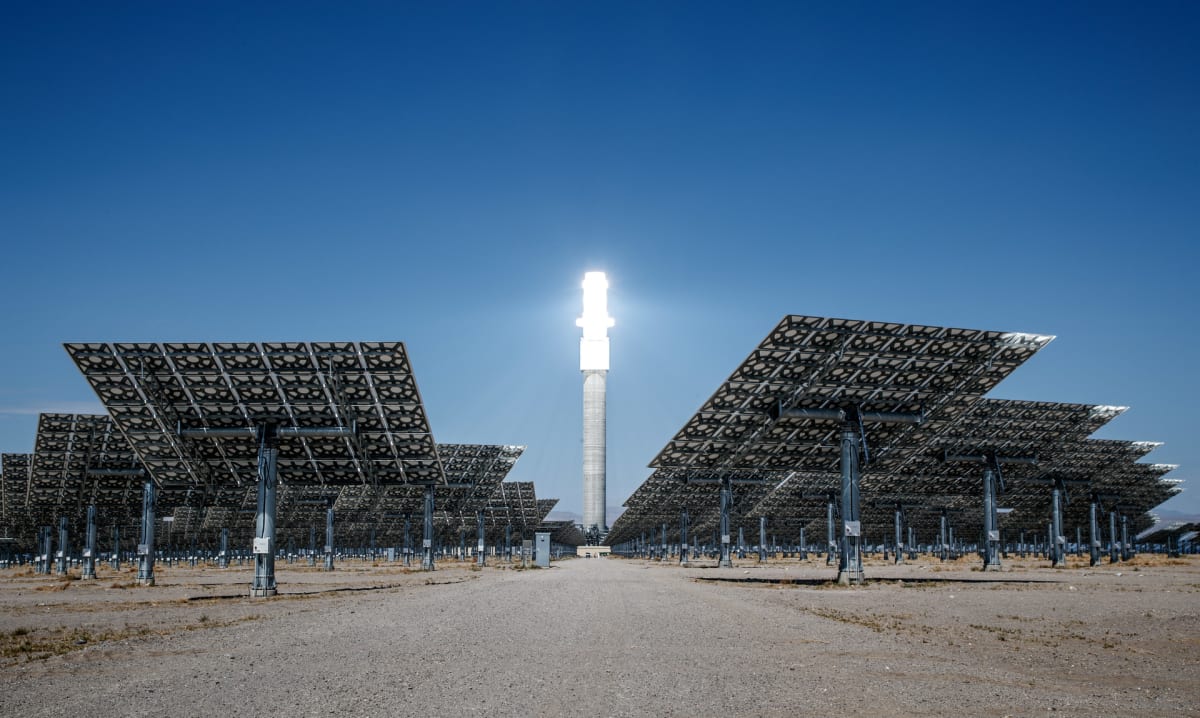
Meanwhile in Nevada, a solar project called Crescent Dunes has been running a different experiment for a decade. Ten thousand mirrors focus sunlight on a central tower, heating tanks of potassium and sodium nitrate to 1,040 degrees Fahrenheit. That stored heat can generate power for up to 10 hours after the sun goes down.
The same molten salt technology has powered guided missiles and nuclear weapons for decades, trusted to work reliably under extreme pressure. Now it's being repurposed for climate solutions.
In the United Arab Emirates, the world's largest battery project pairs solar panels covering an area the size of 12,600 football fields with 19 gigawatt hours of storage. Half a million homes could run through the night on that reserve.
The Ripple Effect
These technologies sidestep some of the thorniest problems with lithium batteries. Cobalt and lithium mining has damaged ecosystems and displaced communities. The batteries wear out after repeated use.
Molten salt and liquid air rely on materials that don't require contested extraction. Industrial salts are found worldwide. Liquid air uses air. Both systems can be recycled when they reach end of life, and many can run indefinitely without degrading.
The supply chains look less fraught, the materials less precious, and the geopolitical complications fewer. What looked like an impossible storage problem is starting to crack open because engineers figured out what to do with substances that have been around forever.
The cleanest grid in the world still needs somewhere to put the power it makes when nobody's using it yet.
Based on reporting by Optimist Daily
This story was written by BrightWire based on verified news reports.
Spread the positivity!
Share this good news with someone who needs it