Galaxies Shaped by Location Just 1.2 Billion Years In
New telescope images reveal that where a galaxy lived determined how it grew, even when the universe was barely a billion years old. The discovery shows cosmic "neighborhood effects" began far earlier than scientists thought possible.
Scientists just found proof that your cosmic address mattered from nearly the beginning of time.
Using the James Webb Space Telescope, astronomers discovered that galaxies living in crowded neighborhoods 12.6 billion years ago grew differently than galaxies in quieter regions. The universe was only 1.2 billion years old at the time, making this the earliest evidence that location shaped how galaxies developed.
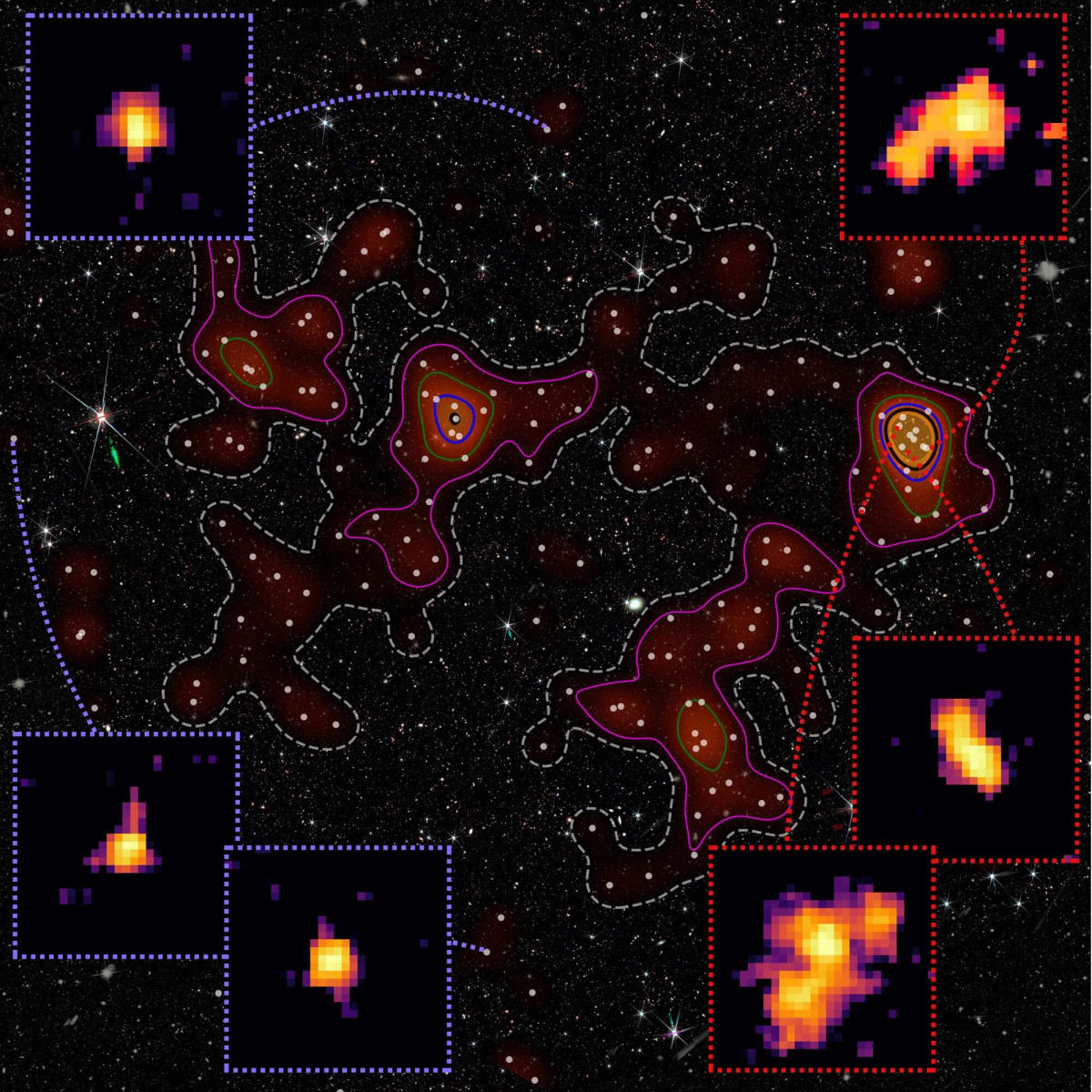
The breakthrough came from studying the Loktak Protocluster, a massive gathering of young galaxies first spotted by Japan's Subaru Telescope. Named after a lake in India where floating islands connect into larger formations, the protocluster showed four separate galaxy clusters linking together into one enormous structure.
Lead researcher Ronaldo Laishram from the National Astronomical Observatory of Japan calls these protoclusters "construction sites of the most massive structures in the present-day Universe." His team compared galaxies inside the crowded protocluster to galaxies in normal neighborhoods from the same era.
The differences were striking. While the star-forming cores of both galaxy types looked similar, galaxies in dense environments had grown about 1.4 times larger overall. Their outer regions built up faster and earlier than their isolated cousins.
Think of it like city living versus rural life. Galaxies in the cosmic equivalent of downtown developed their suburbs faster, even though their centers grew at similar rates.
Today's universe shows clear neighborhood effects. Galaxies in clusters look rounder, struggle to form new stars, and grow more massive than isolated galaxies. Scientists wondered when these patterns started, whether they emerged only after billions of years or began much earlier.
Why This Inspires
This discovery rewrites our understanding of cosmic community. Even in the universe's childhood, connection and proximity mattered. Galaxies didn't evolve alone in isolation but were shaped by their neighbors and surroundings from remarkably early times.
The finding suggests that fundamental patterns governing how structures grow and interact were already in place when the universe was less than one-tenth its current age. The same forces that organize galaxies into clusters today were already at work in the cosmic dawn.
The James Webb Space Telescope's infrared vision made these observations possible, peering through dust and distance to reveal details invisible to previous instruments. Combined with the Subaru Telescope's wide-field surveys, astronomers can now map how cosmic neighborhoods formed and influenced their residents across billions of years.
Understanding when and how environment affects galaxy growth helps scientists piece together the full story of how the universe evolved from a smooth soup of matter into the rich tapestry of structures we see today. Even in the earliest chapters of cosmic history, place shaped destiny.
Based on reporting by Google: James Webb telescope
This story was written by BrightWire based on verified news reports.
Spread the positivity!
Share this good news with someone who needs it
%2Fhttps%3A%2F%2Ftf-cmsv2-smithsonianmag-media.s3.amazonaws.com%2Ffiler_public%2F3f%2F55%2F3f5579c8-c4a7-43a5-bb54-6498478792fd%2Fhelix1940__fitmaxwzk3mcw2ntbd.jpg)