Webb Telescope Finds Hidden Moon Orbiting Uranus
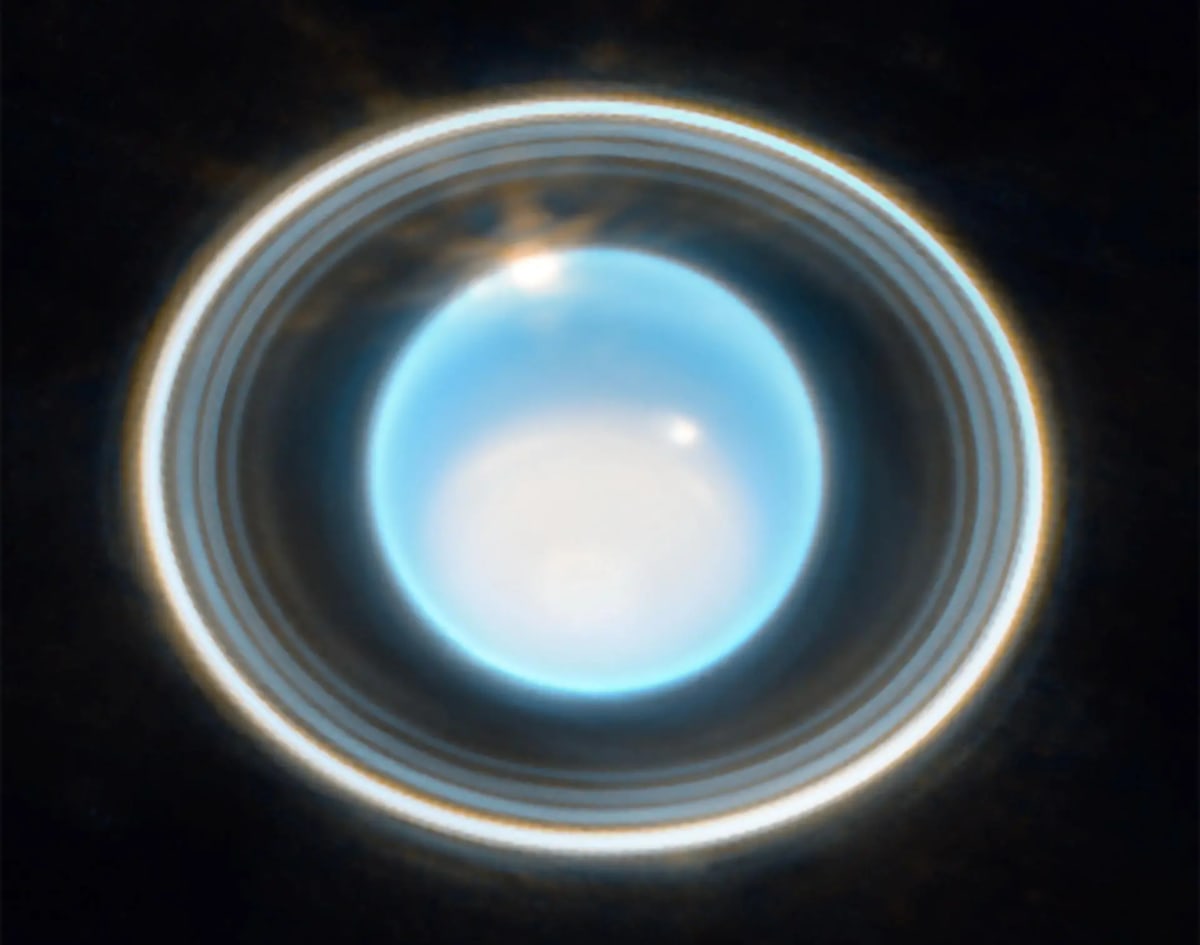
The James Webb Space Telescope just discovered a tiny moon hiding in Uranus's rings that no spacecraft or telescope has ever seen before. This 29th moon proves we still have surprises waiting around planets we thought we knew.
A world just 6 miles wide has been hiding around Uranus for billions of years, and astronomers finally spotted it thanks to the most powerful space telescope ever built.
Maryame El Moutamid and her team at the Southwest Research Institute found the tiny moon buried deep within images captured by the James Webb Space Telescope on February 2, 2025. To spot something so faint, they stacked ten different images together, each one requiring 40 minutes of exposure time through Webb's Near-Infrared Camera.
The moon is so small that NASA's Voyager 2 spacecraft flew right past it in 1986 without noticing. Every ground-based telescope has missed it too, for nearly four decades.
Now officially called S/2025 U 1 until it receives a proper name, this little world orbits about 35,000 miles from Uranus's center. It sits snugly between two other small moons named Ophelia and Bianca, traveling in a nearly perfect circle that lines up with the planet's equator.
That circular orbit tells scientists something important. The moon likely formed right where it is now, rather than being a captured asteroid or comet from deep space.
Why This Inspires
This discovery shows that even worlds we visited decades ago still hold secrets. Uranus now officially has 29 known moons, but the real excitement isn't just about adding one more to the list.
Tiny moons like S/2025 U 1 help scientists understand how ring systems and moon families evolve over billions of years. These small inner satellites constantly tug at each other with gravity, pulling on the planet's rings and reshaping the entire system in ways researchers are only beginning to understand.
Matthew Tiscareno, a senior research scientist at the SETI Institute, points out that no other planet packs so many small inner moons into such a tight space. Their complex dance with Uranus's rings hints at a chaotic history that blurs the line between what counts as a ring and what counts as a moon.
The International Astronomical Union will eventually give this moon an official name, following tradition by choosing a character from William Shakespeare's plays or Alexander Pope's poetry. Future observations will help scientists nail down its exact orbit, composition, and size.
More importantly, this fresh data gives mission planners critical information as they design a flagship expedition to Uranus. Webb's discovery proves that patience, powerful tools, and curiosity can reveal wonders hiding in plain sight, even in places we thought we'd already explored.
More Images




Based on reporting by Google: James Webb telescope
This story was written by BrightWire based on verified news reports.
Spread the positivity!
Share this good news with someone who needs it