German Solar Breakthrough Hits 27% Efficiency Without Solvents
German scientists just cracked a major barrier in solar panel production, creating a highly efficient cell without using a single drop of industrial solvent. The breakthrough could finally bring next-generation solar technology from the lab to your rooftop.
Scientists in Germany just made solar panels cleaner to produce and more powerful than ever. Researchers at the University of Freiburg and Fraunhofer Institute created the world's first completely solvent-free perovskite-silicon tandem solar cell, achieving an impressive 27.3% efficiency.
This might sound technical, but here's why it matters. Traditional solar cell manufacturing uses liquid solvents that create contamination, waste, and extra processing steps. The German team eliminated every single solvent from their production process.
Lead researcher Mohamed A. A. Mahmoud and his team used a technique called physical vapor deposition. Instead of dissolving materials in liquids, they transferred them directly onto the substrate through vapor under vacuum. Think of it like spray-painting with pure material instead of mixing paint with thinner first.
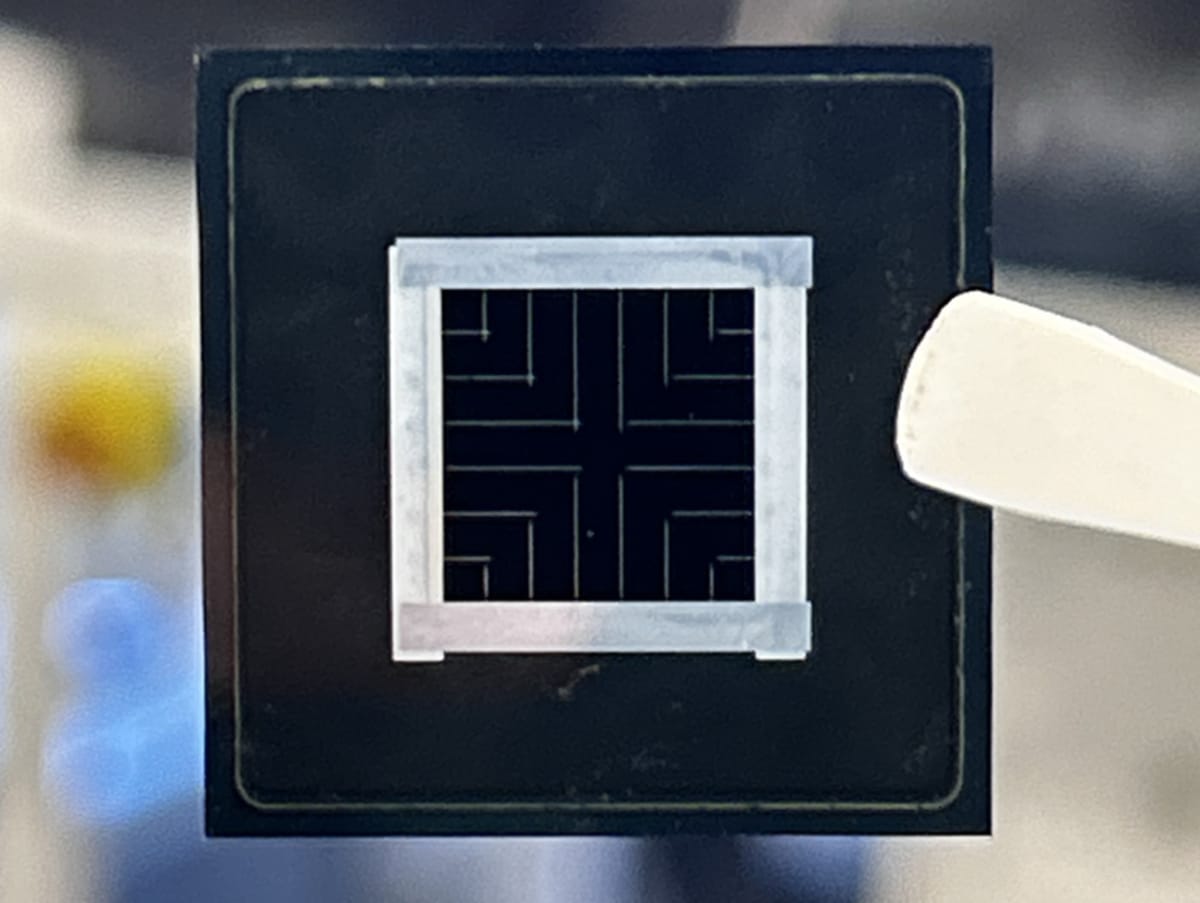
The results speak for themselves. The 1-square-centimeter cell achieved 27.1% efficiency in converting sunlight to electricity. After nearly 6,800 hours of storage testing, it still retained 97% of its original performance.
Co-author Juliane Borchert emphasized the collaborative effort that made this possible. "Thanks to excellent collaboration with researchers from four different countries, we were able to combine various measurement techniques to gain a detailed understanding of the processes taking place," she said.
The team discovered something unexpected during their research. When they tested their vapor deposition process on different silicon surfaces, the textured surfaces converted materials into the perovskite phase more effectively than smooth ones. These kinds of insights help optimize the technology for mass production.
The Ripple Effect
This breakthrough addresses one of the biggest obstacles preventing next-generation solar cells from reaching mass production. Perovskite-silicon tandem cells have long promised superior efficiency, but manufacturing challenges kept them confined to laboratories.
By proving that solvent-free production works at high efficiency, the German team opened the door for reliable, large-scale manufacturing. Factories won't need complex solvent handling, drying equipment, or contamination controls. The process becomes simpler, cleaner, and more scalable.
The researchers noted that their findings lay "an important foundation" for industrial implementation. As solar energy becomes increasingly crucial for climate solutions, making production cleaner while boosting efficiency creates a double win.
The world installed record amounts of solar capacity last year, and demand keeps growing. Technology like this could accelerate that growth while reducing the environmental footprint of manufacturing itself.
Clean energy just got a little cleaner to make.
More Images


Based on reporting by PV Magazine
This story was written by BrightWire based on verified news reports.
Spread the positivity!
Share this good news with someone who needs it