Germany Turns Steel Waste Into Jet Fuel After 10 Years
A German steel company just celebrated a decade of turning factory emissions into useful chemicals and sustainable aviation fuel. What started as an ambitious experiment now has over 20 partners working to scale carbon recycling across entire industries.
Imagine if steel mills could stop polluting the air and start producing airplane fuel instead.
That's exactly what Germany's thyssenkrupp has been doing for the past decade through its Carbon2Chem project. The company just celebrated ten years of transforming CO2 emissions and renewable hydrogen into valuable products like methanol, ammonia, and sustainable aviation fuel.
The breakthrough lies in how they see waste. Instead of treating blast furnace gases as pollution, the project captures carbon, hydrogen, and nitrogen from steel production and uses them as raw materials for chemicals.
"We view CO2 and other components of blast furnace gases not as waste, but as raw materials," says Matthias Kammel, Managing Director of thyssenkrupp Carbon2Chem. The approach closes carbon loops by connecting steel production, energy systems, and chemical manufacturing in one integrated system.
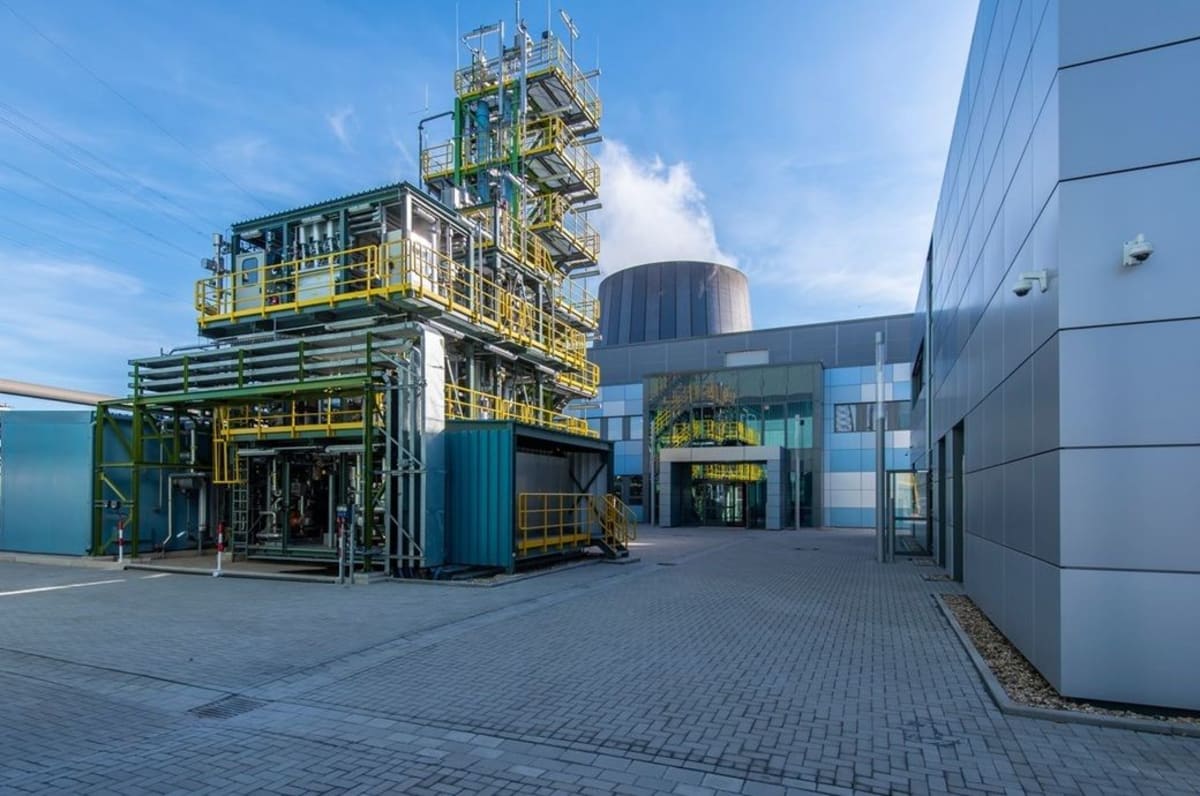
What started in 2016 with a single technical center in Duisburg has grown into a collaboration involving more than twenty partners from industry and academia. Research institutes like the Max Planck Institute for Chemical Energy Conversion and the Fraunhofer Institute work alongside various thyssenkrupp companies to refine the technology.
The project has moved from laboratory experiments to real-world testing. The technical center has spent years investigating key process steps under industrial conditions, providing reliable data that proves the concept works at scale.
Now comes the exciting part. The next phase includes building an additional electrolysis hall and a sustainable aviation fuel plant in Duisburg, pushing the technology toward full industrial deployment.
The Ripple Effect
This isn't just about one company cleaning up its emissions. The technology offers a blueprint for other energy-intensive industries looking to decarbonize while creating new revenue streams.
Small and medium-sized businesses are already showing interest in adapting these carbon recycling technologies for their own operations. The project demonstrates that renewable energy can be flexibly integrated into industrial processes, helping stabilize energy grids while reducing emissions.
Professor Robert Schlögl, the project coordinator for basic research, points out an unexpected benefit: "Renewable energy can thus be flexibly integrated into industrial processes—a contribution to system stability that extends beyond the individual site."
The German Federal Ministry of Research, Technology, and Aerospace has funded the initiative, recognizing its potential to transform how industries think about waste and emissions. By establishing carbon as a valuable raw material rather than a disposal problem, the project strengthens economic resilience while addressing climate goals.
Ten years of collaboration between researchers, industrial partners, and government has proven that transforming energy-intensive industries is possible when technology, partnership, and persistence align.
Based on reporting by Google News - Germany Innovation
This story was written by BrightWire based on verified news reports.
Spread the positivity!
Share this good news with someone who needs it