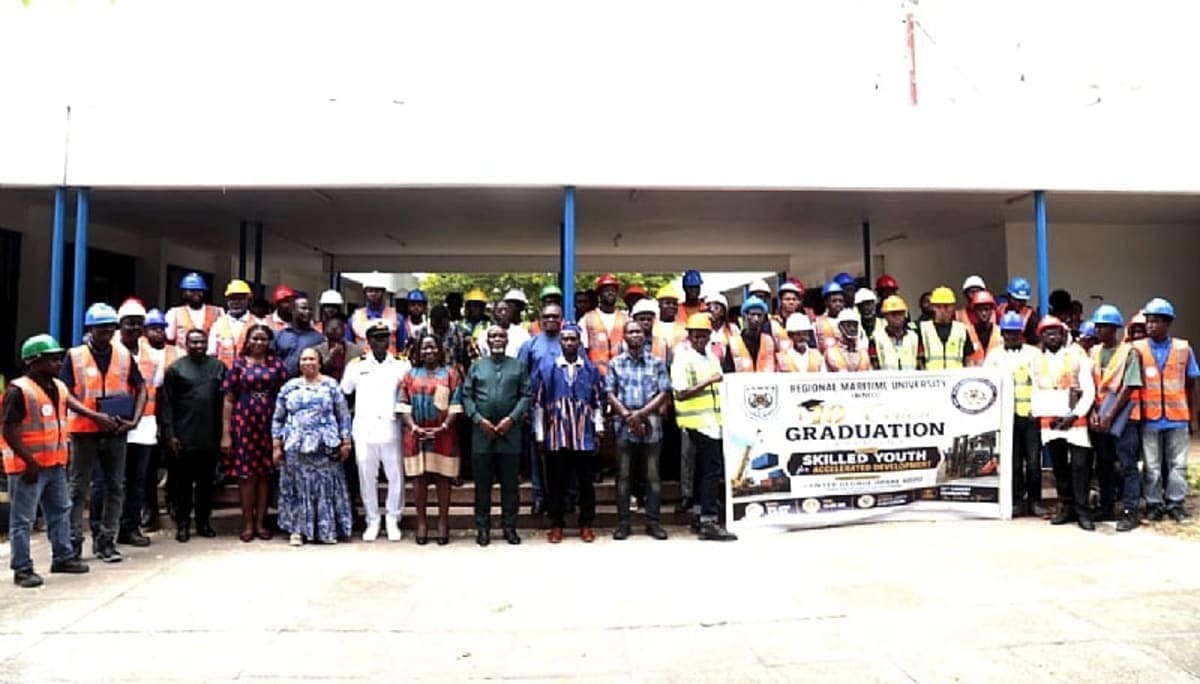
Ghana Graduates 74 in Forklift and Crane Skills Training
Seventy-four young Ghanaians just gained the technical skills that industries across the country are desperately seeking. Their graduation marks a hopeful step toward closing critical workforce gaps in construction, mining, and logistics.
Seventy-four young people in Ghana now have the specialized training that employers in construction, ports, mining, and manufacturing urgently need.
The graduates completed intensive programs in forklift operation, mobile crane operation, and excavator operation through a partnership between the National Association of Heavy Duty Equipment Operators Ghana and the Regional Maritime University. The 10th cohort included 32 forklift operators, 35 mobile crane operators, and 7 excavator operators.
Ghana's Ministry of Youth Development and Empowerment celebrated the achievement as evidence that practical skills training works. Deputy Director General Reine Adzo Agbo told graduates that academic qualifications alone cannot drive national development without a workforce that has strong technical and vocational competencies.
The ceremony highlighted how countries achieve rapid economic progress by investing in youth skills rather than relying solely on traditional education paths. Industries like construction, maritime services, logistics, and infrastructure development depend on trained operators who can immediately contribute to projects.
Professor Jethro W. Brooks, Vice Chancellor of the Regional Maritime University, emphasized that Africa's growing infrastructure demands require exactly this kind of competent workforce. He urged graduates to view their certificates as starting points for continuous learning, not finish lines.
The Ripple Effect
The training represents more than individual opportunity. It addresses a persistent shortage that slows down entire industries across Ghana and creates safer workplaces through proper operator certification.
The National Association of Heavy Duty Equipment Operators Ghana is pushing for heavy duty equipment training to be integrated into the government's National Apprenticeship Programme. President Dominic Kofi Eyiah pointed out that expanding access to this training would create jobs, close skills gaps, and accelerate industrial growth nationwide.
One former trainee already demonstrated the program's quality by excelling during an employment assessment, showing that the hands-on training translates directly to workplace competence. The success story offers proof that investing in vocational education creates immediate economic impact.
The government's broader youth empowerment efforts include the Adwumawura Programme, which supports young entrepreneurs through training, mentorship, business incubation, and market access. These initiatives recognize that sustainable livelihoods emerge from practical skills that match what industries actually need.
The graduation ceremony ended with calls for stronger partnerships between government, universities, and industry to expand similar training opportunities and build the skilled workforce Ghana needs for economic competitiveness.
More Images



Based on reporting by Google News - Ghana Development
This story was written by BrightWire based on verified news reports.
Spread the positivity!
Share this good news with someone who needs it