Giant Star WOH G64 Changes Before Astronomers' Eyes
For the first time in history, astronomers are watching a massive star transform in real time, revealing secrets about how the universe's biggest stars meet their end. The discovery could rewrite what we know about stellar death.
Astronomers are getting a front-row seat to one of the universe's rarest shows: a giant star changing its behavior right before their eyes.
WOH G64, a red supergiant more than 1,500 times larger than our sun, has started behaving in ways scientists never expected. The star, located in the Large Magellanic Cloud galaxy visible from the Southern Hemisphere, is growing dimmer and seemingly warmer after decades of steady, predictable behavior.
What makes this moment extraordinary is the timing. Stars typically change over millions of years, but WOH G64's transformation is happening on a human timescale, allowing researchers to witness something no generation has seen before.
The star caught astronomers' attention in 2024 when a team captured the sharpest image ever taken of a star in another galaxy. They discovered WOH G64 had suddenly started ejecting huge amounts of dust, creating a fresh cloud around itself. At the same time, it began pulsating differently and appeared to shrink.
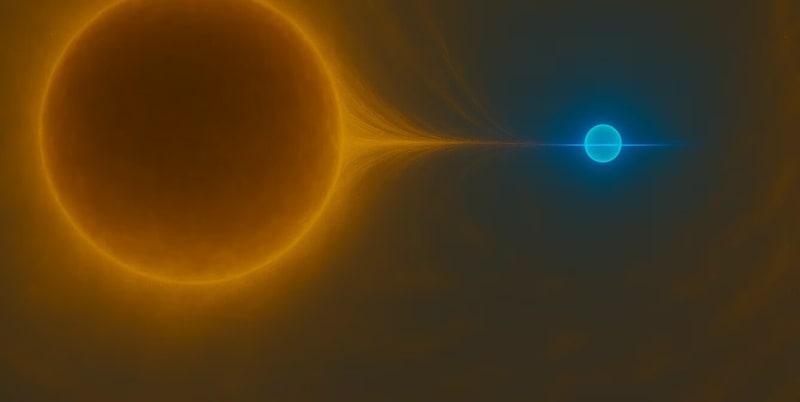
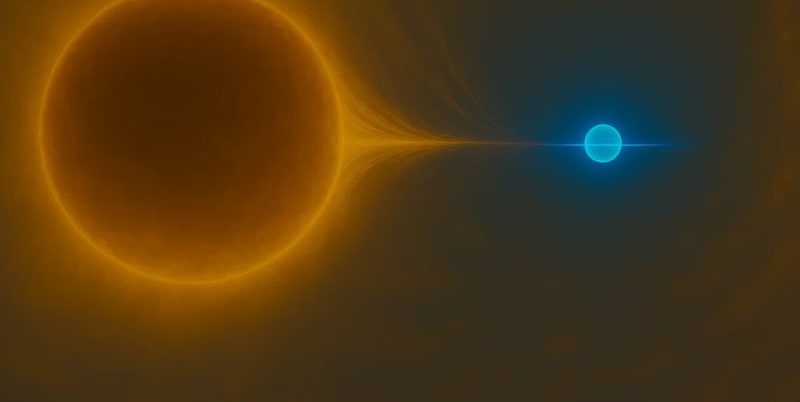
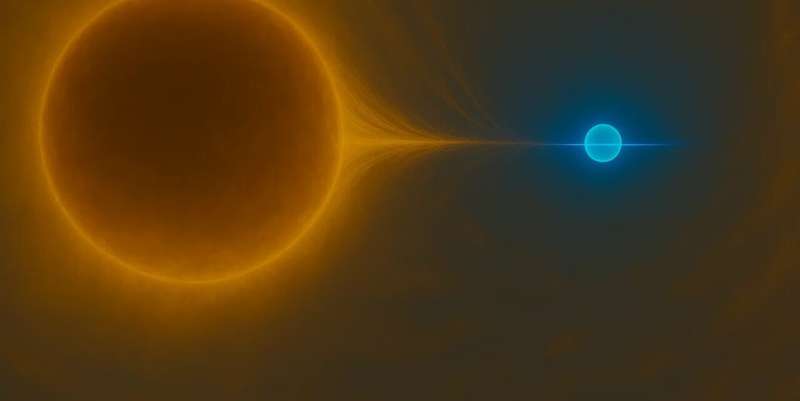
For years, scientists suspected WOH G64 might have a companion star, a smaller, hotter twin orbiting nearby. New observations from the Southern African Large Telescope in 2026 are making that theory look increasingly likely. The team found evidence of both hot and cool gas around WOH G64, suggesting the red giant isn't alone.
The breakthrough came when researchers detected ions near the star, which only form when gas gets heated to extreme temperatures by something much hotter than a red supergiant. The most logical explanation? A blue companion star is heating gas it captured from WOH G64's stellar wind.
If the companion star's orbit is elongated rather than circular, it might be getting closer to WOH G64, potentially triggering the dramatic changes astronomers are observing.
Why This Inspires
This discovery represents something truly special in astronomy: a chance to watch cosmic evolution unfold in real time rather than piecing together the story from ancient light. Most astronomical events happen so slowly that generations of scientists study the same unchanging objects. WOH G64 is giving us something different.
The findings also remind us how much we still have to learn about the universe. Red supergiants have been studied for decades, but WOH G64 is showing scientists that even well-understood stellar processes can hold surprises. The star's unexpected behavior suggests that the final stages of massive stars' lives might be more complex and faster-moving than anyone thought.
For astronomers, WOH G64 offers an unprecedented opportunity to understand how the universe's biggest stars die, shedding light on processes that forge the heavy elements essential for planets and life itself.
Scientists worldwide are now watching WOH G64 closely, knowing they might be witnessing the opening act of a cosmic finale that could unfold within our lifetimes.
More Images

Based on reporting by Phys.org
This story was written by BrightWire based on verified news reports.
Spread the positivity!
Share this good news with someone who needs it