Grad Student Cracks Quantum Math Puzzle That Stumped Experts
A 25-year-old doctoral student solved a mathematical problem so difficult that top researchers had given up hope. His breakthrough connects quantum physics, chaos theory, and fractal patterns in ways never before achieved.
Alex Cohen solved one of mathematics' toughest puzzles while still working on his doctoral degree at MIT, earning himself a professorship at just 25 years old.
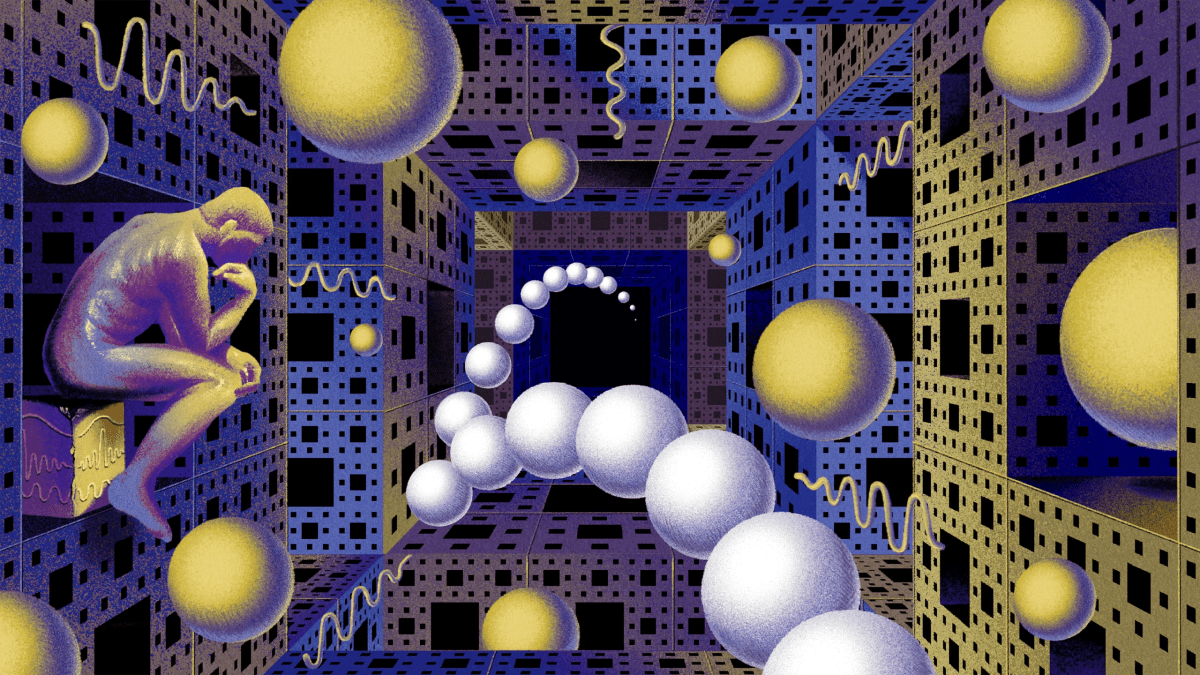
The challenge involved something called the fractal uncertainty principle. At the quantum level, tiny particles behave strangely because you can't know both their exact location and speed at the same time. Cohen figured out how this rule applies to fractals, those infinitely complex patterns that look the same no matter how far you zoom in.
A decade ago, MIT mathematician Semyon Dyatlov wondered if quantum particles could get trapped in fractal patterns the way ordinary objects can. He worked with renowned mathematician Jean Bourgain to prove this for simple, one-dimensional fractals that look like jagged lines.
But expanding that proof to higher dimensions seemed impossible. In 2016, Dyatlov and Bourgain brought together some of the world's best mathematicians in New Jersey to tackle the problem. By the end of the workshop, nobody thought it could be done.
Years passed with no progress. Then Cohen, while still a graduate student, made the breakthrough everyone had abandoned hope for. He extended the fractal uncertainty principle to all higher dimensions.
His solution got published in the Annals of Mathematics, considered the top journal in the field. The paper became his doctoral thesis and landed him an assistant professor position at New York University.
Peter Sarnak from the Institute for Advanced Study called it "a foundational result" and "a pretty remarkable achievement for a guy in his thesis." The principle now serves as a universal mathematical tool that researchers can use across multiple fields.
Why This Inspires
Cohen's breakthrough shows that some of science's hardest problems just need fresh eyes and persistence. A roomful of established experts couldn't crack this puzzle, but a graduate student who refused to accept "impossible" found the answer. His work has already revealed new ways that quantum particles differ from ordinary ones, opening doors for future discoveries.
The story reminds us that breakthrough moments often come from unexpected places, and that youth and determination can triumph where experience alone falls short.
More Images


Based on reporting by Google News - Science
This story was written by BrightWire based on verified news reports.
Spread the positivity!
Share this good news with someone who needs it