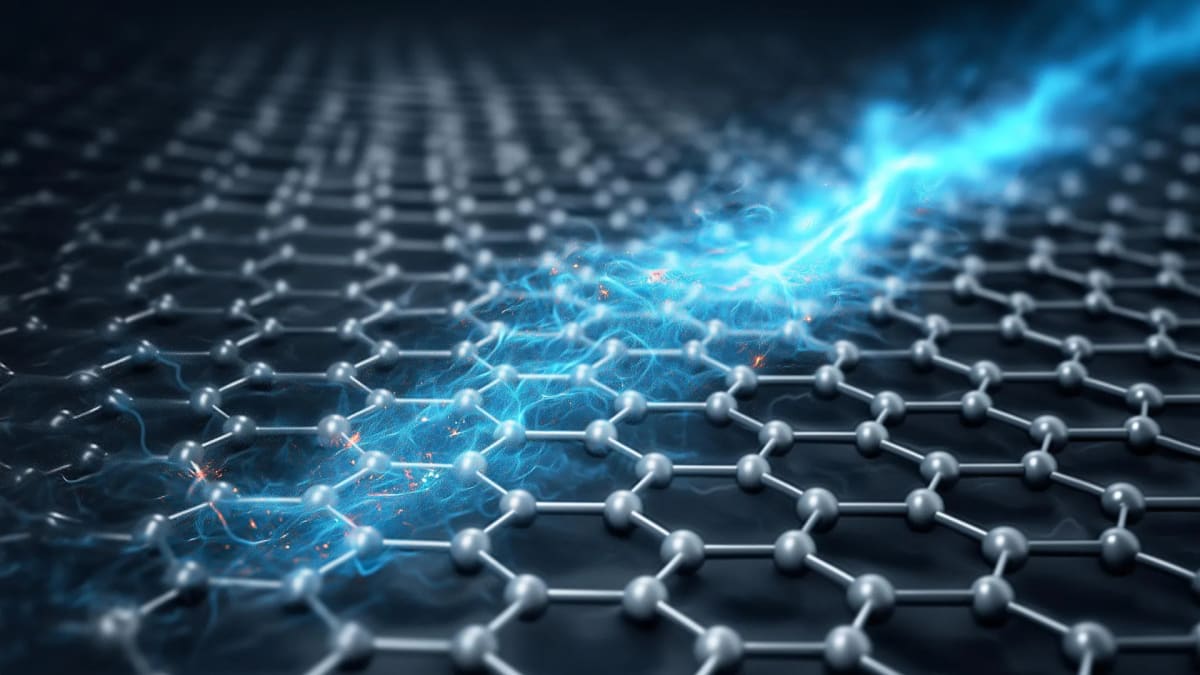
Graphene Breaks Physics Law, Flows Like Perfect Liquid
Scientists in India discovered electrons in graphene flowing like a nearly frictionless liquid, defying a 150-year-old physics law. This breakthrough could unlock powerful quantum sensors and let researchers study black hole physics in a lab.
Imagine a material where electrons glide through it like water with almost no resistance, breaking rules that physicists thought were unbreakable.
Researchers at the Indian Institute of Science just observed exactly that in graphene, a sheet of carbon atoms just one layer thick. Working with colleagues from Japan, they discovered electrons moving collectively like an exotic quantum fluid, contradicting a fundamental law that has stood for over a century.
The team created ultra-clean graphene samples and measured something shocking. As the material's electrical conductivity increased, its heat conductivity dropped, the exact opposite of what should happen. This directly breaks the Wiedemann-Franz law, which states that metals should conduct heat and electricity in proportion to each other.
The deviation wasn't small. At low temperatures, the measurements were off by more than 200 times what the law predicts.
"It is amazing that there is so much to do on just a single layer of graphene even after 20 years of discovery," says Professor Arindam Ghosh, who led the study published in Nature Physics.
The magic happens at something called the Dirac point, where graphene balances perfectly between being a metal and an insulator. At this precise condition, electrons stop acting like individual particles and start flowing together like a liquid with incredibly low viscosity.
PhD student Aniket Majumdar explains that this "Dirac fluid" actually mimics the quark-gluon plasma, the soup of super-energetic particles that scientists create in massive particle accelerators like CERN. Except now, researchers can study similar effects on a lab bench instead of in a billion-dollar facility.
Why This Inspires
This discovery transforms an everyday lab material into a window for exploring the universe's most extreme physics. Scientists can now investigate phenomena usually associated with black holes and high-energy astrophysics without leaving Earth.
The practical applications shine just as bright as the science. This quantum fluid behavior could enable ultra-sensitive sensors that detect the faintest electrical signals and magnetic fields, opening doors to technologies we haven't even imagined yet.
For two decades, physicists struggled to observe this perfect fluid state because tiny imperfections in materials would destroy the delicate quantum effects. The team's success in creating samples clean enough to finally see it proves that persistence in science pays off.
The breakthrough reminds us that even materials we've studied for years still hold secrets waiting to reveal themselves.
Based on reporting by Science Daily
This story was written by BrightWire based on verified news reports.
Spread the positivity!
Share this good news with someone who needs it