Scientists Freeze New Matter Phase at Room Temperature
Scientists at Brown University stabilized a never-before-seen crystal structure that could revolutionize quantum computing. The breakthrough material shows quantum effects at room temperature, something usually requiring extreme cold.
Scientists just created a phase of matter that only existed in theory until now, and it works at room temperature instead of needing ultra-cold conditions.
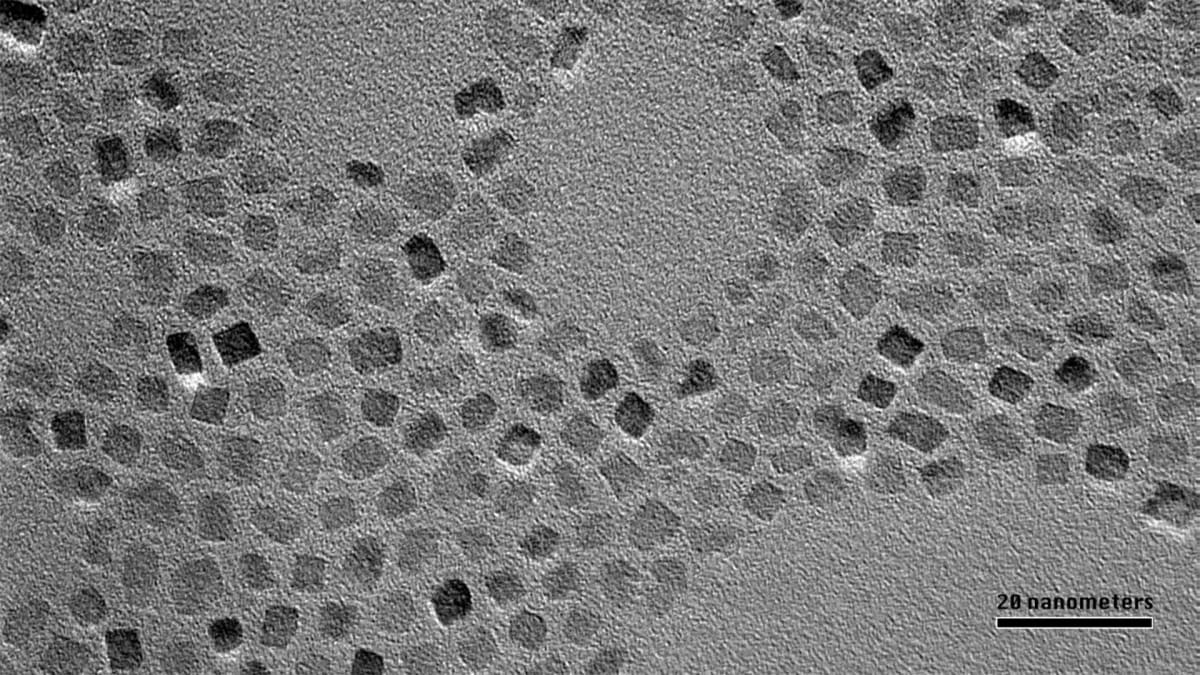
Researchers at Brown University and the University of Michigan assembled tiny silver particles like nanoscale LEGO blocks to capture a fleeting crystal structure that appears when metals transform from one atomic arrangement to another. The achievement, published in Science, solves a puzzle that has stumped materials scientists for decades.
When metals like iron heat up, their atoms reorganize between two common patterns called face-centered cubic and body-centered cubic structures. Scientists predicted that unstable intermediate phases form during this switch, but these transitions happen so fast they've been impossible to observe directly.
The Brown team cracked the problem by building the structure from scratch using custom-shaped silver nanoparticles. Lead researcher Yasutaka Nagaoka created particles shaped like 14-sided gems, then coated them with long molecular chains that act as flexible connectors. These "hairy particles" could shift positions while staying locked together, stabilizing the previously unobservable crystal phase.
"Our work is a little bit like kids playing with LEGO blocks," said Ou Chen, associate professor of chemistry at Brown. "We synthesize unique nanoscale building blocks and stack them into interesting structures."
The real surprise came when the team shined light on their creation. The silver particles showed signs of deep-strong light-matter coupling, where electrons and light waves oscillate in perfect sync and become quantum mechanically entangled. This phenomenon usually requires temperatures near absolute zero to occur.
Why This Inspires
Room-temperature quantum effects have been a holy grail in materials science. Quantum computers today need expensive cooling systems that chill components to hundreds of degrees below zero. A material that maintains quantum properties at normal temperatures could make quantum technology dramatically more practical and accessible.
Beyond quantum computing, the breakthrough demonstrates an entirely new approach to materials design. Instead of mining or synthesizing traditional materials, scientists can now engineer nanoparticles from the ground up and assemble them into structures with custom properties tailored for specific applications.
"Being able to observe these structures is a fundamental breakthrough in materials science, and it gives us greater control over nanomaterial engineering," said Tim Moore, assistant research scientist at the University of Michigan.
The discovery opens doors scientists didn't even know existed. Every new phase of matter brings unexpected applications that researchers are only beginning to explore.
Based on reporting by Science Daily
This story was written by BrightWire based on verified news reports.
Spread the positivity!
Share this good news with someone who needs it