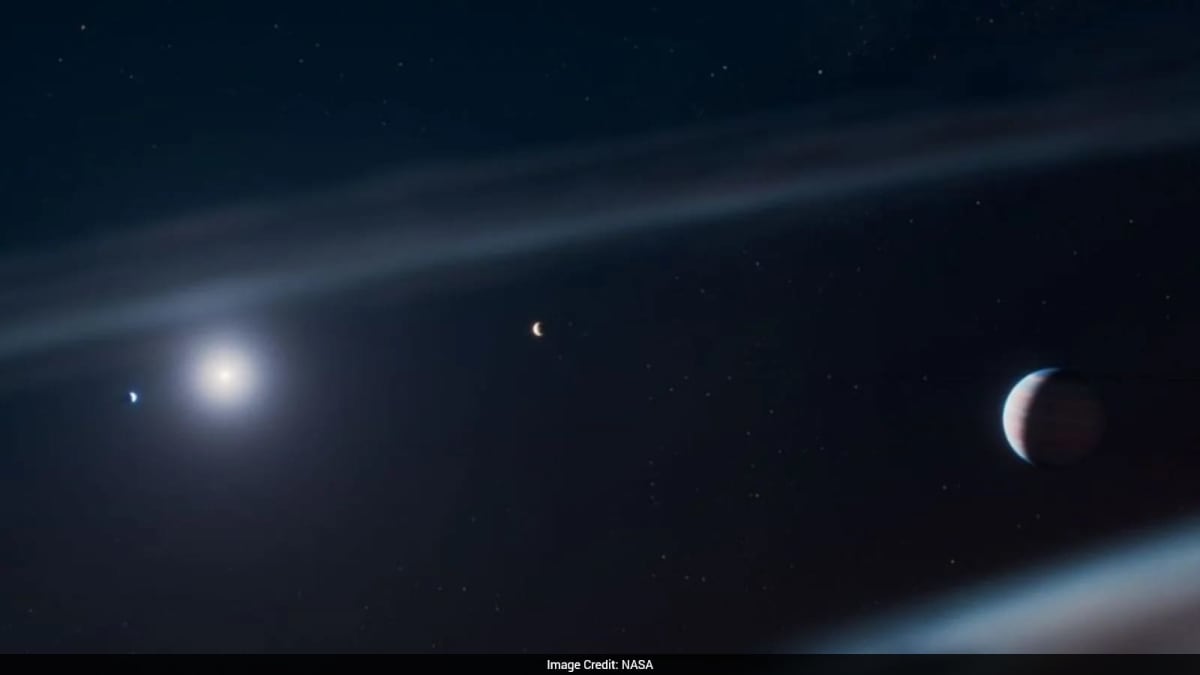
Hidden Planet Found by Accident Near Our Solar System
Astronomers discovered a third giant planet orbiting Beta Pictoris, one of the most studied stars in our galaxy. The James Webb Space Telescope found it using a groundbreaking technique that could revolutionize how we find new worlds.
Scientists just stumbled upon a massive planet that was hiding in plain sight, and the discovery could change how we search for worlds beyond our solar system.
The James Webb Space Telescope accidentally spotted Beta Pictoris d while studying its neighboring planet's atmosphere. Instead of seeing a bright dot like most planet discoveries, researchers detected the chemical fingerprint of carbon monoxide, revealing a giant planet no one knew existed.
The newly discovered world orbits Beta Pictoris, a young star just 63 light years away that astronomers have studied extensively for decades. Two other giant planets already circle this star, making Beta Pictoris only the second known system with three directly imaged planets.
Jean-Baptiste Ruffio, a research scientist at UC San Diego, led the team that made the discovery. His group was using Webb's Near-Infrared Spectrograph to study another planet when they noticed something unexpected in the data.
"There was an unexpected bright source of light, but we've learned not to trust bright blobs in images," Ruffio explains. The spectrum revealed absorption lines from carbon monoxide, a telltale sign of a giant planet's atmosphere rather than scattered light from cosmic dust.
Follow-up observations confirmed the finding by detecting water vapor and methane. The European Southern Observatory's Very Large Telescope independently verified the planet's existence, working alongside Webb's instruments to confirm scientists weren't seeing an illusion.
Why This Inspires
Beta Pictoris d stayed hidden because it lives inside one of the brightest debris disks known to science. This dusty cosmic fog scattered starlight and made conventional imaging nearly impossible, like trying to spot a firefly in a searchlight beam.
Webb's spectroscopic instruments saw through the dust by reading chemical signatures instead of just looking for bright spots. This marks the first time anyone has directly imaged a planet through spectroscopy, opening a completely new path for planet hunters.
The technique could help scientists find worlds that have remained invisible to traditional detection methods. Instead of waiting for a planet to pass in front of its star or hoping to capture its faint light, astronomers can now identify planets by their unique atmospheric chemistry.
This accidental discovery proves that even the most studied corners of our galaxy still hold surprises, and the right tools can reveal worlds we never knew were there.
Based on reporting by Google: James Webb telescope
This story was written by BrightWire based on verified news reports.
Spread the positivity!
Share this good news with someone who needs it