Hubble Spots Giant 'Chaotic' Planet Nursery 400B Miles Wide
NASA's Hubble Space Telescope just captured the largest planet-forming disk ever seen, and it's nothing like scientists expected. The enormous cosmic nursery could reshape our understanding of how planets are born.
Astronomers are celebrating a stunning discovery that might rewrite the playbook on how planets form across the universe.
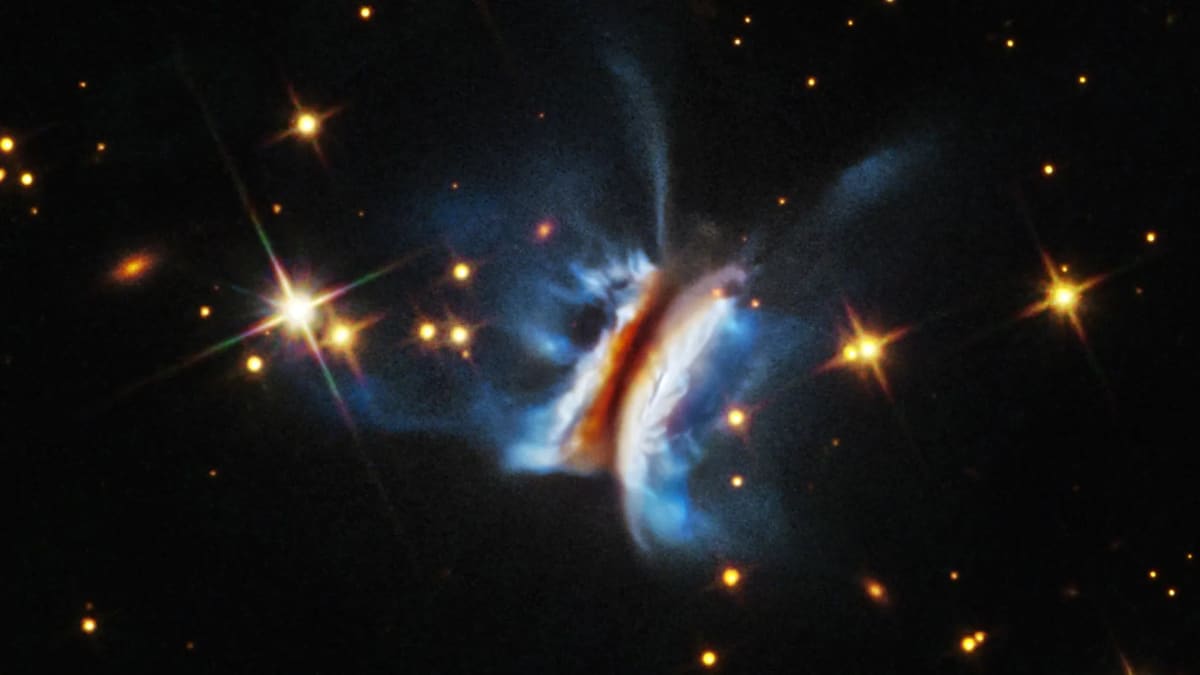
NASA's Hubble Space Telescope has photographed the largest known planet nursery ever observed, a massive disk of swirling gas and dust stretching nearly 400 billion miles across. That's 40 times wider than our entire solar system, giving scientists an unprecedented view of planetary birth on a truly enormous scale.
The system, playfully nicknamed "Dracula's Chivito" by the research team, sits about 1,000 light-years from Earth. At its center lies a young star shrouded in thick cosmic clouds, possibly even two stars orbiting each other.
What makes this discovery so exciting is how wildly different it looks from other planet-forming disks. Hubble's detailed images reveal towering filaments of material extending high above the disk, but only on one side. The other side appears smooth and clearly defined, creating an asymmetry that has scientists buzzing with curiosity.
"The level of detail we're seeing is rare in protoplanetary disk imaging," said lead author Kristina Monsch from the Center for Astrophysics at Harvard & Smithsonian. "Planet nurseries can be much more active and chaotic than we expected."
The disk contains enough material to build multiple giant planets, equal to 10 to 30 times the mass of Jupiter. Researchers believe this cosmic laboratory could show them how planetary systems develop in extreme environments, offering clues about worlds forming across the galaxy.
The lopsided appearance might result from fresh material actively falling into the disk or interactions with the surrounding space. Either way, Hubble has given astronomers a front-row seat to processes they don't yet fully understand.
Why This Inspires
This discovery reminds us that even after 30 years of operation, Hubble continues to reveal cosmic wonders that challenge what we think we know. The telescope keeps expanding our understanding of how the universe works, showing us that there's always more to learn.
The research team's playful nickname reflects their diverse backgrounds, one from Transylvania and another from Uruguay, proving that scientific discovery brings people together from across the globe. Their collaborative work opens new possibilities for understanding not just how other planets form, but how our own solar system came to be billions of years ago.
Every new observation brings fresh questions and opportunities for discovery, turning this chaotic cosmic nursery into a gateway for future breakthroughs that could transform planetary science.
Based on reporting by Google: NASA discovery
This story was written by BrightWire based on verified news reports.
Spread the positivity!
Share this good news with someone who needs it