Hubble Spots Growing Star Jet 30 Years After First Look
The Hubble Space Telescope returned to the stunning Trifid Nebula after nearly three decades and captured something amazing: scientists can now watch a newborn star's energy jet expanding in real time. This cosmic time-lapse shows us stellar birth happening right before our eyes. #
Scientists just witnessed something incredible: they caught a baby star growing up.
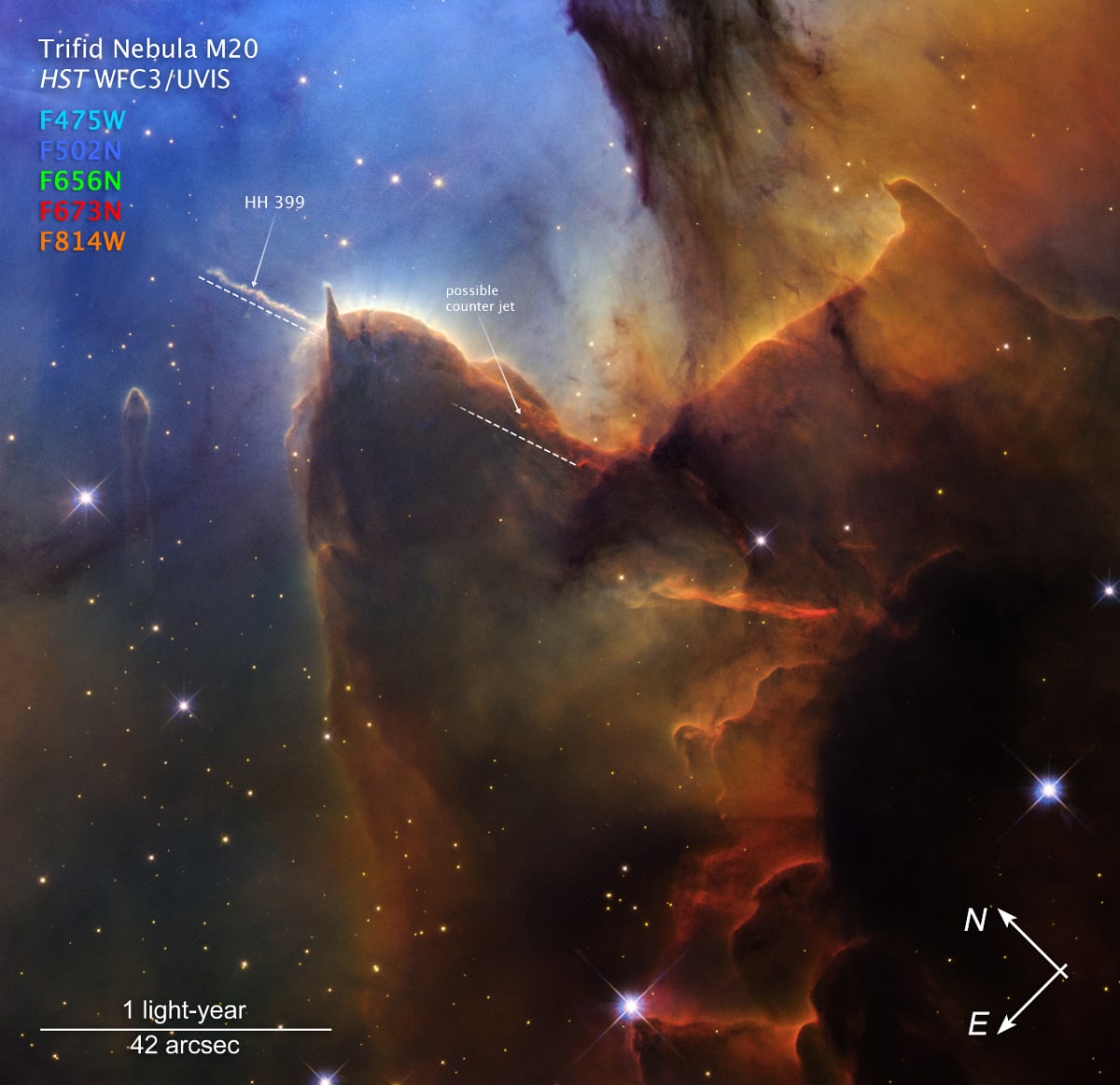
The Hubble Space Telescope revisited the Trifid Nebula, a star-forming cloud 5,000 light-years away, nearly 30 years after first photographing it in 1997. This time, Hubble's more powerful camera revealed something researchers had hoped to see: visible growth in a jet of energetic gas shooting from a newborn star.
The nebula, nicknamed the "Cosmic Sea Lemon" for its aquatic appearance, glows with orange clouds where ultraviolet light from massive stars strips electrons from nearby gas. Between two horn-shaped structures, yellow gas splashes outward like volcanic lava as starlight erodes surrounding dust and gas.
But the real discovery sits inside what astronomers call the sea lemon's "head." A baby star hidden within is blasting out a jet of material called HH-399. By comparing the new image with the 1997 photograph, scientists can actually measure how much the jet has expanded over three decades.
This cosmic time-lapse will help researchers calculate the jet's speed and understand how much energy young stars pump into their surroundings as they form. There's even a thick streak of blazing red and orange material that might be a second jet from another forming star.
The Trifid Nebula has been a stellar nursery for at least 300,000 years. Several giant stars, not visible in this close-up view, have been sculpting this region with their powerful winds and radiation.
The Bright Side
Bright orange stars scattered across the scene have already cleared the gas and dust around them, emerging fully formed from their cosmic cocoons. Over the next few million years, the remaining stars buried in the nebula will do the same, eventually leaving behind a sparkling cluster where a cloud once swirled.
Hubble released this image to celebrate its 36th anniversary of operations. The upgrade from its 1997 camera to the current Wide Field Camera 3 demonstrates how returning to familiar cosmic landmarks with better tools can reveal changes happening on timescales we can actually observe.
The ability to watch these jets grow gives scientists a front-row seat to stellar birth, one of the universe's most fundamental processes.
#
More Images

Based on reporting by Google News - Science
This story was written by BrightWire based on verified news reports.
Spread the positivity!
Share this good news with someone who needs it