IIT Grads Build AI Robots to Save India's Coral Reefs
Two engineers from Kochi created underwater robots that dive up to 300 meters deep, inspecting infrastructure and helping scientists protect vanishing coral reefs. Their company, EyeROV, is replacing dangerous human dives with AI-powered machines that see clearly even in murky water.
When a ship collided at sea and needed an urgent underwater inspection, there was just one problem: no diver could reach it in time.
That frustrating moment stuck with Kannappa Palaniappan, then a scientist aboard the vessel. When he reconnected with his college friend Johns T Mathai years later, they realized dangerous underwater inspections still depended almost entirely on human divers risking their lives in rough seas and zero visibility conditions.
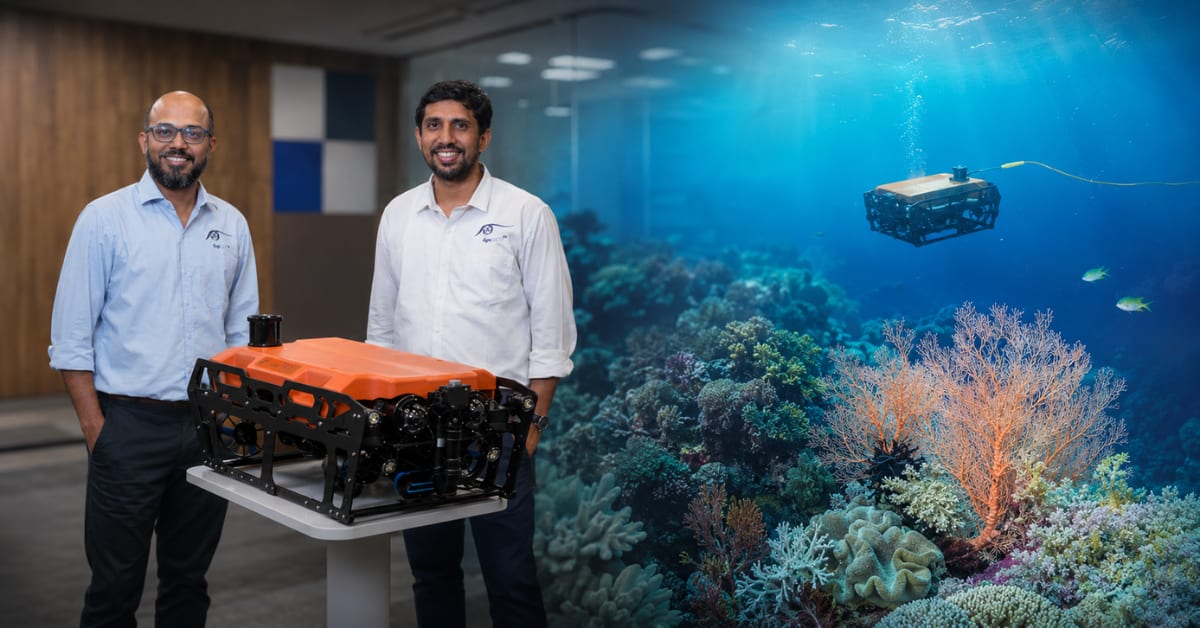
So in 2017, the two IIT graduates started EyeROV in Kochi. Their mission was simple: build robots that could go where humans shouldn't have to.
Today, their AI-powered underwater robots dive as deep as 300 meters to inspect ship hulls, dams, tunnels and pipelines across India. But their work goes beyond infrastructure.
Scientists studying coral reefs in the Andaman and Lakshadweep islands now use EyeROV's machines to collect detailed visual data without disturbing fragile ecosystems. At a time when warming seas and coral bleaching threaten India's marine environments, these robots offer a gentler way to monitor what's happening beneath the waves.
The company's smallest robot, TUNA, carries HD and 4K cameras into depths where sediment turns water pitch black. Their larger platform, SAGARA, moves in six directions and uses dual 4K cameras with 10x zoom for complex operations.
The real breakthrough came with their AI platform called EVAP. As robots stream live video back to the surface, the system processes murky footage to identify cracks, corrosion and leaks. It can even reconstruct clearer images from water so cloudy that human eyes would see nothing.
Johns brought robotics experience from Samsung Research and GreyOrange, one of India's early robotics startups. That background showed him Indian engineers could compete globally. Kannappa brought firsthand knowledge of the ocean's challenges.
Together, they built machines that tunnel through 10 kilometers of narrow pipelines, map underwater terrain and patrol coastlines for surveillance. Operating from Maker Village in Kerala's Technology Innovation Zone, EyeROV now offers Indian-built alternatives to expensive imported marine robotics.
The Ripple Effect
The impact reaches beyond saving time and money on inspections. Divers no longer wait days in emergency situations. Engineers can spot infrastructure problems before they become disasters. Marine researchers gather data without repeated dives that stress sensitive coral colonies.
For a country with over 7,500 kilometers of coastline and aging underwater infrastructure, these robots fill a critical need. They work in conditions too dangerous, too deep or too murky for humans. They never get tired. They don't need to surface for air.
Most importantly, they're helping scientists understand and protect marine ecosystems that might otherwise remain invisible until it's too late.
Two friends saw a gap between what technology could do and what was actually being done underwater, then spent years building machines to close it.
More Images
%2Fenglish-betterindia%2Fmedia%2Fmedia_files%2F2026%2F07%2F10%2Fcoral-reef-2026-07-10-16-22-42.png)
%2Ffilters%3Aformat(webp)%2Fenglish-betterindia%2Fmedia%2Fmedia_files%2F2026%2F07%2F10%2Fcoral-reef-1-2026-07-10-16-23-51.png)
%2Ffilters%3Aformat(webp)%2Fenglish-betterindia%2Fmedia%2Fmedia_files%2F2026%2F07%2F10%2Fcoral-reef-2-2026-07-10-16-24-58.png)
Based on reporting by The Better India
This story was written by BrightWire based on verified news reports.
Spread the positivity!
Share this good news with someone who needs it