IIT Guwahati Cleans Toxic Water for $0.02 Per 1,000 Liters
Millions of Indians drink groundwater laced with invisible arsenic and fluoride that slowly poison their bodies. Engineers at IIT Guwahati just cracked the code to remove both toxins at once for mere pennies.
A glass of water can look perfectly clear and still be slowly poisoning you. Across India, millions of people drink groundwater containing arsenic and fluoride, invisible toxins that cause serious health problems over time.
The challenge gets trickier when both contaminants lurk in the same water source. Most treatment systems can handle one or the other, but tackling both simultaneously has remained expensive and complicated.
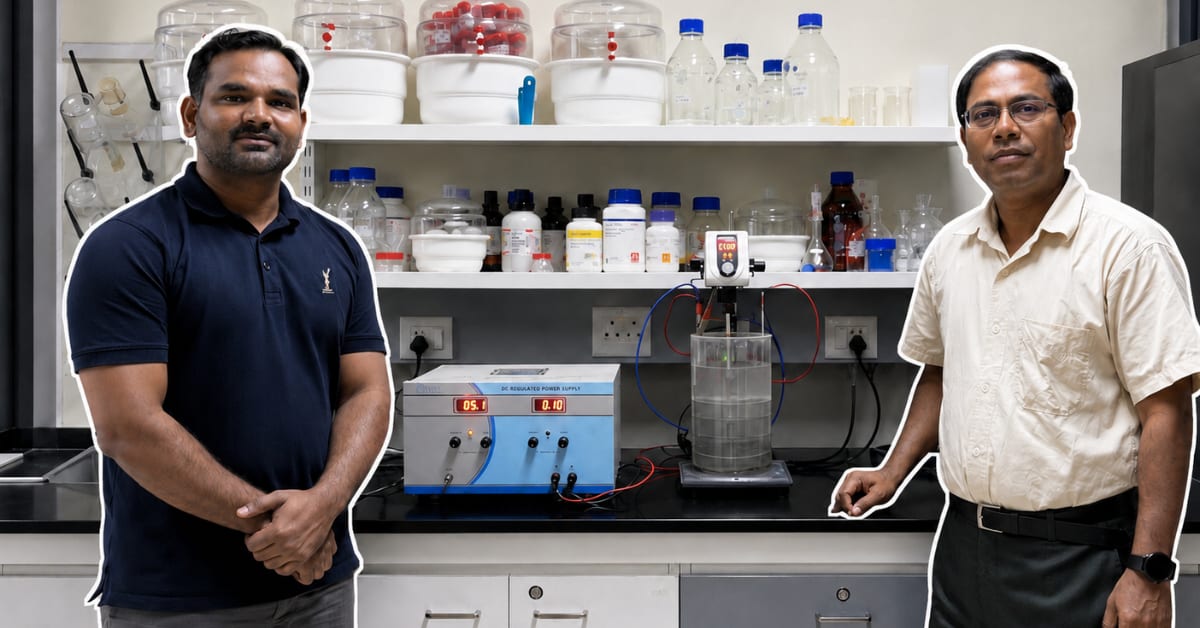
Researchers at IIT Guwahati just changed that equation. Their new rotating-anode electrocoagulation reactor removes up to 98.2% of arsenic and 91.8% of fluoride within minutes, all for just 18 to 58 rupees per 1,000 liters of water.
The breakthrough came from a surprisingly simple tweak. Traditional electrocoagulation systems use stationary aluminum electrodes to pull pollutants from water. The IIT Guwahati team made their electrode spin.
That rotation transforms everything happening inside the reactor. The spinning motion improves water mixing, helps contaminants contact the treatment process better, and continuously refreshes the electrode surface to keep it working efficiently.
As electricity flows through the reactor, aluminum ions combine with hydroxide to form microscopic particles called flocs. These tiny catchers grab onto arsenic and fluoride molecules, allowing them to be filtered out through adsorption, coagulation and precipitation.
The rotating design also solves a common problem called electrode passivation, where buildup on stationary electrodes gradually reduces their effectiveness. The constant motion keeps the aluminum surface active and ready to work.
Professor Mihir Kumar Purkait from the Department of Chemical Engineering explained why dual removal matters. "Treating them together has remained particularly challenging because they behave differently during conventional purification processes and compete for removal sites," he said.
The team didn't just test their system with pristine laboratory water. They pushed it with real groundwater samples collected from Assam, complete with naturally occurring calcium, magnesium, bicarbonate, sulfate and phosphate ions that can interfere with treatment.
Research scholar Mukesh Bharti confirmed the technology held up under realistic conditions. The reactor maintained its effectiveness even when faced with the complex chemistry found in actual groundwater sources.
The Ripple Effect
The applications extend far beyond a single village or treatment plant. This technology could power community drinking water systems, decentralized rural treatment facilities, and industrial wastewater processing. It might even combine with membrane filtration or adsorption systems for enhanced performance.
The team has published their findings in the peer-reviewed Chemical Engineering Journal. Now they're building a pilot-scale, continuous-flow version to test how the reactor performs outside the laboratory at larger volumes.
Groundwater serves as the primary drinking source for millions across India. Clean water technology that costs pennies per thousand liters could transform public health outcomes in regions where families currently have no choice but to drink contaminated water.
More Images
%2Fenglish-betterindia%2Fmedia%2Fmedia_files%2F2026%2F09%2F02%2Fiit-guwahati-2026-09-02-15-37-50.png)
%2Ffilters%3Aformat(webp)%2Fenglish-betterindia%2Fmedia%2Fmedia_files%2F2026%2F09%2F02%2Fiit-guwahati-2026-09-02-15-38-33.png)
%2Ffilters%3Aformat(webp)%2Fenglish-betterindia%2Fmedia%2Fmedia_files%2F2026%2F09%2F02%2Fiit-guwahati-2026-09-02-15-39-29.png)
%2Ffilters%3Aformat(webp)%2Fenglish-betterindia%2Fmedia%2Fmedia_files%2F2026%2F09%2F02%2Fiit-guwahati-2026-09-02-15-42-19.png)
Based on reporting by The Better India
This story was written by BrightWire based on verified news reports.
Spread the positivity!
Share this good news with someone who needs it