India Startup Builds Jet Engine With Zero Moving Parts
A New Delhi company has successfully tested a revolutionary jet engine that uses controlled explosions instead of spinning turbines. The breakthrough could make supersonic flight simpler, cheaper, and more reliable.
For the first time in India, a startup has proven that jet engines don't need turbines to fly.
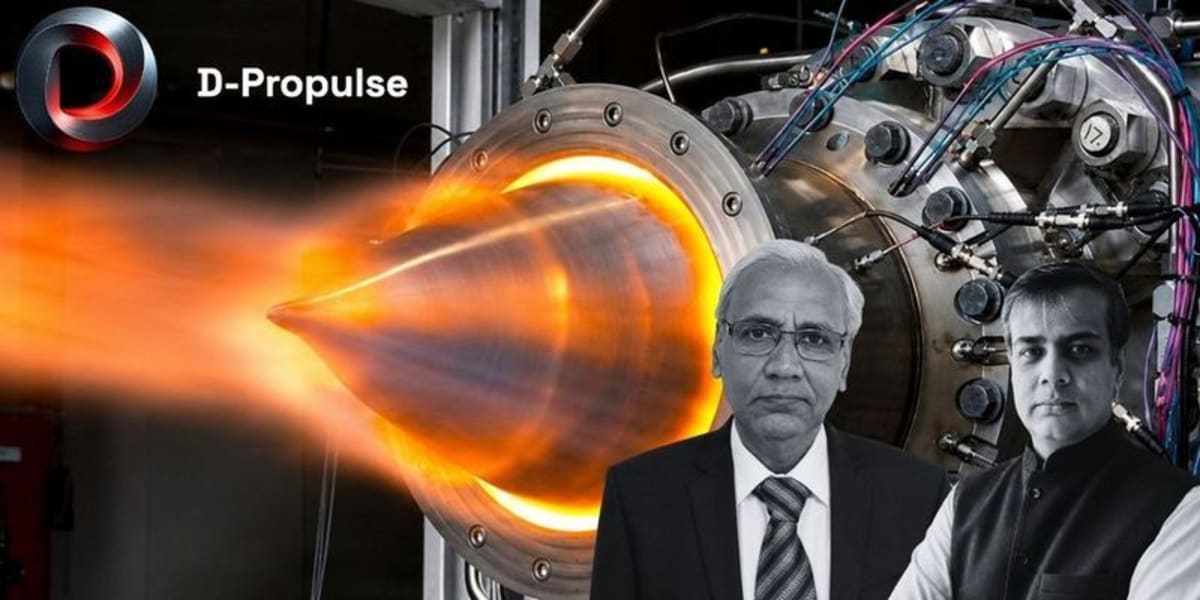
D-Propulse Aerospace tested a working prototype in July 2026 that creates thrust through continuous detonations rather than steady burning. The engine has no moving parts at all.
Traditional jet engines burn fuel in a controlled flame and use complex rotating machinery to compress air and generate thrust. D-Propulse's rotating detonation engine works differently: fuel detonates in a wave that travels continuously around a ring-shaped chamber, creating more power from a mechanically simpler design.
The company was founded in July 2025 by defense journalist Saurav Jha and Dr. V. Ramanujachari, a former government scientist who led India's scramjet program. They've assembled an impressive team, including Dr. V.K. Saraswat, former head of India's Defense Research and Development Organisation, as board chairman.
In January 2026, D-Propulse raised $2.7 million from the IAN Alpha Fund and IIT Madras. By March, they were posting images of a 5-kilonewton combustor paired with an aerospike nozzle, a design that maintains efficiency across different altitudes.
The July test runs at a government facility marked a major milestone. The team successfully fired the engine at reduced air and fuel flow, validating that the rotating detonation combustor and aerospike nozzle work together as intended.
The company claims their approach delivers over 25% better thermal efficiency than conventional engines. Without turbines, compressors, or other moving parts, the engine should be easier to manufacture and more reliable in extreme conditions.
Why This Inspires
Only a handful of teams worldwide are pursuing this technology, and no country has confirmed fielding one in an operational system yet. D-Propulse is racing to change that from India.
The potential applications extend beyond breaking speed records. The company plans to build high-supersonic drones and other custom platforms that could benefit from simpler, more efficient propulsion.
Ground tests are just the beginning. The road from a successful test rig to a flight-certified engine involves extensive validation, but D-Propulse has moved from lab concept to working prototype in under a year.
India is building engines that could redefine how we think about flight.
More Images



Based on reporting by YourStory India
This story was written by BrightWire based on verified news reports.
Spread the positivity!
Share this good news with someone who needs it