Indian Firm's AI Saves 2 Billion kWh, Cuts Water Loss
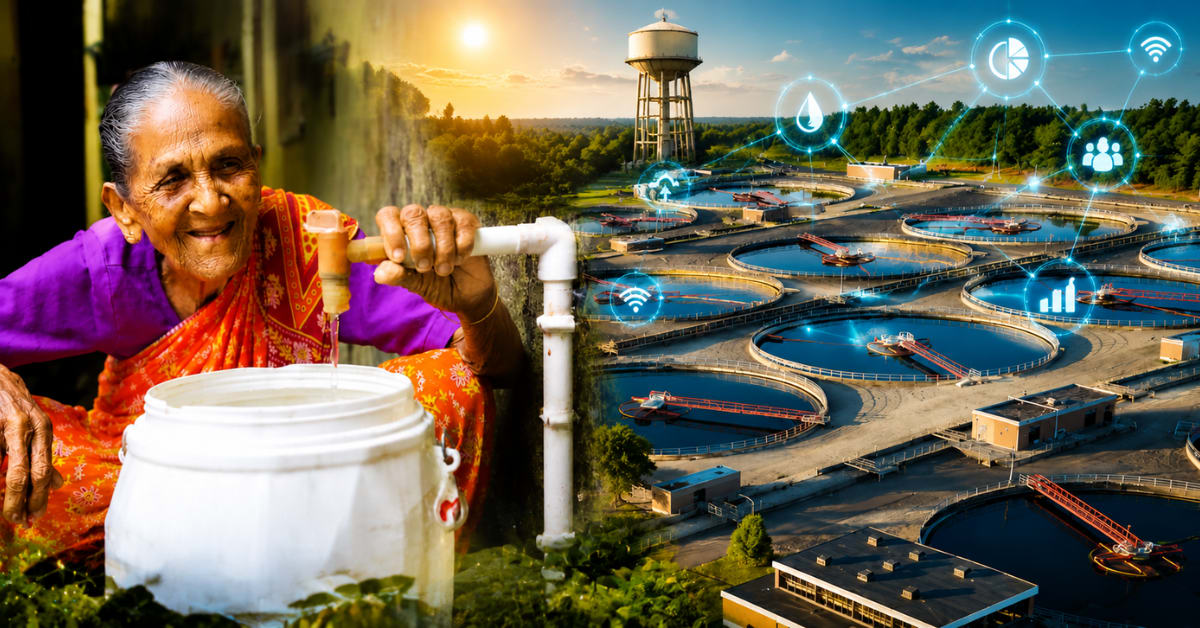
An Ahmedabad company is helping cities across India stop water leaks before thousands of liters disappear and fix broken pumps before households run dry. Using sensors and AI, Cimcon has saved over 2 billion kWh of electricity while making essential services more reliable for millions.
In countless Indian homes, the morning routine still begins with a question: has the water arrived yet?
Across cities and villages, families plan their days around uncertain water supplies. Women spend hours fetching water where pipes remain unreliable. For millions, turning on a tap and expecting water to flow remains a luxury rather than a reality.
But a quiet revolution has been underway for nearly four decades. Ahmedabad-based Cimcon is helping cities detect leaking pipelines before thousands of liters vanish, identify malfunctioning pumps before households run dry, and make public infrastructure efficient enough to save both water and energy.
The journey began in 1988 when Anil Agrawal returned from studying automation in the United States. India ran almost entirely on manual systems back then. Utilities relied on paperwork, field inspections and endless phone calls.
Agrawal's first challenge wasn't technical but economic. "The first task was to reduce the cost and make automation economical," he says. His team built affordable solutions using readily available computer components and simple software that operators could actually use.
Convincing people proved harder than building the technology. Many feared automation would replace jobs. Others couldn't imagine software solving real infrastructure problems.
The breakthrough came in the early 1990s working with ONGC. Oil wells in remote regions would break down, but operators only discovered problems after production had already suffered. Cimcon created a monitoring system that sent alerts when wells stopped working, earning the nickname "speaking wells."
For the first time, infrastructure could communicate its own problems.
That same technology soon found a new purpose in the hills around Dehradun. Water distribution depended on workers traveling long distances to operate pumps and valves manually, often in harsh weather. If someone couldn't reach a pumping station on time, entire communities lost water.
Cimcon enabled remote monitoring and control. What once required manual intervention could now be managed through connected systems.
The Ripple Effect
Today, sensors and AI across Indian cities monitor water networks, pumping stations and street lights in real time. The company's systems have saved over 2 billion kWh of electricity while reducing water loss and improving service reliability for millions.
The technology isn't about making cities smarter for the sake of innovation. It's about ensuring families don't have to wonder if water will arrive this morning, and communities don't lose thousands of liters to leaks that go undetected for days.
What started as "speaking wells" in remote oil fields has become a digital nervous system helping cities care for their most essential resources.
Across India, more taps are flowing reliably, and fewer households are planning their days around uncertainty.
More Images
%2Fenglish-betterindia%2Fmedia%2Fmedia_files%2F2026%2F07%2F02%2Fcimcon-2026-07-02-11-40-15.png)
%2Ffilters%3Aformat(webp)%2Fenglish-betterindia%2Fmedia%2Fmedia_files%2F2026%2F07%2F02%2Fcimcon-2026-07-02-11-40-50.png)
%2Ffilters%3Aformat(webp)%2Fenglish-betterindia%2Fmedia%2Fmedia_files%2F2026%2F07%2F02%2Fcimcon-2026-07-02-11-42-40.png)
Based on reporting by The Better India
This story was written by BrightWire based on verified news reports.
Spread the positivity!
Share this good news with someone who needs it