Indian Fishing Families Add Seaweed Crops for Extra Income
As fish catches decline along India's coast, fishing families in Maharashtra and Tamil Nadu are growing seaweed in the ocean for a reliable second income. The underwater crop needs no land or freshwater and grows in just 45 days.
When fishing became too unpredictable to depend on, Mahesh Dhake learned to grow crops in the sea instead of on land.
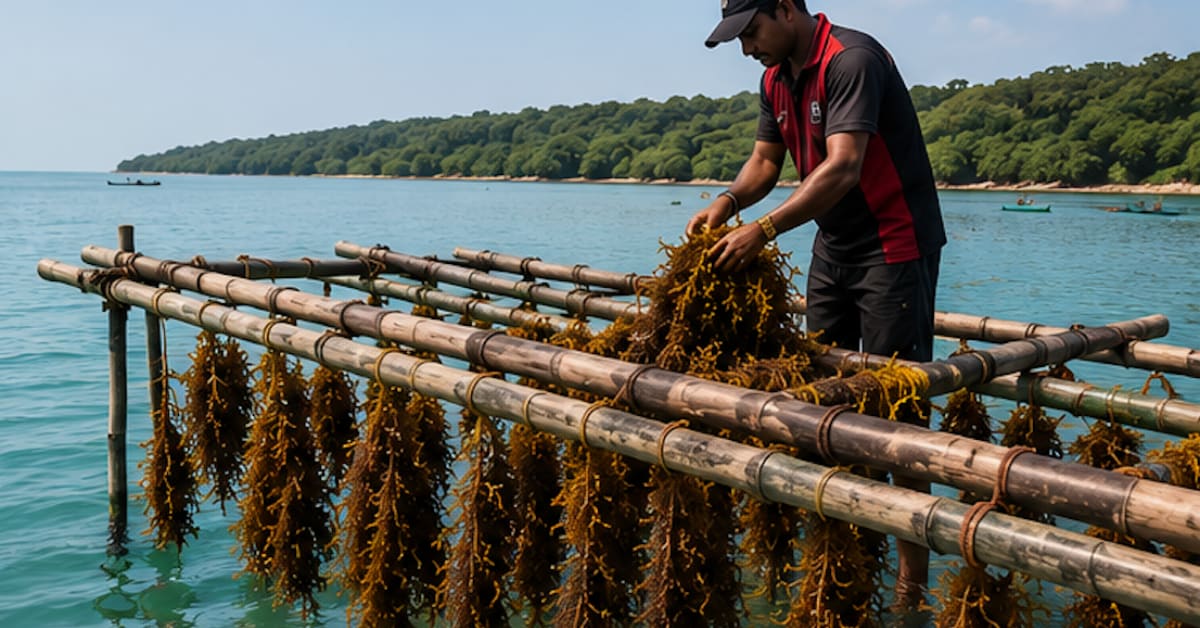
For generations, Koli fishing families near Alibag, Maharashtra went out each day hoping for good catches from the Arabian Sea. Now, bamboo rafts float near the Mandwa jetty holding something new: rows of red seaweed growing underwater, ready to harvest in about 45 days.
The shift is changing how coastal households earn money. Fishing has become harder to survive on as catches shrink, diesel costs rise, and rough weather keeps boats ashore more often. One bad week at sea can mean almost no income for a family.
Seaweed farming offers something different: a crop that grows while fishing continues. Families tie small pieces of seaweed to ropes or bamboo rafts in shallow water. The seaweed grows naturally over six weeks, then gets harvested, dried onshore, and sold to companies making fertilizers, cosmetics, medicines, and food products.
The economics make sense for struggling fishing families. Dhake told reporters his overall income increased nearly 30 percent after adding seaweed farming. Wet seaweed fetches around 20 rupees per kilogram, while dried seaweed brings in 130 rupees per kilogram depending on quality.
The crop asks for almost nothing that traditional farming demands. No agricultural land. No freshwater or irrigation. No chemical fertilizers. Just ocean space that would otherwise sit empty.
India produced over 72,000 tonnes of seaweed in 2023, mostly Kappaphycus alvarezii used in carrageenan production, a natural thickening agent. The industry is still small but growing along coastlines in Maharashtra and Tamil Nadu.
Women are joining the work too. While men manage the rafts and ocean operations, women prepare seed lines and handle post-harvest sorting and drying. This creates income opportunities for household members who previously had limited ways to earn.
The Ripple Effect
The benefits extend beyond individual families. Seaweed farming reduces pressure on already overfished waters by giving coastal communities an alternative income source. It also produces agricultural inputs without draining India's stressed groundwater supplies or taking up farmland needed for food crops.
In Mandwa, the first commercial seaweed farm uses 50 bamboo rafts and 20 longlines. The model is simple enough that other fishing villages can copy it without major investment in equipment or training.
Researchers see potential for seaweed to become a sustainable raw material source as India faces water scarcity and soil degradation. The crop grows up to ten times faster than land plants and delivers comparable biomass using a fraction of the space.
For fishing families watching the ocean become less reliable, seaweed won't solve everything. But it creates another payment cycle, another source of stability, another reason to stay hopeful about coastal life.
More Images
%2Fenglish-betterindia%2Fmedia%2Fmedia_files%2F2026%2F05%2F15%2Fsea-weed-3-2026-05-15-17-24-19.png)

%2Ffilters%3Aformat(webp)%2Fenglish-betterindia%2Fmedia%2Fmedia_files%2F2026%2F05%2F15%2Fsea-weed-2-2026-05-15-17-25-44.png)
%2Ffilters%3Aformat(webp)%2Fenglish-betterindia%2Fmedia%2Fmedia_files%2F2026%2F05%2F15%2Fsea-weed-1-2026-05-15-17-32-33.png)
Based on reporting by The Better India
This story was written by BrightWire based on verified news reports.
Spread the positivity!
Share this good news with someone who needs it