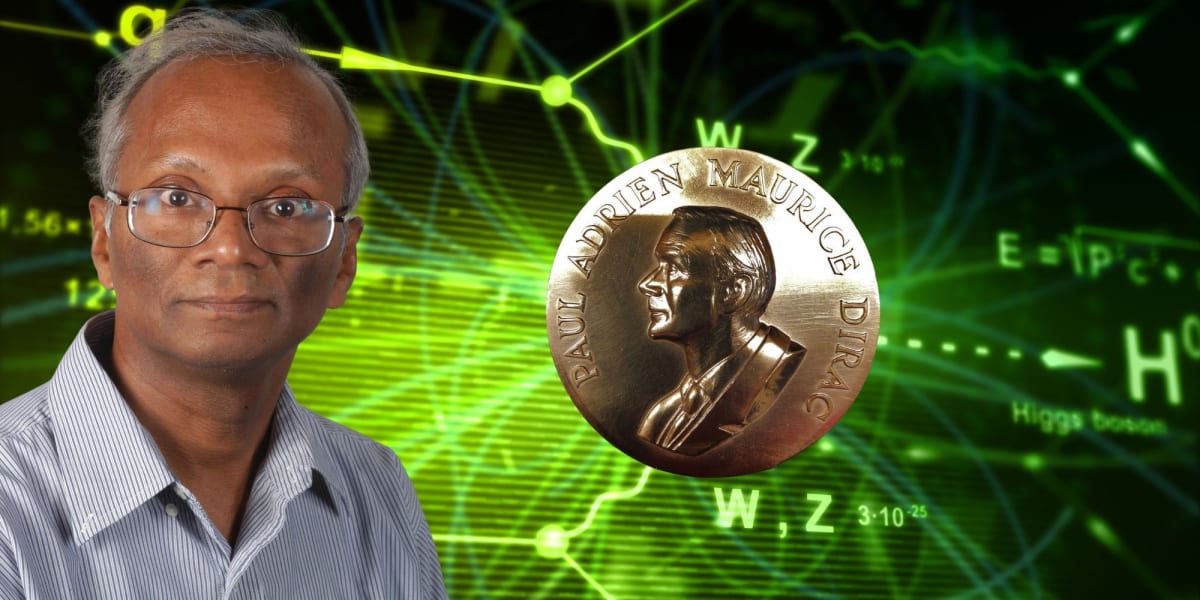
Indian Physicist Deepak Dhar Wins Prestigious Dirac Medal
Deepak Dhar just became only the second scientist working in India to win the 2026 Dirac Medal, one of theoretical physics' highest honors. His groundbreaking work explains how simple rules create complex behavior in everything from sandpiles to artificial intelligence.
A physicist in Bengaluru has earned one of the world's most prestigious awards for explaining how complexity emerges from simplicity.
Deepak Dhar, a professor at the International Centre for Theoretical Sciences, won the 2026 Dirac Medal for his pioneering work in statistical mechanics and complex systems. He shares the honor with three other scientists whose research has reshaped modern physics.
The award matters beyond physics. Dhar's work connects to fields as diverse as artificial intelligence, neuroscience, and computer optimization, showing how the same mathematical principles appear across disciplines.
His most famous contribution involves something everyone has seen: a sandpile. Drop grains of sand one at a time onto a pile, and nothing happens for a while. But at a critical point, one more grain triggers an avalanche.
This simple model reveals how small changes can produce massive effects in complex systems. The same principle helps scientists understand everything from earthquakes to stock market crashes to how neural networks learn.
Dhar is only the second scientist based in India to receive the Dirac Medal, following physicist Ashoke Sen. The recognition shines a light on India's growing role in fundamental science research.
The physicist has spent most of his career at the Tata Institute of Fundamental Research and now works at ICTS-TIFR in Bengaluru. His approach bridges traditional physics with modern challenges in technology and biology.
The Ripple Effect
The implications of Dhar's work extend far beyond theoretical physics. Statistical mechanics, once focused on understanding gases and magnets, now provides tools for tackling some of today's biggest challenges.
Researchers use similar mathematical frameworks to optimize computer algorithms, understand brain function, and develop better artificial intelligence systems. The same principles that explain physical avalanches help engineers prevent network crashes and biologists model disease spread.
ICTP Director Atish Dabholkar noted that the 2026 medalists have established statistical mechanics as a framework for questions well beyond physics. That cross-pollination between fields drives innovation in unexpected ways.
Dhar's recognition adds to an impressive list of honors. He became the first Indian to win the Boltzmann Medal in 2022, another top award in statistical physics. India honored him with the Padma Bhushan in 2023.
ICTS Director Rajesh Gopakumar pointed out that many Dirac Medal winners have later received Nobel Prizes. The award recognizes not just past achievements but ongoing contributions that continue shaping how we understand complex systems.
For India's scientific community, the medal reinforces Bengaluru's emergence as a global hub for theoretical research and highlights how fundamental science today becomes tomorrow's practical applications.
More Images



Based on reporting by YourStory India
This story was written by BrightWire based on verified news reports.
Spread the positivity!
Share this good news with someone who needs it