India's 700-Year-Old Banyan Trees Feed Hundreds of Species
Scientists just confirmed a banyan tree in Bihar has stood for 700 years, feeding wildlife and sustaining entire ecosystems. Across India, these ancient giants shelter hundreds of species and help forests regenerate naturally. #
A single tree in Bihar has been feeding birds, bats, and insects for nearly 700 years, and scientists just proved it.
Using radiocarbon dating, researchers confirmed that a banyan tree in Munger district has lived through seven centuries of Indian history. It's the oldest accurately dated banyan ever identified, and it's still thriving.
But this ancient giant isn't just a record-breaker. It represents something far more important: a living ecosystem that hundreds of species depend on to survive.
Scientists call mature banyans keystone species because they hold entire food webs together. A recent study in Telangana watched this happen in real time.
Between February and May, six large banyans at Kanha Shanti Vanam near Hyderabad became wildlife magnets. Mynas, bulbuls, barbets, hornbills, and coucals flew in to feast on ripe figs during the day. After sunset, Indian flying foxes took over, while palm squirrels claimed the daylight shifts.
The researchers discovered something remarkable about those fig-eating visitors. Seeds that passed through birds and bats sprouted far better than figs that simply fell to the ground. Every creature feeding at the banyan was also planting the next generation of forest.
Near Bengaluru, the 400-year-old Dodda Alada Mara proves this pattern repeats across centuries. Its canopy shelters parakeets, drongos, and mynas year-round, while flying foxes carry seeds across the landscape each night.
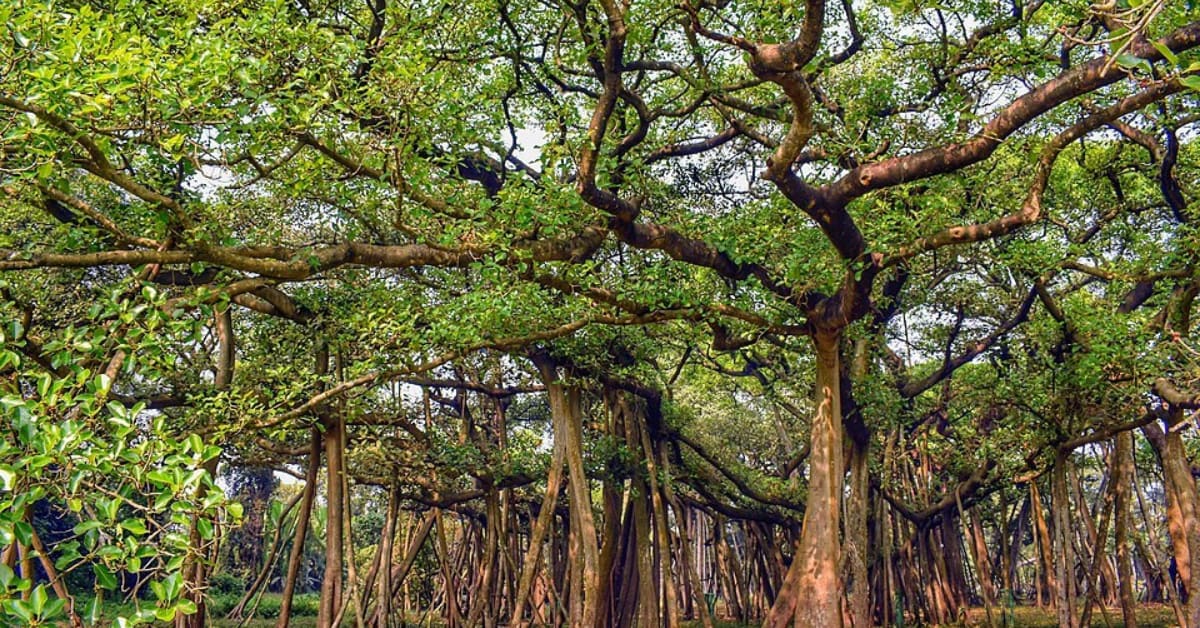
The Great Banyan near Kolkata takes this even further. Spreading across nearly five acres through 3,700 aerial roots, it lost its original trunk decades ago but keeps growing. It now functions less like a single tree and more like an entire forest, complete with fruit bats, squirrels, dozens of bird species, and countless insects living among mosses, orchids, and lichens.
The Ripple Effect
These ancient trees create what scientists call trophic continuity. Because different fig species fruit at different times, wildlife gets a reliable food supply throughout the year, not just during one season.
That steady food source keeps bird populations healthy. Healthy birds disperse more seeds. More seeds mean more trees, which eventually support even more wildlife.
One tree becomes a forest. A forest becomes a refuge. A refuge becomes hope for species struggling as habitats shrink.
The Munger banyan has witnessed 700 years of change, and it's still feeding the future.
#
More Images
%2Fenglish-betterindia%2Fmedia%2Fmedia_files%2F2026%2F07%2F30%2Fbanyan-2026-07-30-19-24-55.png)

%2Ffilters%3Aformat(webp)%2Fenglish-betterindia%2Fmedia%2Fmedia_files%2F2026%2F07%2F30%2Fbanyan-1-2026-07-30-19-26-42.png)
%2Ffilters%3Aformat(webp)%2Fenglish-betterindia%2Fmedia%2Fmedia_files%2F2026%2F07%2F30%2Fbanyan-2-2026-07-30-19-29-36.png)
Based on reporting by The Better India
This story was written by BrightWire based on verified news reports.
Spread the positivity!
Share this good news with someone who needs it