India's AI Weather System Alerts You Before Storms Hit
Your phone knows a storm is coming before you see clouds overhead, thanks to India's network of 50 weather radars, 1,000 sensors, and AI that predicts rain down to your neighborhood. Here's how technology is keeping millions safe.
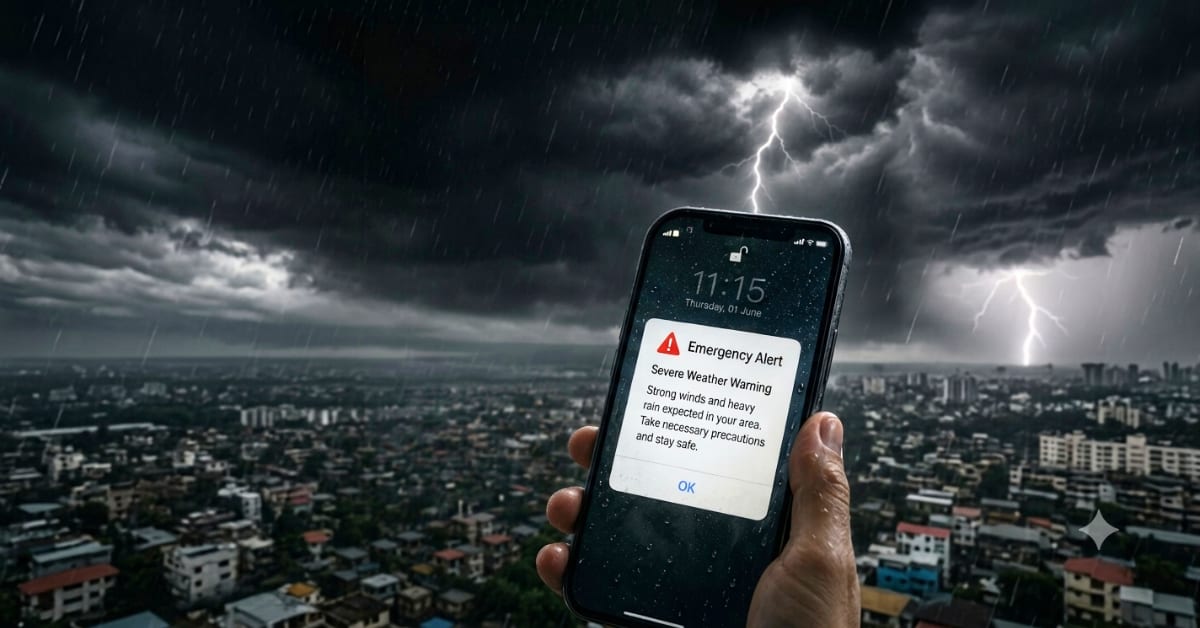
Your phone buzzes with a storm warning before the first raindrop falls. It feels like magic, but it's actually thousands of machines watching the sky for you.
India's weather prediction system starts with 50 Doppler radars and over 1,000 automatic weather stations scattered across the country. These instruments constantly measure rainfall, wind speed, temperature, and humidity, creating a real-time picture of what's happening in the atmosphere.
Satellites operated by ISRO, including the INSAT systems, zoom out even further. They track massive weather patterns forming over oceans and land, spotting storms before they reach your city.
All this raw data flows into Arka, India's weather supercomputer with 11.77 petaflops of computing power. It processes information from thousands of sensors and runs calculations that predict how every cloud and wind current will move across the country.
The computer divides India's atmosphere into tiny grids and uses physics equations to forecast weather changes. What once took hours now happens in minutes, thanks to indigenous prediction models like Mithuna built specifically for India's tropical climate.
But here's where it gets really clever. Artificial intelligence takes those broad forecasts and zooms in to predict weather for individual neighborhoods, sometimes down to grids as small as 300 meters.
Machine learning models can spot patterns the computers miss. They predict lightning strikes, correct forecast errors, and figure out exactly which streets might flood while others stay dry just blocks away.
The Multi-Hazard Early Warning Decision Support System then combines all these predictions with maps and population data. Instead of just saying "heavy rain expected," it identifies which communities face the highest risk and need alerts first.
Getting that warning to your phone is the final step. India's SACHET platform pushes alerts through multiple channels, increasingly using cell broadcast technology that sends messages to every compatible phone connected to mobile towers in affected areas.
Unlike regular text messages, cell broadcasts work even when networks get congested during emergencies. The system can also translate technical weather jargon into simple advisories in regional languages using AI language models.
Why This Inspires
This technology chain represents a quiet revolution in public safety. Every storm alert that reaches your phone is the result of hundreds of scientists, engineers, and sensors working together to protect people they'll never meet.
India is building one of the world's most sophisticated weather warning systems, combining cutting-edge supercomputing with AI to democratize information that saves lives. The same technology once available only to meteorologists now sits in the pocket of anyone with a phone.
What makes this truly hopeful is the potential. As the system grows smarter and reaches more people in more languages, fewer lives will be lost to weather disasters that technology helped us see coming.
Your phone's storm warning is proof that progress sometimes arrives quietly, one buzz at a time.
More Images
%2Fenglish-betterindia%2Fmedia%2Fmedia_files%2F2026%2F09%2F08%2Fweather-alerts-2026-09-08-13-24-28.png)
%2Ffilters%3Aformat(webp)%2Fenglish-betterindia%2Fmedia%2Fmedia_files%2F2026%2F09%2F08%2Fweather-alerts-2026-09-08-13-25-15.png)
%2Ffilters%3Aformat(webp)%2Fenglish-betterindia%2Fmedia%2Fmedia_files%2F2026%2F09%2F08%2Fweather-alerts-2026-09-08-13-25-57.png)
Based on reporting by The Better India
This story was written by BrightWire based on verified news reports.
Spread the positivity!
Share this good news with someone who needs it