India's Amul Earns 0.2% Profit and Wins AAA Rating
A dairy cooperative that keeps almost no profit just became India's first FMCG brand to hit $12 billion in sales. The secret? Giving everything back to 3.6 million farmers who own it.
At six in the morning in a Gujarat village, a woman brings her milk to a collection center, a machine tests it, and money hits her account within minutes. She owns two cows, but together with 3.6 million other farmers, she owns something bigger: a $12 billion brand that just rewrote the rules of business.
Amul earned just $148 million on $7.1 billion in revenue last year. That's a profit margin of 0.2%, or twenty cents on every hundred dollars. Any normal company posting those numbers would fire its CEO by morning.
Instead, CARE Ratings gave Amul its highest possible credit rating: AAA with a stable outlook.
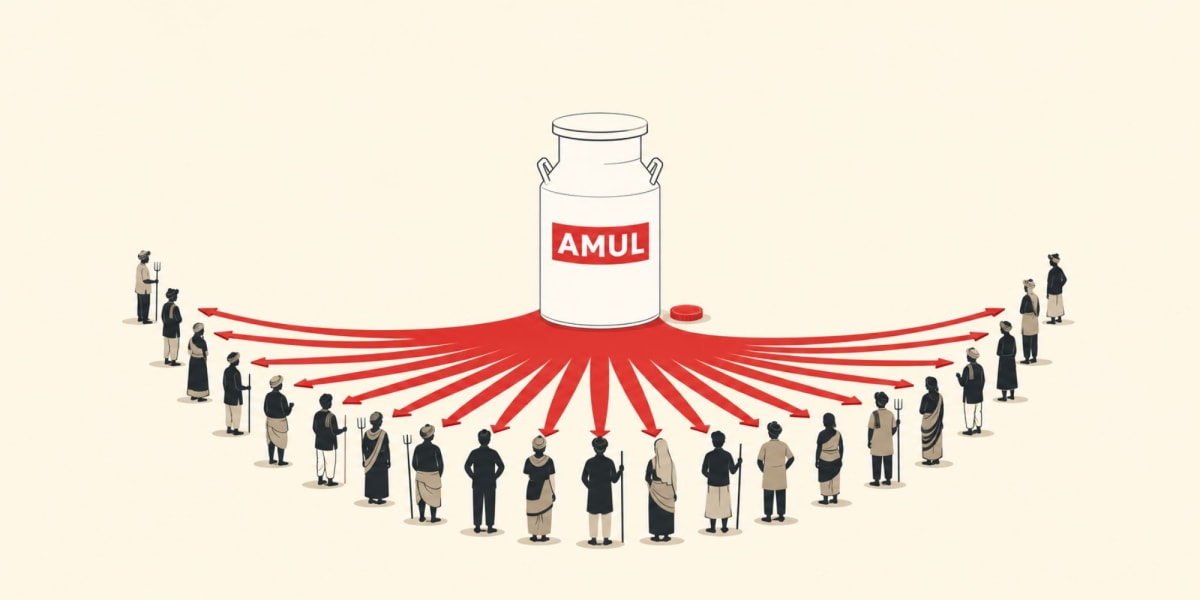
The difference is simple. Amul isn't really a company. It's 18,000 village dairy cooperatives stacked three layers deep, with farmers owning everything from bottom to top.
Every member gets one vote whether they deliver four liters or four hundred. Farmers elect their district boards, and those boards elect the national chairman. The structure means the person selling the milk and the person profiting from it are the same human being.
That changes everything. In normal dairies, farmers want higher prices and shareholders want lower ones, and that fight never ends. At Amul, there's no fight because there are no outside shareholders to pay.
The Ripple Effect spreads through 33 districts. CARE Ratings says Amul exists to pass the maximum price back to farmer owners, keeping only enough to cover debt and operations. The company pays farmers an interim rate all year, then settles up at year's end, sending whatever remains flowing back down.
Amul says this returns 80% to 85% of every consumer dollar to farmers. A Harvard Business School case confirms around 80%, compared to 35% to 40% typical in Western markets. The audited 0.2% margin tells the same story.
Competitors can't copy this even if they wanted to. A private dairy that decided tomorrow to send 80% of revenue to farmers would be destroying its own value, since investors bought shares expecting profit that would no longer exist.
For Amul, that higher price isn't charity but a supply lock. A farmer earning more from you than from the private buyer down the road doesn't switch when market prices spike. CARE actually lists any changes to this ownership structure as a potential trigger for downgrade, right alongside disease outbreaks.
The structure is collateral you cannot hire or outspend.
This year Amul crossed $12 billion in total brand sales, up 11% from last year, making it India's first consumer brand to reach that milestone. Behind that sit 31 to 35 million liters collected daily, around 50 products across 1,200 variations, roughly 200,000 retailers, and sales in over 50 countries.
More than 70% of those suppliers are small farmers or landless laborers. Many own just one or two animals. Serving 3.6 million tiny suppliers through 18,000 collection points looks expensive and inefficient until you remember the suppliers own the company.
The cost of serving them isn't a cost. It's the entire point.
Eighty years after farmers in Kaira district started this experiment, Amul grows at 11% annually, shows almost no profit, and holds a perfect credit rating anyway.
More Images


Based on reporting by YourStory India
This story was written by BrightWire based on verified news reports.
Spread the positivity!
Share this good news with someone who needs it