India's Hand-Powered Device Turns Seawater Into Drinking Water
Indian scientists created a portable device that transforms seawater into clean drinking water without electricity. Originally designed for soldiers in remote areas, it could soon help coastal communities and disaster zones worldwide.
Imagine standing on a beach surrounded by endless water, yet not a single drop safe to drink. India's Defence Research and Development Organisation just solved that problem with a backpack-sized device that turns seawater into clean drinking water using nothing but hand power.
The Sea Water Desalination System, called SWaDeS, launched in January 2026 after years of development for the Indian military. Soldiers stationed in remote coastal areas or at high-altitude lakes like Pangong Tso in Ladakh can now carry their own water supply on their backs.
The technology works like a super-powered filter, using reverse osmosis to strip salt and impurities from seawater. Imagine forcing water through an incredibly fine mesh that catches everything bad but lets the good stuff through. That's essentially what happens inside this compact unit.
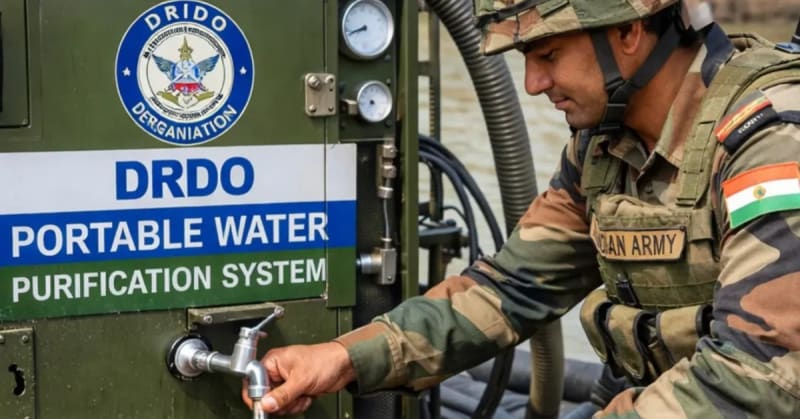
Two versions exist to meet different needs. The hand-operated model weighs little enough for one soldier to carry and produces enough clean water for 10 to 12 people daily without any power source. The engine-powered version sets up in under three minutes and can support 20 to 25 people, turning water with 35,000 mg/L of dissolved solids into safe drinking water below 500 mg/L.
Both models passed rigorous testing by DRDO and are now field-ready. They work in deserts, mountains, islands, and anywhere else freshwater is scarce but saltwater or brackish water exists.
The Ripple Effect
While designed for military operations, SWaDeS represents hope for millions beyond battlefields. Coastal villages across India and island communities worldwide struggle with freshwater access despite being surrounded by ocean. When disasters strike and infrastructure collapses, portable desalination could mean the difference between life and death.
The system requires no power grid, no complex infrastructure, and no specialized training to operate. A single person can set it up and start producing clean water almost immediately. For communities in remote areas where building traditional water treatment plants isn't feasible, this technology offers genuine independence.
This innovation aligns with India's push toward self-reliance, but its impact could reach far beyond national borders. Climate change is making freshwater increasingly scarce globally. Portable solutions that work anywhere, anytime, without electricity could transform how we think about water security.
The device proves that breakthrough technology doesn't always mean complicated or expensive. Sometimes the most powerful innovations are the ones you can carry on your back, operate with your hands, and use to give someone a clean drink of water when they need it most.
More Images
%2Fenglish-betterindia%2Fmedia%2Fmedia_files%2F2026%2F01%2F23%2Fdrdo-portable-water-system-2026-01-23-09-00-07.png)
%2Ffilters%3Aformat(webp)%2Fenglish-betterindia%2Fmedia%2Fmedia_files%2F2026%2F01%2F23%2Fdrdo-swades-2026-01-23-09-07-59.png)
%2Fenglish-betterindia%2Fmedia%2Fpost_attachments%2Fuploads%2F2022%2F10%2FIIT-M-Borewell-Rescue-Device-Inventor--1666962881.jpg)
Based on reporting by The Better India
This story was written by BrightWire based on verified news reports.
Spread the positivity!
Share this good news with someone who needs it