India's Largest Wolf Population Thrives in Madhya Pradesh
Madhya Pradesh is home to 772 Indian wolves, the highest population in the country, thanks to its vast grasslands and scrubland. Now researchers are studying how these ancient predators can share landscapes with returning tigers.
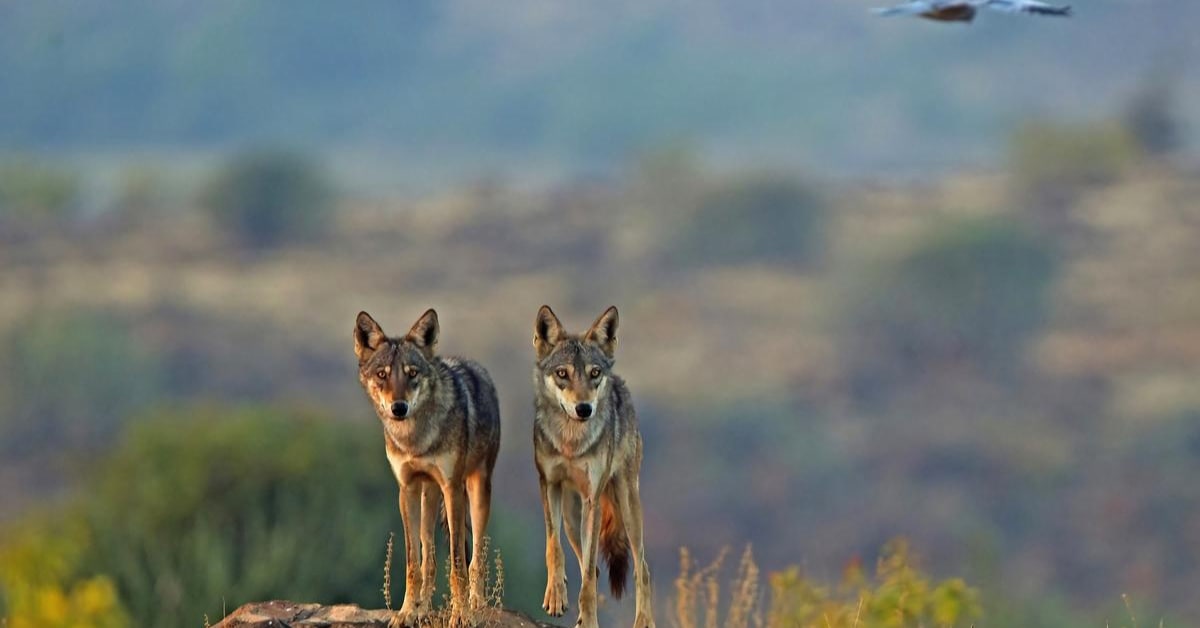
While Madhya Pradesh celebrates its tigers and newly reintroduced cheetahs, another predator has quietly claimed the state as home. An estimated 772 Indian peninsular wolves roam its open landscapes, making it India's wolf capital.
These wolves aren't competing with tigers for dense forest. They thrive in the exact opposite terrain: semi-arid scrubland, grasslands, and open forests that many people overlook as wildlife habitat.
A 2022 study published in Frontiers in Ecology and Evolution counted roughly 3,170 adult Indian wolves across the country using camera trap data from over 26,000 devices. Madhya Pradesh topped the list, followed by Rajasthan with 532 wolves and Gujarat with 494.
The numbers tell only part of the story. Madhya Pradesh offers 81,734 square kilometers of potential wolf habitat, the largest area of any Indian state.
Researchers identified thriving wolf populations across several landscapes, including Shivpuri-Mukundara-Gandhi Sagar and Satpura-Betul-Melghat. But one location is teaching scientists something new about coexistence.
Nauradehi Wildlife Division was once wolf territory. Then tigers were reintroduced in 2018, creating a natural experiment in predator dynamics.
The Madhya Pradesh State Forest Research Institute launched a study to understand how wolves adapt when apex predators return. They're tracking three radio-collared wolves and their packs, examining movement patterns, prey choices, and breeding habits.
The question isn't whether tigers dominate wolves in direct encounters. It's whether both predators can share a landscape by occupying different ecological niches.
The team has deployed 469 cameras across Nauradehi to watch this relationship unfold. Early findings suggest that wolves can persist by sticking to their preferred open habitats while tigers claim denser areas.
The Ripple Effect
This research matters beyond Madhya Pradesh. As India works to expand tiger populations, many recovery landscapes also support wolves and other predators adapted to open country.
Conservation strategies built around dense forest reserves might miss the grasslands and scrublands that wolves need. Understanding how multiple large predators share space helps protect entire ecosystems, not just flagship species.
The Indian peninsular wolf represents an ancient lineage distinct from Himalayan wolves. These animals have survived alongside humans and livestock for centuries, moving through pastoral landscapes and agricultural edges.
Their success in Madhya Pradesh shows that wildlife conservation doesn't always look like pristine wilderness. Sometimes it looks like scrubland, grassland, and the spaces between forests that make room for different kinds of life to flourish together.
More Images
%2Fenglish-betterindia%2Fmedia%2Fmedia_files%2F2026%2F09%2F08%2Fpeninsular-wolf-2026-09-08-16-53-27.png)
%2Fenglish-betterindia%2Fmedia%2Fmedia_files%2F2025%2F11%2F20%2Fwild-at-heart-banner-image-microsite-banner-2025-11-20-16-17-04.jpg)
%2Ffilters%3Aformat(webp)%2Fenglish-betterindia%2Fmedia%2Fmedia_files%2F2026%2F09%2F08%2Fpeninsular-wolf-1-2026-09-08-16-57-56.png)
Based on reporting by The Better India
This story was written by BrightWire based on verified news reports.
Spread the positivity!
Share this good news with someone who needs it