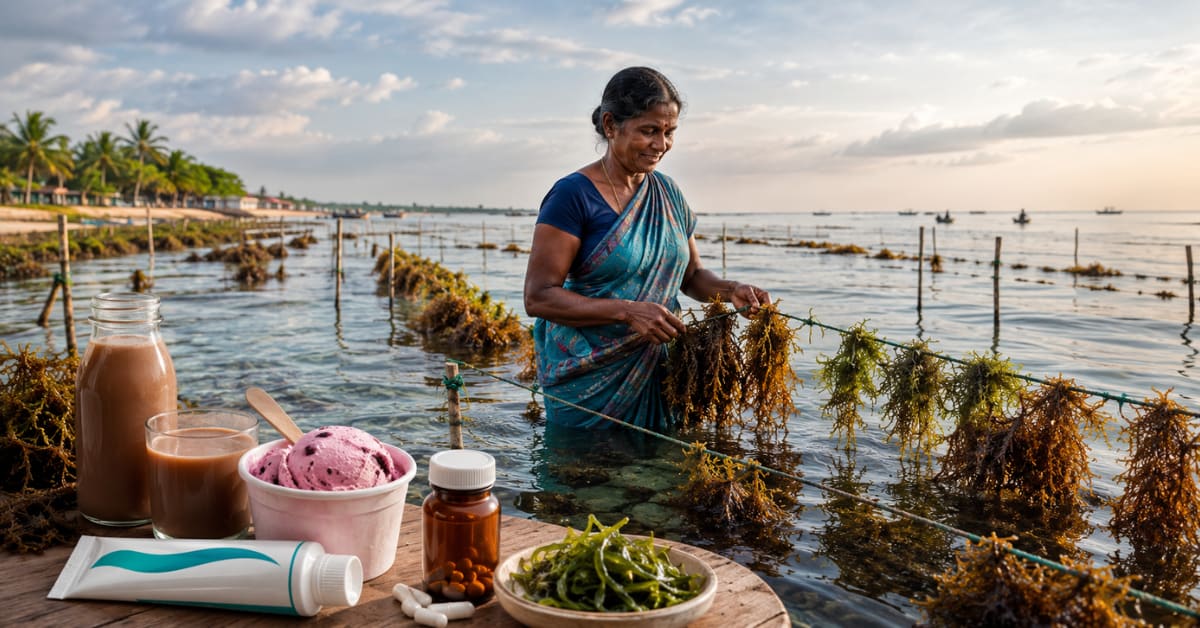
India's Seaweed Powers Your Ice Cream and Medicine
Eight types of seaweed growing along India's 7,500-kilometer coastline are being transformed into everyday products from ice cream to laboratory equipment. The emerging seaweed industry could reach $11.8 billion globally by 2030, offering sustainable alternatives that need no farmland or freshwater.
The seaweed floating in India's coastal waters is probably sitting in your kitchen right now.
It's the reason your ice cream feels creamy, why your toothpaste stays mixed, and possibly why medicines in your cabinet hold their shape. You've never tasted it directly, but you've been using it for years.
More than 800 species of marine algae grow along India's coastline, from red seaweeds clinging to Tamil Nadu's rocks to bright green varieties in shallow waters. About 60 of these species have commercial value, and they're already showing up in surprising places.
Take Kappaphycus alvarezii, the reddish-purple seaweed farmers grow on rope lines near Rameswaram. After being dried and processed, it becomes carrageenan, the natural additive that keeps ice crystals from forming in your ice cream and stops cocoa from settling in chocolate milk.
Gracilaria produces agar, better known as China grass in desserts across South Asia. But its bigger role happens in laboratories worldwide, where scientists grow bacteria and fungi on agar plates to study diseases and develop medicines.
Gelidiella acerosa grows in wiry mats on rocky shores and yields an especially pure form of agar. Pharmaceutical companies and research institutions rely on it for drug development and diagnostic testing.
Then there's Sargassum, the olive-brown seaweed with tiny air bladders that keep it floating. Farmers are turning it into fertilizer, livestock feed, and experimental biofuels. Food manufacturers are even adding Sargassum powder to rice and corn snacks.
The Bright Side
Three major seaweed extracts (carrageenan, agar, and alginate) already form a global industry worth more than half a billion dollars. A 2023 World Bank report projects that 10 emerging seaweed markets could grow to $11.8 billion by 2030.
What makes seaweed especially promising is how it grows. It needs no agricultural land, no freshwater, no fertilizer, and no pesticides. As pressure on farmland and water supplies continues rising worldwide, seaweed offers a sustainable alternative that actually thrives in the ocean.
Researchers are now exploring seaweed-based bioplastics that could replace petroleum products. Early studies suggest these materials could be biodegradable, renewable, and potentially cheaper to produce than conventional plastics.
Communities along India's coast are already benefiting from seaweed farming, which provides income to coastal families while requiring minimal investment. The industry is creating jobs in harvesting, processing, and research.
What started as ocean plants clinging to rocks has become a quiet revolution in how we make everyday products sustainably.
More Images
%2Fenglish-betterindia%2Fmedia%2Fmedia_files%2F2026%2F08%2F10%2Fseaweed-2026-08-10-14-22-57.png)
%2Ffilters%3Aformat(webp)%2Fenglish-betterindia%2Fmedia%2Fmedia_files%2F2026%2F08%2F10%2Fseaweed-1-2026-08-10-14-24-51.png)
%2Ffilters%3Aformat(webp)%2Fenglish-betterindia%2Fmedia%2Fmedia_files%2F2026%2F08%2F10%2Fseaweed-3-2026-08-10-14-32-34.png)
Based on reporting by The Better India
This story was written by BrightWire based on verified news reports.
Spread the positivity!
Share this good news with someone who needs it