India's Trees Store Drinking Water in Their Trunks
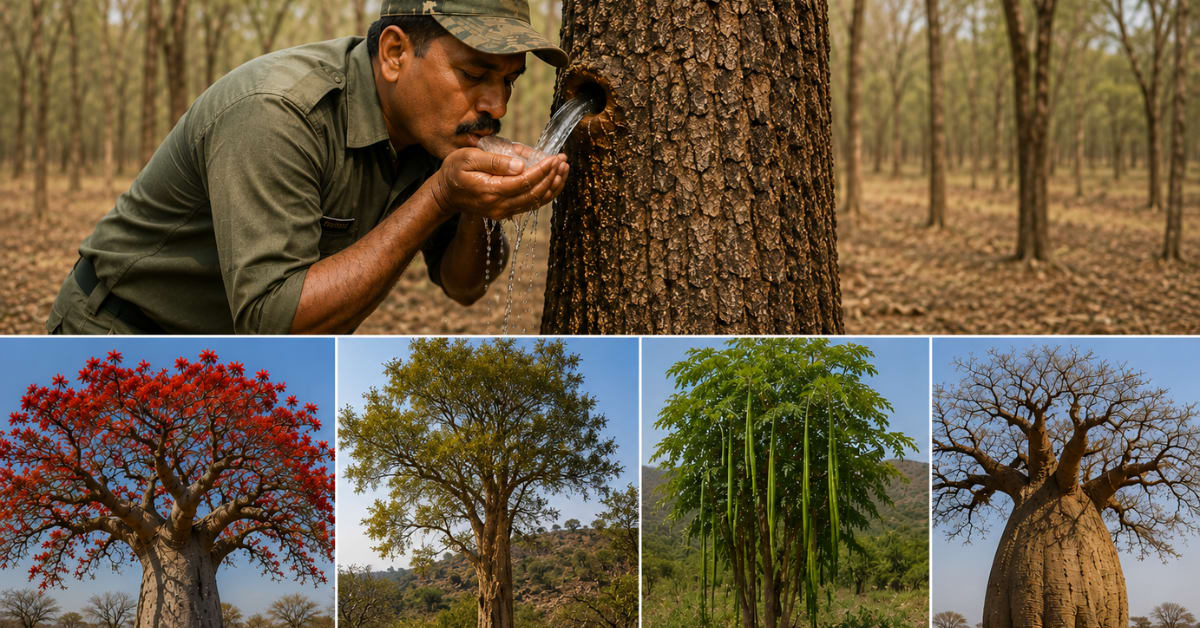
A forest official taps into an ordinary-looking tree and drinks water flowing from its trunk. Across India, several species survive brutal summers by storing reservoirs inside their wood, roots, and bark.
A forest official approaches a rough-barked tree in a dry Indian forest, taps the trunk, and watches water flow into his hands. He drinks it, smiles, and confirms it tastes good.
The viral video stunned viewers because the tree looks completely unremarkable. No swollen trunk, no obvious signs that liters of clean water hide within its wood.
The species is Terminalia tomentosa, known as saj or asan depending on the region. It belongs to a fascinating group of trees that survive India's punishing droughts by storing water inside their trunks, roots, or tissues.
Research from Bandipur National Park found that only 5 to 10 percent of mature saj trees develop water-filled cavities. These special individuals often show a raised ridge on the bark, a sign forest communities have recognized for generations before scientists documented it.
The saj isn't alone in this survival strategy. The semal tree, famous for its massive scarlet flowers, stores water in its spongy trunk to fuel those spectacular blooms during the driest months. Sunbirds, bats, and even sloth bears depend on these flowers when almost nothing else provides food.
The drumstick tree, a kitchen staple across India, hides its water storage underground in a swollen taproot system. Even when cut back severely, it regenerates rapidly by drawing on these hidden reserves rather than starting from scratch.
Then there's the khejri, the lifeline of Rajasthan's Thar Desert. It doesn't store massive quantities like bottle trees, but its deep roots tap underground moisture others can't reach, providing green fodder and shade when temperatures soar past 120 degrees.
India's baobabs, introduced centuries ago by Arab traders, represent the ultimate expression of this strategy. Some trees are over a thousand years old, with trunks containing enormous water reserves. During dry seasons, the trunk visibly shrinks as the tree slowly spends its savings.
The Ripple Effect
These water-storing trees do more than survive. They become seasonal lifelines for entire ecosystems, providing moisture, food, and shelter when conventional water sources disappear.
Forest communities have long known which trees hold water and when to tap them sustainably. That traditional knowledge, now being documented by scientists, reveals a sophisticated understanding of drought survival that took millions of years to evolve.
As climate patterns shift and summers intensify, these living reservoirs offer both inspiration and practical hope for water security in India's driest landscapes.
More Images
.png)
%2Fenglish-betterindia%2Fmedia%2Fmedia_files%2F2026%2F05%2F21%2F1-2026-05-21-17-23-26.png)
%2Fenglish-betterindia%2Fmedia%2Fmedia_files%2F2025%2F11%2F20%2Fwild-at-heart-banner-image-microsite-banner-2025-11-20-16-17-04.jpg)

Based on reporting by The Better India
This story was written by BrightWire based on verified news reports.
Spread the positivity!
Share this good news with someone who needs it