James Webb Finds Galaxy Bar That Shouldn't Exist Yet
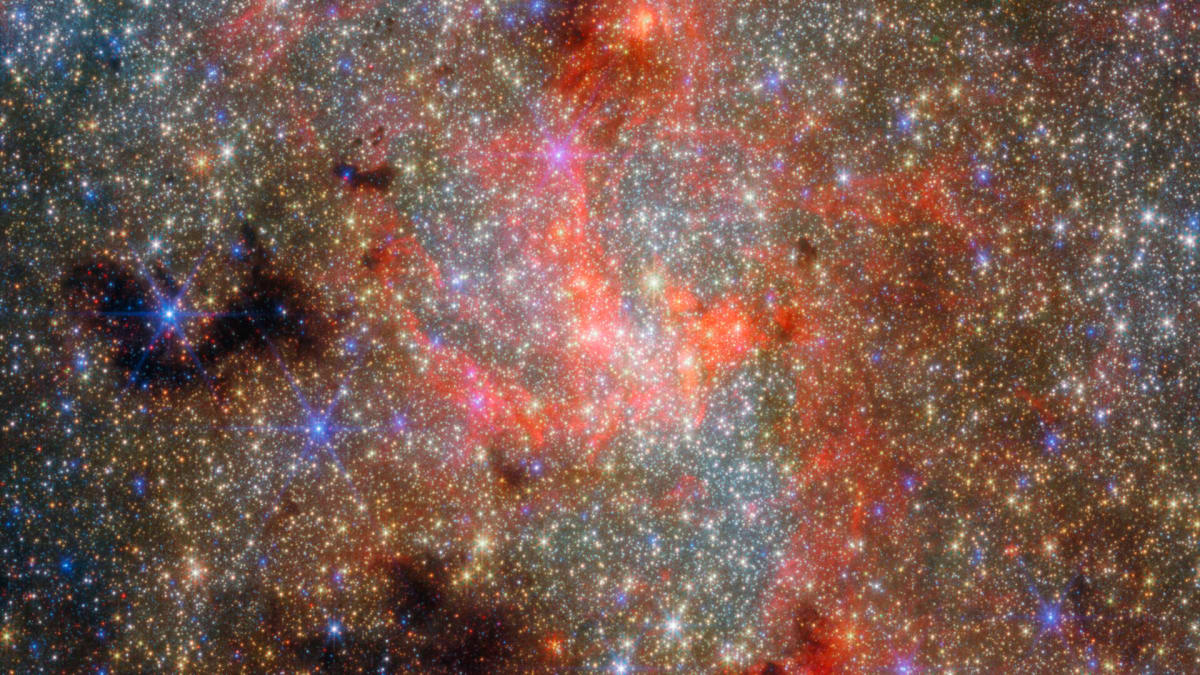
The James Webb Space Telescope spotted a massive stellar bar in a galaxy that existed when the universe was just one-tenth its current age. This discovery challenges everything astronomers thought they knew about how early galaxies evolved and may solve the mystery of why some ancient galaxies suddenly stopped forming stars.
A galaxy from the dawn of time just broke the rules of how the universe was supposed to grow up.
Astronomers using the James Webb Space Telescope discovered a fully formed stellar bar inside galaxy GN20, a structure that simply shouldn't exist yet. These bars are long, cigar-shaped concentrations of stars that slice through the centers of disk galaxies like our Milky Way, and scientists believed they needed billions of years to form.
GN20 didn't have billions of years. It existed when the universe was barely 10% of its current age, yet it somehow built a bar stretching several thousand light-years across, comparable in size to the one in our own galaxy today.
The discovery contradicts three fundamental predictions at once. Young galaxies weren't supposed to have the stable structure needed to support such massive bars. They hadn't existed long enough for gravitational forces to organize stars into these patterns. And the high amounts of turbulent gas swirling through early galaxies should have disrupted the delicate orbital mechanics that hold bars together.
But GN20 defied all three expectations, and it wasn't alone in its evidence. Independent observations using millimeter-wave instruments detected the same elongated structure in the galaxy's dust distribution, confirming what Webb saw across completely different wavelengths.
The bar serves as a cosmic conveyor belt, funneling gas and dust toward the galaxy's center at incredible speeds. This process helps explain why GN20 produces over 1,000 new stars per year, compared to the Milky Way's much slower pace.
Why This Inspires
This discovery might finally explain one of astronomy's biggest mysteries: how supermassive black holes grew so large so quickly after the Big Bang.
The bar isn't just moving gas for star formation. It's potentially feeding a growing black hole at the galaxy's center, offering astronomers a mechanism they've desperately needed to explain rapid black hole growth in the early universe.
Even more exciting, this finding may reveal how massive galaxies die. Many ancient elliptical galaxies burned through their gas supplies and fell silent early in cosmic history, but scientists never understood how they exhausted their fuel so quickly.
GN20 might be showing us exactly how that happens in real time. Channel gas inward fast enough through a bar, ignite it in an explosive burst of star formation, feed a hungry black hole, and a galaxy can deplete its entire gas reservoir in a cosmological blink.
The theoretical twist makes it even better. The same turbulence that should have prevented the bar from forming may actually be what stabilized it, providing internal pressure support that kept the structure from collapsing under its own weight.
This pattern keeps repeating with Webb: the early universe looks far more mature and organized than our models predicted. The cosmos grew up faster and more efficiently than we imagined, turning chaos into structure with surprising speed and elegance.
More Images


Based on reporting by Google: James Webb telescope
This story was written by BrightWire based on verified news reports.
Spread the positivity!
Share this good news with someone who needs it
%2Fhttps%3A%2F%2Ftf-cmsv2-smithsonianmag-media.s3.amazonaws.com%2Ffiler_public%2F3f%2F55%2F3f5579c8-c4a7-43a5-bb54-6498478792fd%2Fhelix1940__fitmaxwzk3mcw2ntbd.jpg)