Webb Telescope Solves Black Hole Mystery After Decades
Scientists just figured out how supermassive black holes keep feeding themselves, solving a puzzle that's stumped astronomers for generations. The James Webb Space Telescope captured the clearest images ever of gas streaming into a black hole 145 million light-years away.
Scientists just cracked one of space's most stubborn mysteries: how do the universe's biggest black holes keep eating?
For decades, astronomers have been puzzled by a cosmic paradox. Supermassive black holes blast out powerful jets that heat up surrounding gas, which should cut off their own fuel supply. Yet somehow, these giants keep growing.
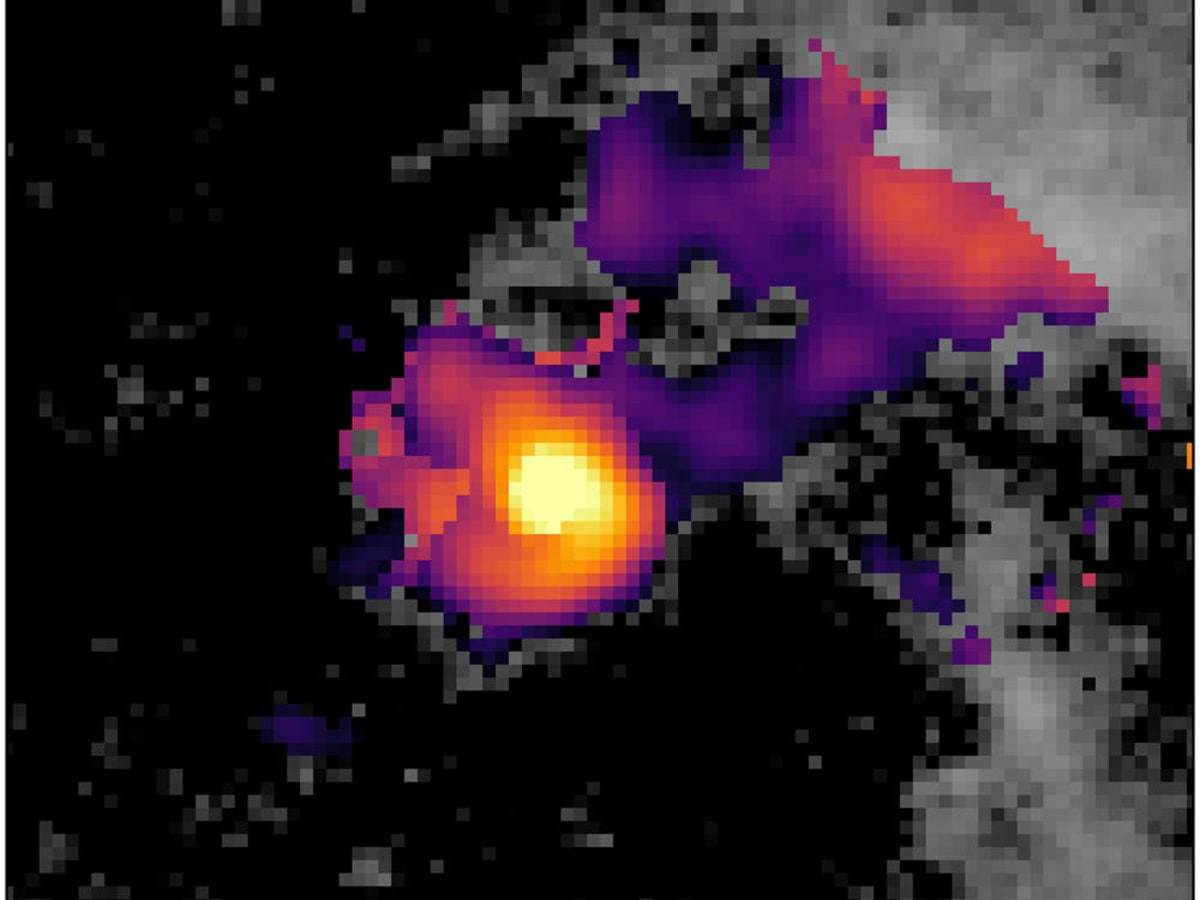
Now, the James Webb Space Telescope has revealed the answer. The telescope spotted massive filaments of gas stretching across space, funneling material directly into a black hole's swirling dinner plate.
An international team led by researchers at the Université de Montréal pointed Webb at galaxy NGC 4696, located 145 million light-years from Earth. They chose this galaxy because it sits at the heart of the Centaurus Cluster, making it a perfect natural laboratory.
After eight hours of observations, the team mapped something remarkable. They found an 800-light-year-wide disk of gas spinning around the central black hole at 600 kilometers per second. Connected to that disk was a huge filament, acting like a cosmic pipeline delivering fresh fuel.
The discovery confirms what scientists had suspected but never seen clearly before. When black holes heat up nearby gas with their powerful jets, that material doesn't just disappear. Instead, it eventually cools down and collapses into thin filaments that can stretch hundreds of thousands of light-years across space.
Magnetic fields guide these filaments back toward the galaxy's center, where they pile up in the rotating disk around the black hole. Think of it like a recycling system on a cosmic scale.
"Calculations done by our Michigan State group predict that magnetic fields should help feed the universe's biggest black holes by channeling cool gas toward them, and it's amazing to see that happening in these JWST images," said Mark Voit, a professor at Michigan State University.
The team even ran computer simulations based on their theory. The predicted behavior matched what Webb observed, strengthening their case.
Why This Inspires
This breakthrough shows how new technology keeps pushing the boundaries of human knowledge. Questions that seemed impossible to answer just years ago now have solutions captured in stunning detail.
The research also reminds us that the universe operates on cycles we're only beginning to understand. These supermassive black holes, millions to billions of times more massive than our Sun, anchor most galaxies in the universe including our own Milky Way.
"JWST observations are offering us thousands of new facts and measurements," said co-author Megan Donahue of Michigan State University. Teams of scientists worldwide are now collaborating to piece together how black holes and their host galaxies interact and shape each other.
Every mystery we solve opens doors to new questions, and the James Webb Space Telescope is just getting started.
Based on reporting by Google: James Webb telescope
This story was written by BrightWire based on verified news reports.
Spread the positivity!
Share this good news with someone who needs it