James Webb Finds Galaxy from 280M Years After Big Bang
NASA's James Webb Space Telescope spotted the most distant galaxy ever detected, shining bright just 280 million years after the universe began. The discovery is rewriting what scientists thought possible about early galaxy formation.
Scientists just spotted a galaxy that formed when the universe was barely a toddler, and it's turning everything we thought we knew about space upside down.
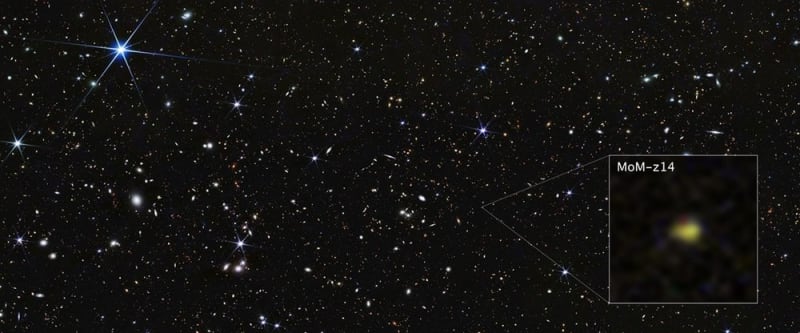
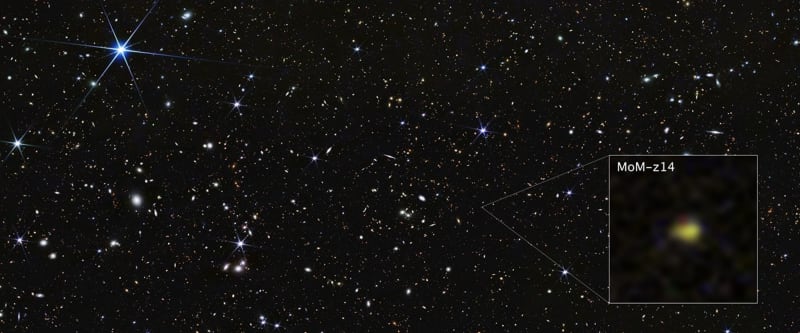
The James Webb Space Telescope detected MoM-z14, a galaxy that existed just 280 million years after the Big Bang. To put that in perspective, the Milky Way didn't form until 800 million years after the universe began.
The galaxy's light has been traveling through space for 13.5 billion years of the universe's 13.8 billion year existence. When scientists look at MoM-z14, they're literally looking back in time to see what the cosmos looked like in its infancy.
Here's where it gets really interesting. MoM-z14 is shining far brighter than it should be for such a young galaxy. The number of bright galaxies at this distance is 182 times larger than scientists predicted.
"With Webb, we are able to see farther than humans ever have before, and it looks nothing like what we predicted, which is both challenging and exciting," said Rohan Naidu, lead author of the study from MIT's Kavli Institute for Astrophysics and Space Research. The galaxy simply shouldn't have had enough time to accumulate the mass or form enough stars to glow so brilliantly.
Scientists are exploring several explanations for this cosmic puzzle. Early galaxies might have converted gas into stars far more efficiently than modern galaxies do. The dense environment of the early universe could have even produced supermassive stars that behaved differently from anything we see today.
Another surprise came from the chemistry. Some stars in MoM-z14 show unusually high levels of nitrogen, similar to the oldest stars in our own Milky Way. The galaxy was too young to produce that much nitrogen through normal stellar processes, suggesting the early universe played by different rules than scientists expected.
The galaxy is also helping solve another cosmic mystery. MoM-z14 shows signs of clearing away the thick hydrogen fog that filled the early universe, a process called reionization. The James Webb telescope was specifically designed to study this transformation, when the first stars began punching through the fog and letting light travel freely through space.
Why This Inspires
This discovery shows that the universe was far more dynamic and active in its early days than anyone imagined. Every time scientists think they understand the cosmic story, telescopes like James Webb reveal new chapters that challenge and expand our knowledge. The fact that we can see back 13.5 billion years and watch galaxies forming reminds us how far human curiosity and ingenuity have brought us.
We're witnessing the universe's baby pictures, and they're more beautiful and mysterious than we ever dreamed.
More Images

Based on reporting by Google: James Webb telescope
This story was written by BrightWire based on verified news reports.
Spread the positivity!
Share this good news with someone who needs it