Japan Unlocks Key to Faster Sodium-Ion Batteries
Japanese scientists used supercomputers to solve a major puzzle in sodium-ion batteries, revealing how to make them store energy better and charge faster. This breakthrough brings us closer to having abundant, affordable batteries that don't rely on scarce lithium.
Scientists in Japan just cracked the code on making sodium-ion batteries work better, and the timing couldn't be more perfect for our energy future.
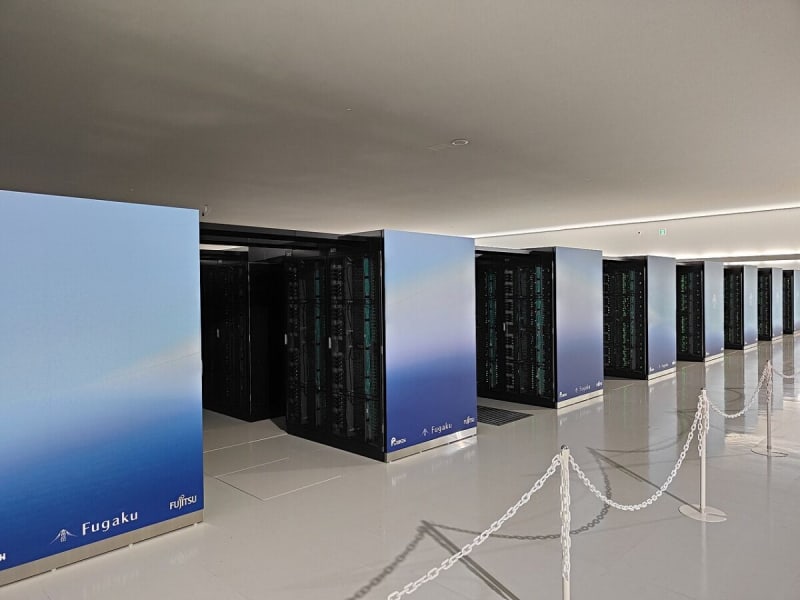
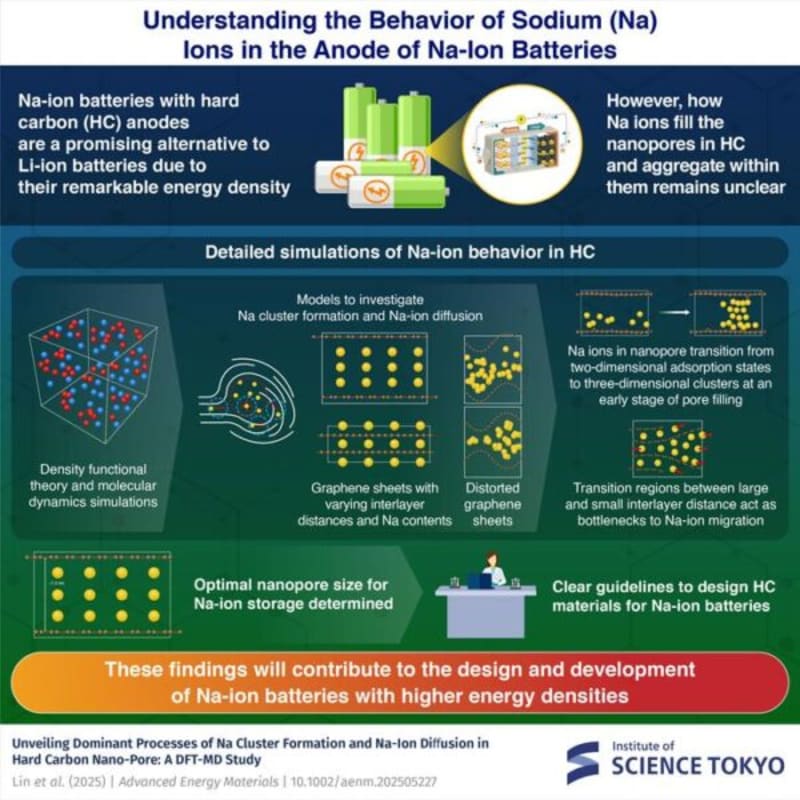
Researchers at the Institute of Science Tokyo ran massive simulations on Fugaku, one of the world's fastest supercomputers, to watch sodium atoms move inside battery materials at the tiniest scale. What they discovered could transform how we store renewable energy and power electric vehicles.
The team focused on hard carbon, a key material in sodium-ion batteries that's been puzzling scientists for years. Nobody could explain why sodium ions moved so slowly through it, limiting how fast these batteries could charge and discharge.
The supercomputer simulations revealed something surprising. Sodium ions cluster together in tiny pores measuring just 1.5 nanometers across. When the ions try to move between narrow and wide spaces in the carbon structure, they create bottlenecks, like traffic jams at construction zones.
"We showed that sodium ions have really high mobility in most regions of hard carbon," explained lead researcher Che-an Lin. "It's just these transition zones that slow everything down. If we optimize the structure, we can significantly improve performance."
This matters because sodium is everywhere. Unlike lithium, which comes from limited sources and drives up battery costs, sodium can be extracted from seawater. As the world races to store solar and wind power and electrify transportation, we need batteries that everyone can afford.
Several companies are already ramping up sodium-ion battery production, focusing on applications where lithium struggles. These batteries charge faster in extreme temperatures and cost less to manufacture.
The Ripple Effect spreads far beyond cheaper batteries. Every sodium-ion battery that replaces a lithium one frees up limited lithium supplies for applications where it works best. This diversification strengthens global battery supply chains and reduces dependence on concentrated mineral resources.
The Japanese team's findings provide manufacturers with specific design guidelines: keep pores around 1.5 nanometers, maintain consistent pore sizes, and minimize structural bottlenecks. These aren't theoretical suggestions but practical blueprints backed by atomic-level visualization.
"The widespread adoption of sodium-ion batteries will increase the overall supply of batteries in society, supporting the realization of a carbon-neutral future," said research leader Yoshitaka Tateyama.
The breakthrough demonstrates how supercomputing power now lets scientists see molecular dance moves that were invisible just years ago. Problems that stumped researchers for decades can be solved in weeks when you can simulate millions of atomic interactions.
Sodium-ion batteries won't replace lithium everywhere, but they don't need to. They'll complement lithium technology, filling gaps where cost and charging speed matter most: grid storage, backup power, and budget-friendly electric vehicles.
The future of clean energy just got more accessible, one nanometer at a time.
More Images
Based on reporting by PV Magazine
This story was written by BrightWire based on verified news reports.
Spread the positivity!
Share this good news with someone who needs it