Jean Purdy: The Forgotten Pioneer of IVF Finally Honored
A brilliant embryologist helped create the world's first IVF baby in 1978, but sexism erased her name from history for decades. Now, Jean Purdy is finally getting the recognition she always deserved.
When the world's first IVF baby, Louise Brown, was born on July 25, 1978, it took three brilliant minds to make the impossible possible. Yet for decades, the world only remembered two of them.
Jean Purdy was just 26 when she joined physiologist Robert Edwards in 1968 as a research nurse at Cambridge's Physiological Laboratory. What started as a nursing role quickly became something extraordinary.
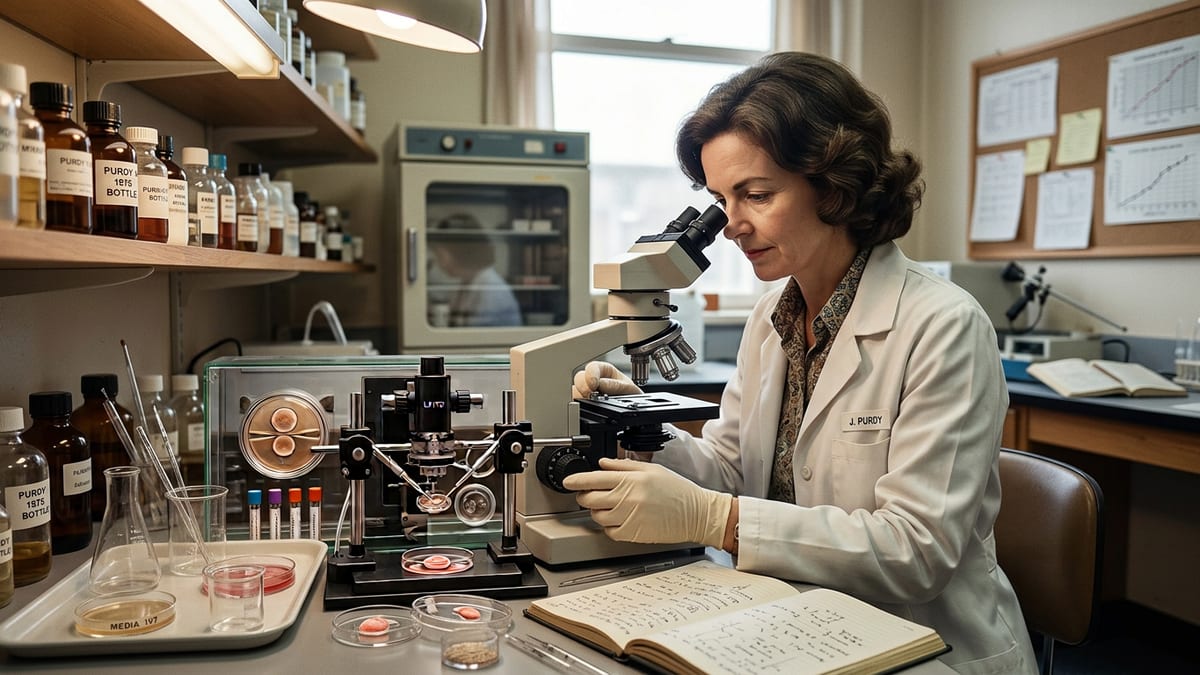
Working alongside Edwards and gynecologist Patrick Steptoe, Purdy became the backbone of their groundbreaking work. She managed the laboratory, prepared and tested culture media, and meticulously recorded every detail of their experiments. When public opinion turned against IVF research, she stood by the women who volunteered, offering support when they needed it most.
Then came the breakthrough moment. Purdy became the first person to witness a human blastocyst forming in culture, a cluster of cells appearing five to six days after fertilization. In July 1978, she watched embryonic cells successfully divide in the lab, cells that would soon become baby Louise Brown.
Her contributions went far beyond that single moment. Between 1970 and 1985, she co-authored 26 papers in leading journals like Nature, helping refine IVF techniques and make them safer. When government funding dried up, she helped establish the world's first dedicated IVF clinic at Bourn Hall in 1980, serving as technical director and overseeing more than 500 successful births.
Edwards himself wrote that Purdy had become "crucial" to their work, noting they were no longer a duo but a "threesome." Yet when a commemorative plaque went up at Oldham Hospital, her name was missing.
Why This Inspires
Recent research analyzing Purdy's detailed laboratory notebooks revealed the full scope of her genius. Scientists Martin Johnson and Kay Elder concluded that without her systematic approach and dedication, the entire IVF project might have failed. She wasn't just assisting; she was innovating, even modifying surgical instruments to improve embryo transfer procedures.
Tragically, Purdy died of cancer in 1985 at just 39 years old. Edwards later won the Nobel Prize in 2010, but Purdy's name remained largely forgotten for years.
That's finally changing. Museums now recognize her as the first clinical embryologist. Institutions are naming awards and exhibitions in her honor. The woman who helped millions of families worldwide is getting her due.
Today, over 10 million babies have been born through IVF, and Jean Purdy made every single one possible.
Based on reporting by The Hindu
This story was written by BrightWire based on verified news reports.
Spread the positivity!
Share this good news with someone who needs it