Jharkhand Farmer's Mangoes Now Sell in England, Triple Income
For years, Jiwanti Bara watched her mangoes rot because local traders controlled prices. Now her fruit reaches international markets, and she's earning three times more.
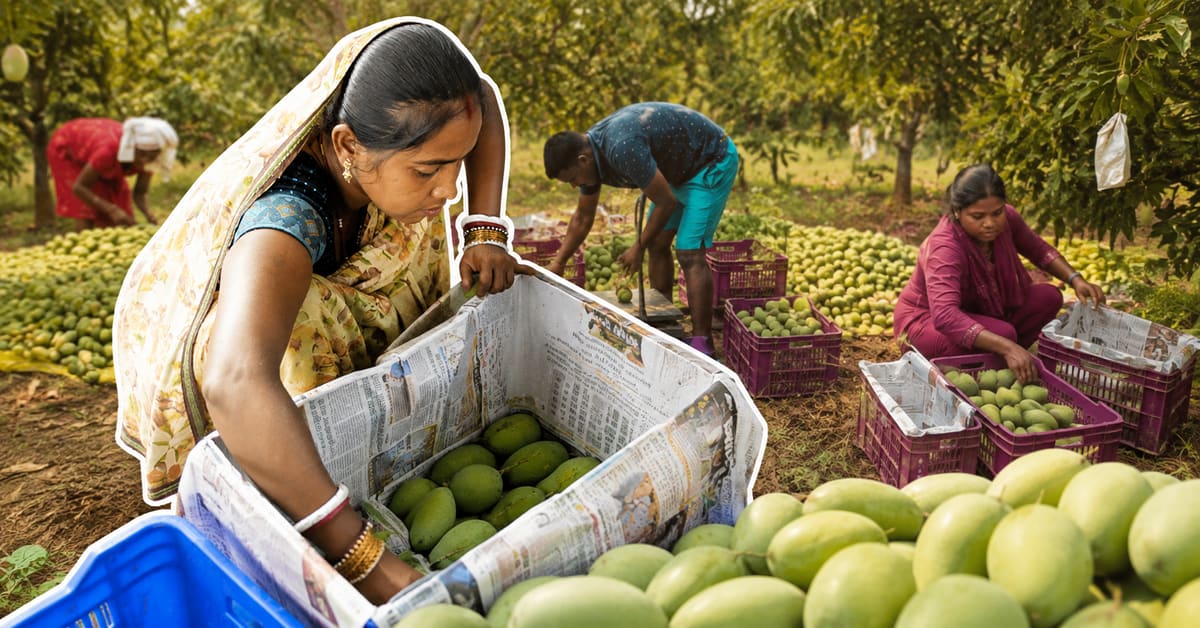
Jiwanti Bara spent eight years watching perfectly good mangoes spoil outside her home in rural Jharkhand because she had nowhere else to sell them. The 50-year-old farmer could only accept whatever price local traders offered, or risk losing her entire harvest.
Every summer, she tended her Amrapali mango orchard with careful attention to watering, pruning and pest control. But when harvest arrived, her options narrowed to a single frustrating choice: sell cheap or watch the fruit rot.
"Earlier, if we couldn't sell our mangoes in time, they would eventually rot," Jiwanti says from her village in Simdega district. "We had no option but to accept whatever price the local traders offered us."
Thousands of families across Jharkhand faced the same trap. Women spent months growing quality fruit but had zero bargaining power when buyers finally showed up.
The problem wasn't farming skill. Families had successfully planted orchards across nearly 460,000 acres through a state program called Birsa Harit Gram Yojana, benefiting over 215,000 rural households. The trees produced beautiful mangoes, but farmers lacked connections to reach better markets beyond their villages.
Everything changed when development organization PRADAN partnered with local government agencies and farmer cooperatives to bridge that gap. Starting in December 2025, they taught farmers how to sort, grade, pack and maintain quality standards that organized buyers required.
Women farmers formed producer companies that could collect fruit from multiple orchards, negotiate as a group and connect directly with domestic and international markets. For the first time, small farmers had real bargaining power.
Today, Jiwanti's mangoes travel to England, Italy and the United Arab Emirates. Her income has tripled.
The Ripple Effect
The transformation extends far beyond one farmer's orchard. Across 24 districts in Jharkhand, women who once watched their harvest spoil now send fruit to organized buyers throughout India and overseas.
These farmer-owned cooperatives give members collective strength they never had individually. Women who spent years accepting unfair prices now help decide how their crops get sold and what they'll accept.
"I felt very happy and proud when I learnt that our mangoes had reached an international market," Jiwanti says. "Earlier, we never imagined that fruit grown by farmers like us could go outside India."
The success proves that small farmers don't lack ability. They lack market access, and solving that single problem can transform entire communities overnight.
Jiwanti now hopes to reach even more markets and continue improving her family's income, one mango at a time.
More Images
%2Fenglish-betterindia%2Fmedia%2Fmedia_files%2F2026%2F08%2F27%2Fjharkhand-women-farmers-mango-export-2026-08-27-16-26-10.png)
%2Ffilters%3Aformat(webp)%2Fenglish-betterindia%2Fmedia%2Fmedia_files%2F2026%2F08%2F27%2Fjharkhand-women-farmers-mango-export-2026-08-27-16-28-47.png)
%2Ffilters%3Aformat(webp)%2Fenglish-betterindia%2Fmedia%2Fmedia_files%2F2026%2F08%2F27%2Fjharkhand-women-farmers-mango-export-2026-08-27-16-30-18.png)
Based on reporting by The Better India
This story was written by BrightWire based on verified news reports.
Spread the positivity!
Share this good news with someone who needs it