Jupiter Created a "Planet Factory" in Our Early Solar System
Scientists discovered a ring-shaped region beyond Jupiter's orbit that acted like a planetary nursery, creating the building blocks of planets when our solar system was young. This breakthrough explains the mysterious origins of rare meteorites that still land on Earth today.
Scientists just solved a 4.6-billion-year-old mystery about how the building blocks of our solar system first formed, and Jupiter played the starring role.
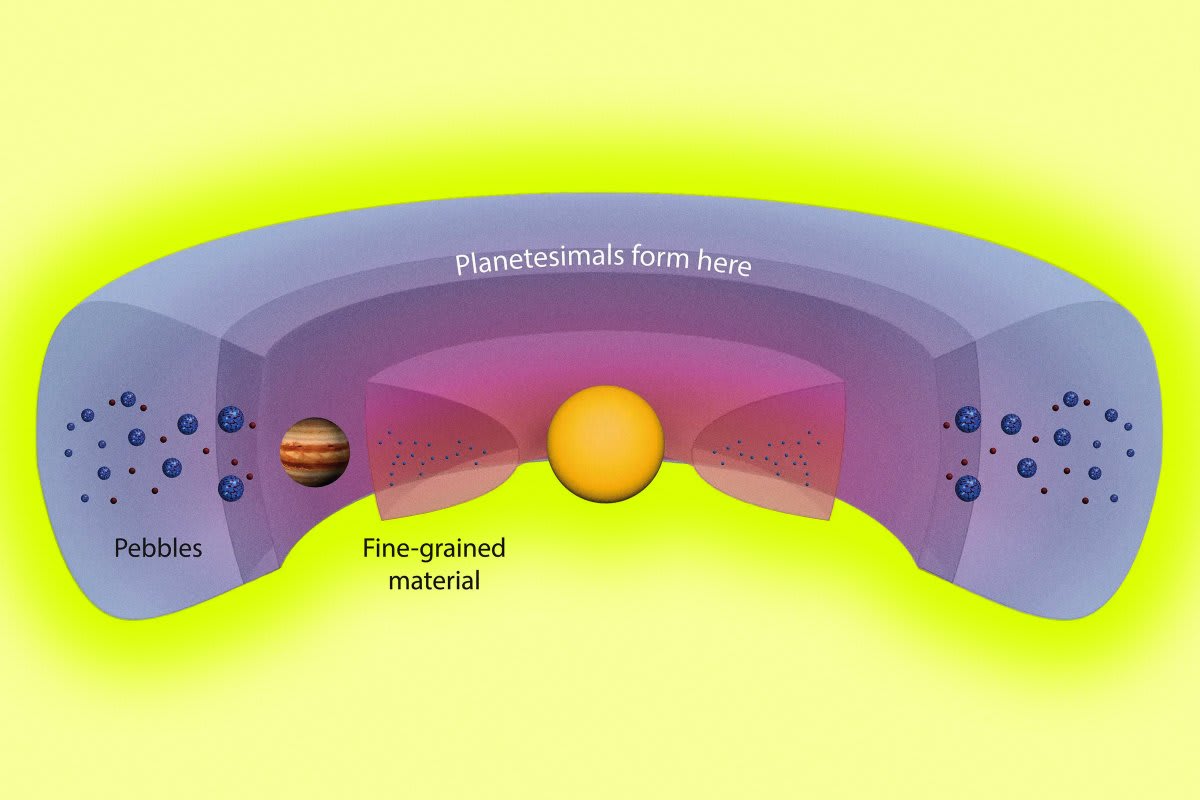
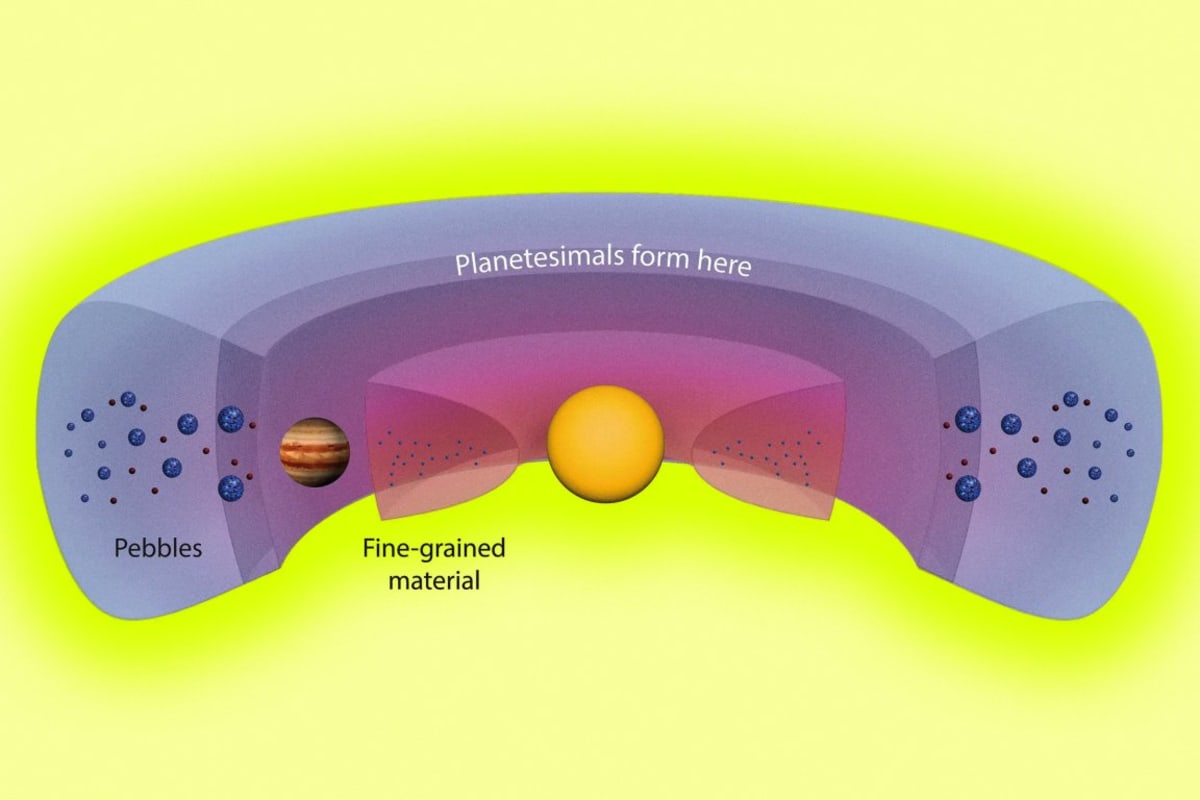
Astronomers at the Max Planck Institute for Solar System Research discovered a ring-shaped "planet factory" just beyond Jupiter's orbit. This region, packed with gas and dust, created mile-long solid masses called planetesimals that eventually became the planets we know today.
The discovery explains something puzzling. Rare meteorites called carbonaceous chondrites keep falling to Earth, and they contain wildly different materials even though they formed around the same time. Some are crumbly, others sturdy, all born within a narrow window of time millions of years ago.
Using computer simulations, researchers recreated what happened when our solar system was an infant. When Jupiter formed, its massive gravity vacuumed up nearby material, creating a gap in the swirling disk around the young Sun. This gap created a high-pressure ring just outside Jupiter's orbit that trapped dust particles like a cosmic net.
Over 500,000 years, these trapped particles clumped together into pebbles, then into planetesimals. The process created two distinct generations of building blocks with different compositions, perfectly matching what scientists see in meteorite samples today.
"For the first time, we have succeeded in accurately reproducing the results of laboratory studies of meteorites using computer simulations," said cosmochemist Thorsten Kleine. The meteorites serve as a touchstone, proving the theory works.
The Ripple Effect
This discovery changes how we understand our cosmic neighborhood's birth story. The research suggests dust traps like this one weren't rare accidents but preferred nurseries where most planetesimals formed throughout the solar system.
Jupiter didn't just shape its own neighborhood. Its gravitational influence created conditions that built the materials for rocky planets like Earth. The same process that trapped dust beyond Jupiter billions of years ago directly led to the world beneath our feet.
The finding also gives scientists a new framework for studying planet formation around other stars. If dust traps played such a crucial role here, they're likely creating planets across the galaxy right now.
Every meteorite that lands on Earth carries evidence of this ancient factory, fragments of our solar system's first construction project still arriving after billions of years.
More Images
Based on reporting by Futurism
This story was written by BrightWire based on verified news reports.
Spread the positivity!
Share this good news with someone who needs it