Jupiter's Moon Europa Shows Signs of Life-Friendly Molecules
NASA scientists discovered ammonia on Jupiter's moon Europa, a key ingredient for life, buried in old data from a spacecraft mission that ended over 20 years ago. The finding makes Europa one of the most promising places to search for extraterrestrial life in our solar system.
A NASA researcher just uncovered something remarkable hidden in decades-old spacecraft data: life-friendly molecules leaking through cracks on Jupiter's icy moon Europa.
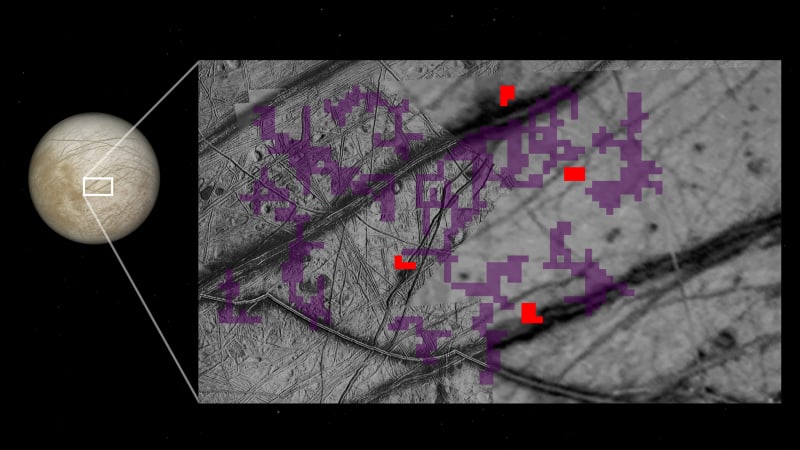
Al Emran was sifting through information gathered by the Galileo spacecraft in 1997 when he spotted faint signals of ammonia near fractures on Europa's frozen surface. It's the first time anyone has detected this crucial compound on the moon.
The discovery matters because ammonia is a nitrogen-bearing molecule, one of the essential ingredients for life as we know it. Along with carbon, hydrogen, oxygen and water, nitrogen plays a vital role in the chemistry that makes living things possible.
Europa ranks as one of the most likely places in our solar system to host alien life. The moon measures about 90% the size of Earth's moon and hides a vast, salty ocean beneath its thick ice shell. That hidden ocean has made scientists wonder for years whether life could exist there.
The ammonia likely came from either Europa's subsurface ocean or shallow areas beneath the ice. Scientists believe icy volcanism pushed the compounds to the surface through cracks in the frozen crust. The ammonia acts like antifreeze, lowering the freezing point of water in those fractures.
Here's what makes the timing special: ammonia doesn't survive long in space because ultraviolet light and cosmic radiation break it down quickly. Finding it on the surface suggests it leaked out relatively recently, offering a fresh glimpse of what lies beneath Europa's icy exterior.
The Galileo spacecraft studied Jupiter and its moons from 1995 to 2003 before running low on fuel. Engineers deliberately crashed it into Jupiter to avoid any risk of contaminating Europa or other potentially habitable moons. But scientists continue finding new insights in its treasure trove of data more than two decades later.
Why This Inspires
Sometimes the biggest discoveries come from looking at old information with fresh eyes. Emran's patience in reviewing data that's older than many college students today led to a finding that could reshape our search for life beyond Earth.
We won't have to wait much longer for answers. NASA's Europa Clipper spacecraft launched in October 2024 and will arrive at Jupiter in April 2030, specifically hunting for chemical signs of habitability on the icy moon.
The next chapter in humanity's search for cosmic neighbors is already in motion.
More Images



Based on reporting by Live Science
This story was written by BrightWire based on verified news reports.
Spread the positivity!
Share this good news with someone who needs it