Korean Researchers Make Nuclear Plants Safer With New Math
Scientists in South Korea just cracked the code on predicting pipe failures in nuclear plants before they happen. Their breakthrough could make aging reactors safer and help design better power plants for the future.
Nuclear power plants could become significantly safer thanks to a team of Korean engineers who figured out how to predict pipe failures with unprecedented accuracy.
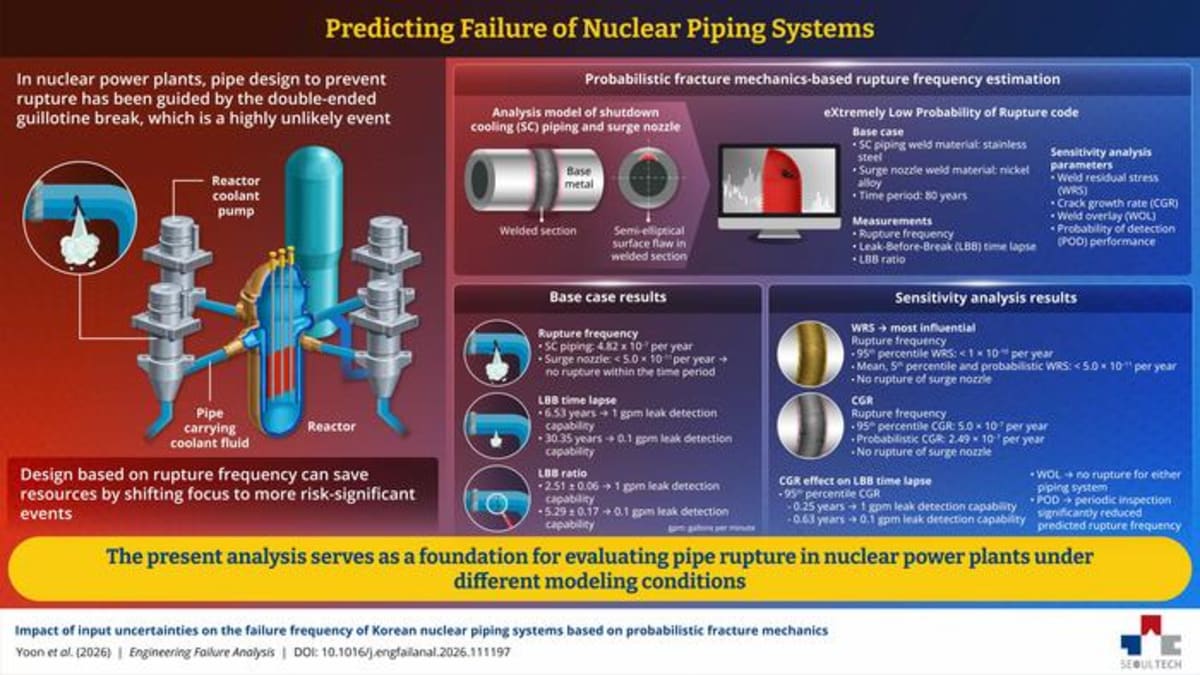
Professor Nam-Su Huh and his team at Seoul National University of Science and Technology developed a new way to calculate the odds of pipe ruptures in nuclear reactors. Instead of assuming worst-case scenarios that almost never happen, their method focuses on what's actually likely to go wrong.
The research centers on the pipes that carry coolant through nuclear reactors. These pipes are critical because a rupture could lead to dangerous coolant loss. For decades, engineers designed around a catastrophic "double-ended guillotine break" where a pipe completely splits in two, even though this scenario is extremely unlikely.
The Korean team used advanced computer modeling to simulate 80 years of plant operation. They tested pipes from an actual Korean nuclear power plant, tracking how tiny cracks might grow over time due to stress and corrosion.
Their findings revealed something important. The biggest factor affecting pipe safety wasn't the pipes themselves but the stress left behind during welding. Small changes in how welds are made can dramatically change rupture risk.
The Ripple Effect
The implications stretch far beyond Korea. Countries worldwide operate aging nuclear plants that need better safety assessments. This new approach gives engineers a smarter way to decide where to focus maintenance efforts and money.
The research also showed that regular inspections work incredibly well. Periodic checks reduced rupture risk by several orders of magnitude, proving that consistent monitoring saves lives.
For new nuclear plants, the method could revolutionize design. Engineers can now identify which pipe sections need extra attention and which worst-case scenarios can be safely downgraded. This means safer plants built more economically.
Professor Huh explains that probabilistic analysis accounts for real-world uncertainties like material variations, aging effects, and inspection quality. Traditional methods couldn't do this.
The team's work appears in the journal Engineering Failure Analysis this November. Their computer code, called xLPR (extremely Low Probability of Rupture), can simulate different materials, weld types, and operating conditions.
In testing, some pipe configurations showed zero rupture risk over 80 years, while others needed targeted repairs. The surge nozzle they tested showed no rupture risk under any scenario, validating its current design.
As the world seeks clean energy solutions, nuclear power remains controversial but carbon-free. Making existing plants safer while we transition to renewables protects communities and workers today. This Korean breakthrough shows that sometimes the best progress comes from understanding problems more precisely, not just building bigger safety margins.
More Images
Based on reporting by Regional: south korea technology (KR)
This story was written by BrightWire based on verified news reports.
Spread the positivity!
Share this good news with someone who needs it