Korean Scientists Restore Brain Function in Alzheimer's Mice
Researchers in South Korea have discovered how to rebalance the brain's immune system to reduce Alzheimer's symptoms in mice, opening a promising new path for treating the disease. By blocking a specific immune protein, they restored protective brain cells and calmed overactive neurons.
Scientists at Sungkyunkwan University just achieved something remarkable: they reversed key symptoms of Alzheimer's disease in mice by fixing the brain's immune system.
The breakthrough centers on microglia, tiny cells that act like the brain's cleanup crew. In healthy brains, they rush to damaged areas and protect surrounding tissue. But in Alzheimer's patients, these crucial helpers stop responding properly while neurons fire too rapidly, creating chaos in the brain.
Professor Minah Suh and her team discovered that two immune proteins, PD-1 and PD-L1, were behaving differently in Alzheimer's mice. These proteins, already famous in cancer treatment, were throwing off the brain's delicate balance.
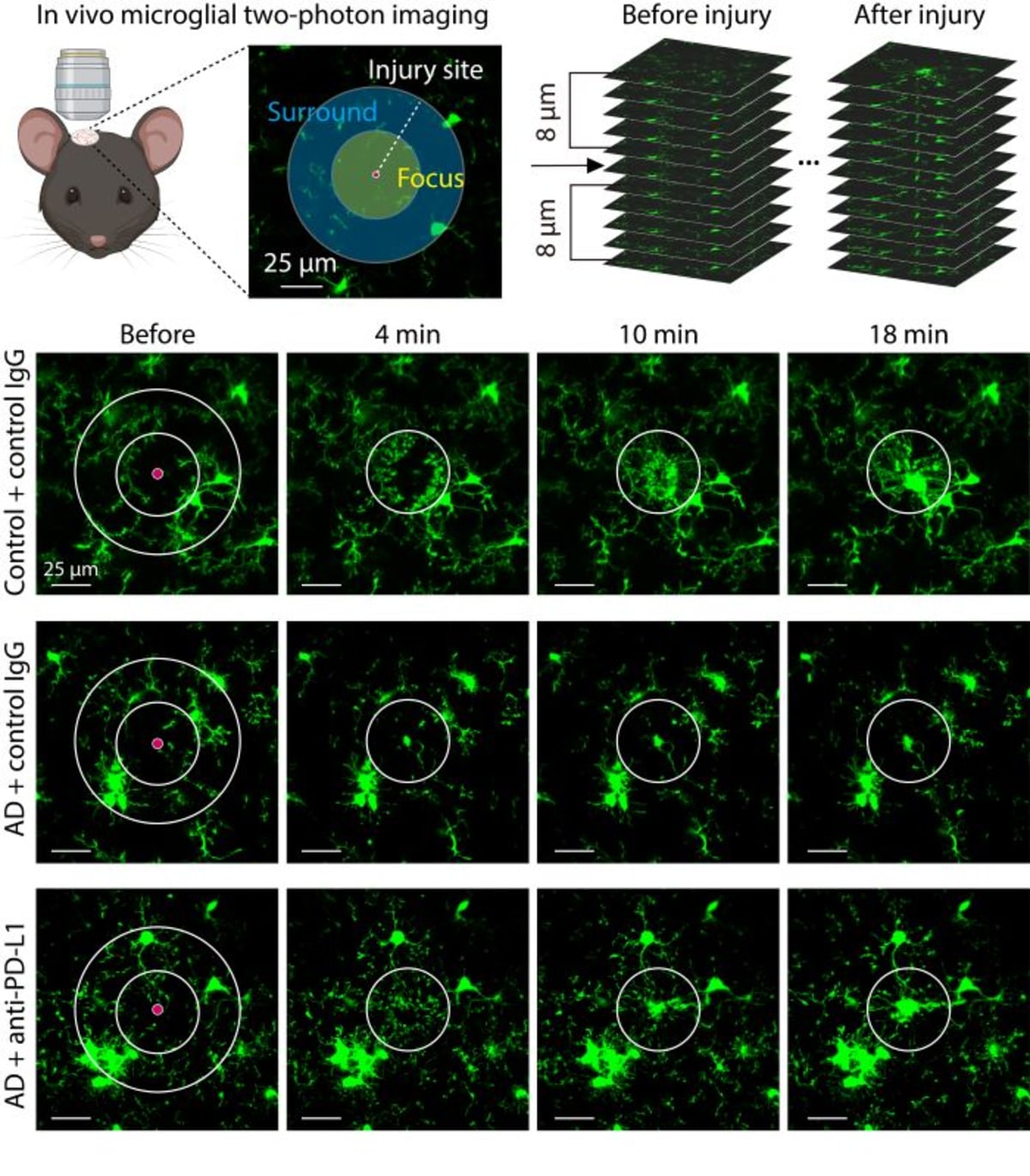
The researchers tested a bold idea: inject an antibody directly into the brain to block PD-L1. Using advanced microscopes that let them watch living brain cells in action, they observed something exciting happen.
The once-sluggish microglia sprang back to life, responding to damage sites just like they should. Even better, the overactive neurons calmed down significantly. The team found these improvements worked best when the treatment was delivered straight to the brain rather than through the bloodstream.
The Ripple Effect
This discovery matters beyond one lab experiment. Alzheimer's disease affects over 55 million people worldwide, and current treatments only manage symptoms without addressing root causes. This research suggests we've been looking at the problem wrong.
Instead of just targeting the protein plaques that build up in Alzheimer's brains, scientists might need to focus on restoring the immune balance that keeps neurons healthy. The fact that these immune proteins are already used successfully in cancer therapy means the safety hurdles are lower than starting from scratch.
The study, published in Science Advances, received backing from South Korea's national dementia research program and involved collaboration between university scientists and the biotech company IMNEWRUN. That partnership between academia and industry could speed the path from mouse studies to human trials.
Graduate student Taeyoung Park, who led the hands-on research, helped prove that precisely targeting immune signals in the brain could be the key we've been missing. Professor Suh put it simply: disrupted immune signaling connects directly to both failing protective cells and misfiring neurons.
The next steps involve testing whether this approach works safely in humans, but for millions of families watching loved ones fade to Alzheimer's, this research offers something precious: a genuinely new direction forward.
Based on reporting by Google News - New Treatment
This story was written by BrightWire based on verified news reports.
Spread the positivity!
Share this good news with someone who needs it