Korean Scientists Slash AI Cooling Costs by 90%
Researchers in South Korea just solved one of AI's biggest problems: the massive amounts of energy needed to keep data centers from overheating. Their breakthrough could make AI computing 10 times more efficient.
Scientists at the Korea Advanced Institute of Science and Technology have developed a cooling system that slashes the energy needed to cool AI chips by roughly 90 percent.
As artificial intelligence grows more powerful, the computers running it generate enormous amounts of heat. Keeping those systems cool now accounts for a massive chunk of data center electricity bills and environmental impact.
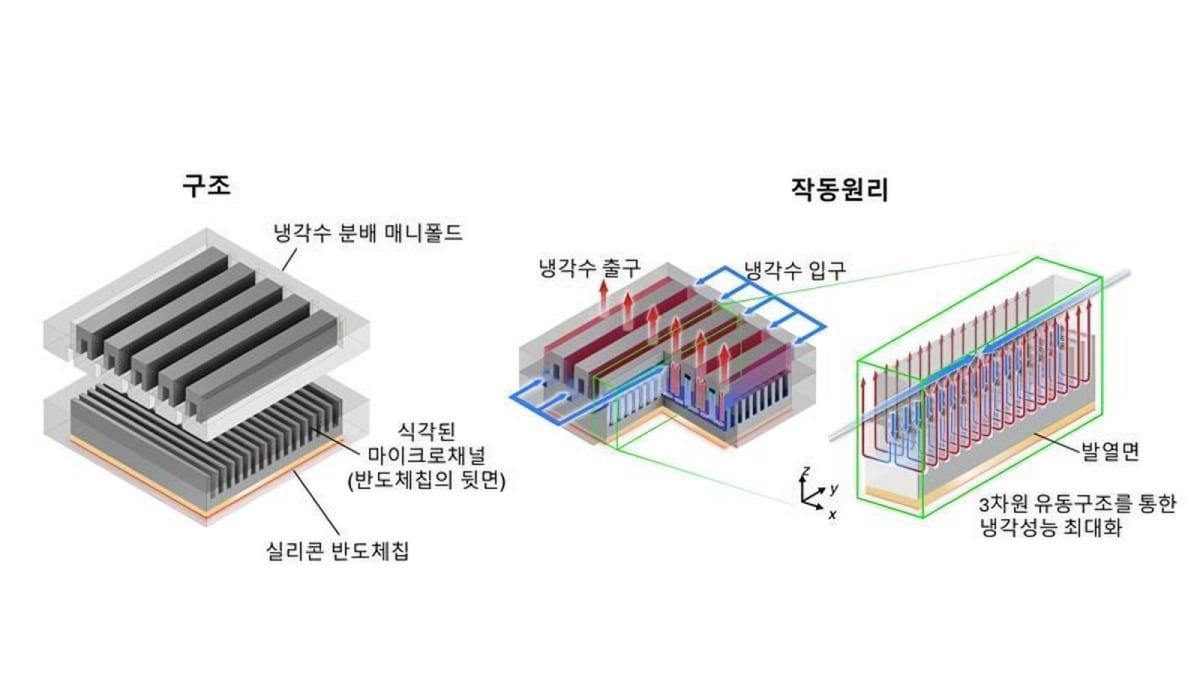
The Korean research team tackled this problem by threading microscopic channels, thinner than a human hair, directly into semiconductor chips. These tiny pathways carry room temperature water through the processor, whisking heat away far more efficiently than traditional methods.
Previous attempts at this approach struggled with uneven water flow. Some channels got flooded while others ran dry. The KAIST team solved this by designing a manifold structure that distributes coolant evenly through multiple pathways, like a perfectly balanced irrigation system.
The results speak for themselves. The researchers measured a coefficient of performance of 106,000, meaning one unit of cooling energy can remove 106,000 units of heat. That's more than 10 times better than the previous world record published in Nature journal in 2020.
What makes this even more impressive is what the technology doesn't need. No boiling-based systems. No expensive diamond components. No special nanostructured surfaces. Just room temperature water flowing through cleverly designed channels.
The team also confirmed their design works with existing semiconductor manufacturing processes. No new factories required. No special equipment. Companies could integrate this technology into their current production lines.
When the researchers tested the concept in actual data center cooling plates, they saw performance improvements of over 30 percent compared to conventional systems.
The Ripple Effect
This breakthrough arrives at a critical moment. AI systems are multiplying rapidly, and their energy demands are becoming a genuine concern for both tech companies and climate advocates. Data centers already consume about 1 percent of global electricity, and that number keeps climbing.
Cutting cooling costs by 90 percent could transform that equation entirely. It means cheaper AI services, smaller carbon footprints, and the ability to build powerful computing systems in places where energy is limited or expensive.
The technology could also extend beyond AI data centers. Any industry using high-performance computing, from scientific research to financial modeling, could benefit from more efficient chip cooling.
The findings were published Sunday in the journal Energy Conversion and Management, opening the door for other researchers and manufacturers to build on this work. What started as a solution to overheating chips might just help cool down AI's growing environmental impact.
Based on reporting by Google News - South Korea Breakthrough
This story was written by BrightWire based on verified news reports.
Spread the positivity!
Share this good news with someone who needs it