Lost Notebooks Solve 55-Million-Year-Old Fossil Mystery
A paleontologist's rediscovered field notebooks just unlocked the secrets of a spectacular fish fossil found 27 years ago in New Zealand. The emotional family donation made it possible to finally honor their father's remarkable discovery.
A stunning fossil discovery sat incomplete for nearly three decades until a scientist's children made a touching decision that changed everything.
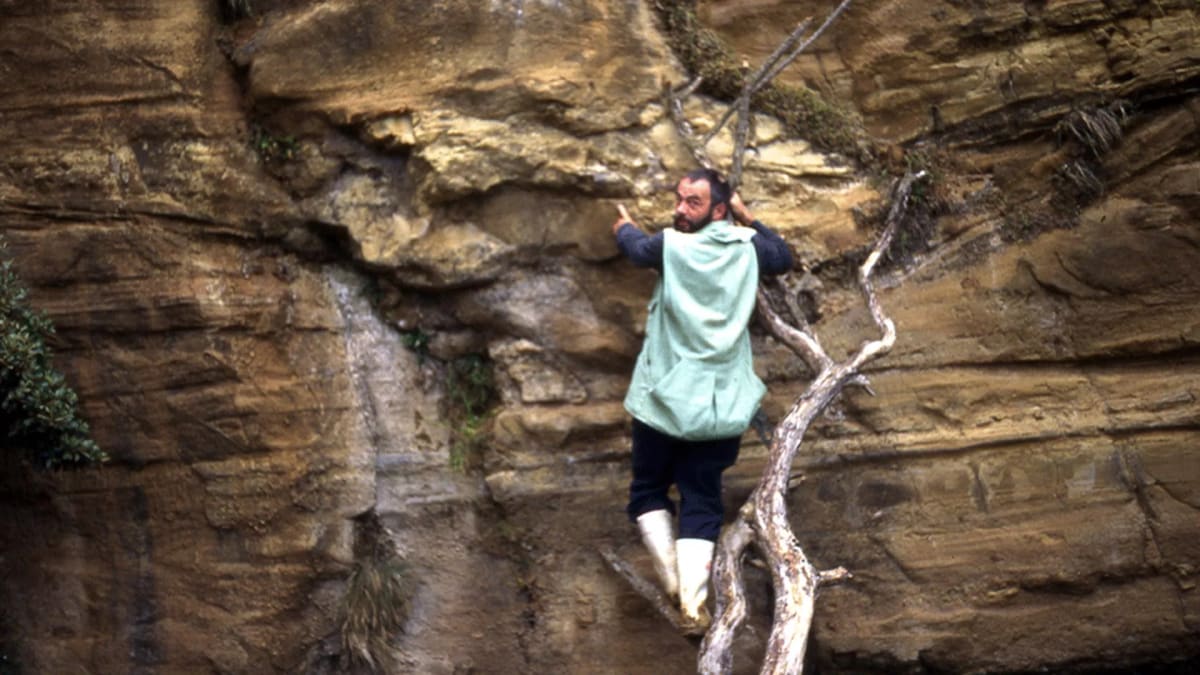
In 1999, Dr. Richard Köhler spotted something extraordinary on a remote cliff above Waihere Bay in New Zealand's Chatham Islands. A perfectly preserved fish fossil jutted from the rock face, its three-dimensional detail so rare that Köhler walked 3 kilometers back to his lodging just to borrow a ladder.
He hauled the massive stone blocks back to the University of Otago, where researchers immediately knew they had something special. The 1.2-meter fossil was unlike any fish ever found in New Zealand waters.
Scientists spent years carefully preparing the specimen, revealing an ancient tarpon with powerful jaws and thick scales. This prehistoric predator hunted at the top of the food chain 55 million years ago, swallowing smaller fish whole as it cruised warm New Zealand seas that no longer exist.
But there was a problem. Critical details about exactly where and how Köhler found the fossil were missing, and he had passed away years earlier. Without this geological information, the research paper sat in limbo.
The breakthrough came in early 2025 when one of Köhler's children, now studying at Otago, visited the department hoping to find photographs of his father. After meeting with Professor Daphne Lee, the family made a generous choice.
They donated Richard's field notebooks, including the precious pages from that 1999 Pitt Island expedition. Those handwritten notes contained every detail researchers needed to complete their work.
Why This Inspires
This story shows how scientific discovery often depends on human connection and generosity. The Köhler family could have kept those notebooks as private mementos, but they chose to share their father's legacy with the world.
Their gift allowed researchers to properly catalog the fossil and publish their findings in the New Zealand Journal of Geology and Geophysics. The species now bears an official name: Ikawaihere koehleri, honoring both Richard Köhler and the bay where he made his discovery.
Professor Mike Gottfried called it "among the most important and impressive fossils recovered to date" from New Zealand. The find expands our understanding of tarpon evolution and preserves unique features in exquisite detail.
Lee says the completed study offers "a fitting tribute to Richard, Ewan and Andrew," the three scientists who worked on the fossil but didn't live to see the research finished.
Sometimes the greatest discoveries need more than scientific skill—they need family love and the willingness to share a father's life work with strangers who will treasure it forever.
Based on reporting by Google: fossil discovery
This story was written by BrightWire based on verified news reports.
Spread the positivity!
Share this good news with someone who needs it

