Lost Notebooks Unlock 55-Million-Year-Old Fish Mystery
A family's donated field notebooks just solved a decades-old scientific puzzle about a spectacular fossil fish from New Zealand. The heartwarming discovery let researchers finally honor the paleontologist who found it.
A stunning fossil that sat in a New Zealand university collection for nearly 30 years finally got its scientific debut, thanks to a son looking for photos of his late father.
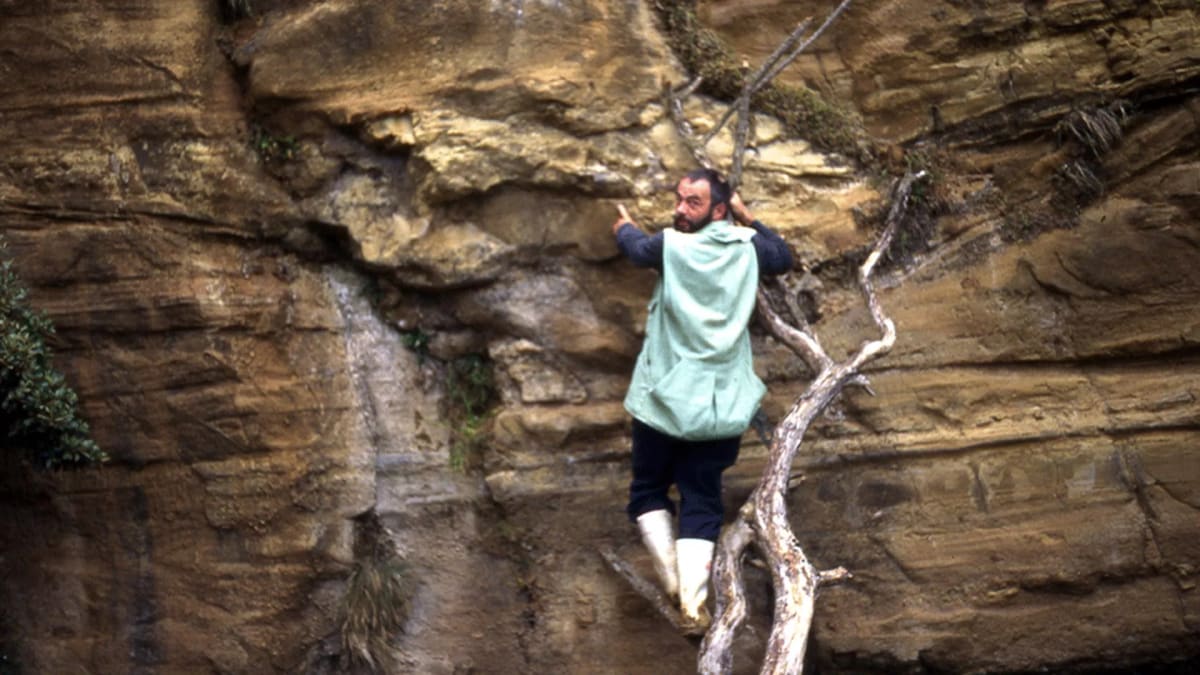
The story started in 1999 when Dr. Richard Köhler spotted something extraordinary on a remote cliff face on Pitt Island. Embedded high in the rock was a perfectly preserved, mummified fish fossil over a meter long. Getting it down required walking 3 kilometers back to his lodging to grab a ladder, then hauling extremely heavy blocks of stone all the way back.
Researchers at the University of Otago immediately knew the fossil was special. Professor Daphne Lee recalls that the 1.2-meter specimen was unlike any fish fossil ever found in New Zealand. The ancient tarpon had cruised these waters 55 million years ago as a top predator, swallowing smaller fish whole with its large upward-facing mouth.
But there was a problem. Richard had passed away, and critical details about exactly where he found the fossil were missing. Without precise location data, the research team couldn't publish their findings, even though they'd already drafted a scientific paper.
The breakthrough came in early 2025 when Richard's son, then studying at Otago, visited the geology department hoping to find photographs of his father. After meeting with researchers, the family made a decision that would change everything. They donated Richard's field notebooks, including those from the original Pitt Island expedition.
Why This Inspires
The notebooks contained exactly what scientists needed. With the detailed field information finally in hand, researchers could properly document and catalogue the fossil, completing work that had stalled for years.
The team published their study this month in the New Zealand Journal of Geophysics and Geology. They named the new species Ikawaihere koehleri in honor of both Richard Köhler and the location where he made his remarkable find. The name was approved by the Hokotehi Moriori Trust.
Professor Mike Gottfried from Michigan State University, who studied the fossil, calls it "among the most important and impressive fossils recovered to date" from New Zealand. Its exquisite 3D preservation reveals unique features that expand our understanding of tarpon evolution.
For Lee, seeing the study finally published felt especially meaningful. Three people who worked on the fossil have since passed away: Köhler, his colleague Professor Ewan Fordyce, and the preparator who carefully cleaned the specimen, Andrew Grebneff.
"It is a fitting tribute to Richard, Ewan and Andrew," Lee says, adding that completing the work wouldn't have been possible without the family's generosity in donating those crucial notebooks.
Based on reporting by Science Daily
This story was written by BrightWire based on verified news reports.
Spread the positivity!
Share this good news with someone who needs it