Mars May Have Had Ocean as Large as Earth's Arctic
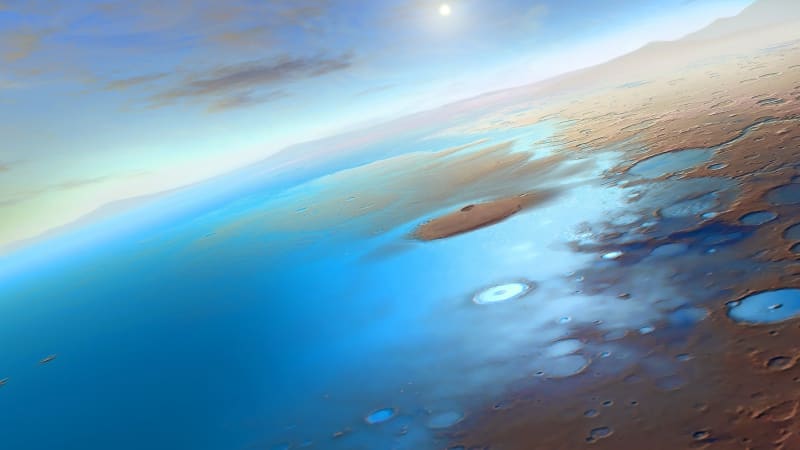
New evidence suggests Mars once held a massive ocean across its northern hemisphere, potentially supporting life billions of years ago. Scientists discovered ancient shoreline features at identical elevations across the Red Planet's largest canyon system.
Scientists just found compelling evidence that Mars wasn't always red. The planet may have once been blue with an ocean at least as large as Earth's Arctic Ocean.
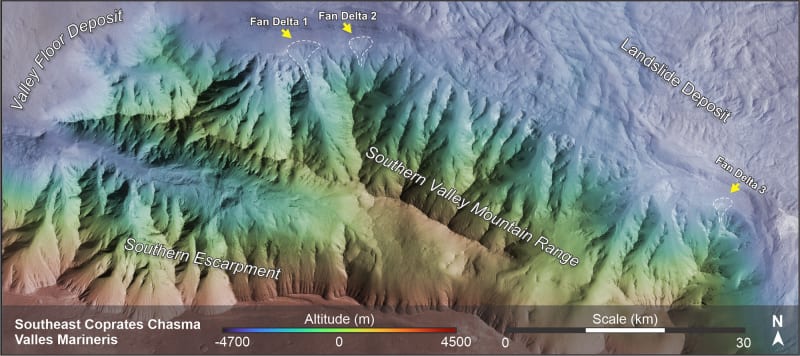
Researchers studied high-resolution images from multiple Mars orbiters, including the European Space Agency's ExoMars Trace Gas Orbiter and NASA's Mars Reconnaissance Orbiter. They focused on a 620-mile canyon called Coprates Chasma, part of the massive Valles Marineris canyon system that stretches over 2,485 miles along Mars's equator.
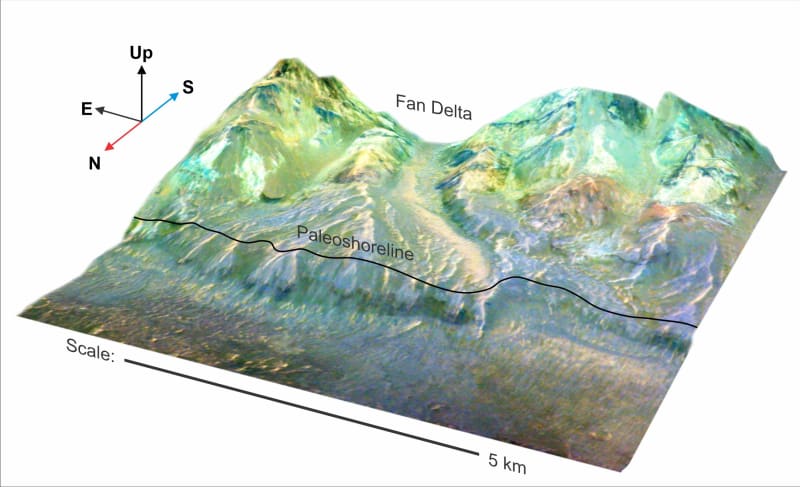
The team discovered geological formations that look remarkably similar to fan deltas on Earth. These fan-shaped deposits form where rivers flow into oceans, creating cones of sand and debris.
Here's what makes the discovery particularly exciting: all these ancient delta structures sit at the exact same elevation, between 11,975 and 12,300 feet deep. They all formed around 3.37 billion years ago, suggesting a consistent shoreline around a vast ocean.
"Together, these instruments act like a geological time machine, helping us reconstruct the planet's past condition," said study lead author Ignatius Argadestya, a planetary geologist at the University of Bern in Switzerland. Wind-sculpted dunes now cover these former deltas, but their original shapes remain recognizable beneath the Martian sand.
The evidence points to an ocean that once covered Mars's entire northern hemisphere. This wasn't just a collection of isolated lakes, but a connected water system spanning vast distances across the planet.
Why This Inspires
This discovery rewrites our understanding of how long Mars might have supported conditions suitable for life. The finding suggests Mars sustained stable surface water on a planetary scale for much longer than scientists previously believed.
Water flowing across such vast distances could have created the perfect conditions for life to emerge and evolve. If Mars held an ocean for extended periods, the building blocks of life had more time and space to develop than researchers once thought possible.
The team plans to investigate ancient Martian soil composition next, which could reveal even more about how water shaped the Red Planet's history. Each new piece of evidence brings us closer to answering one of humanity's most profound questions: are we alone in the universe?
The discovery reminds us that even distant, barren worlds once thrived with possibility.
More Images

Based on reporting by Space.com
This story was written by BrightWire based on verified news reports.
Spread the positivity!
Share this good news with someone who needs it