Maryland Firm Boosts Output 12x With 58 Welding Robots
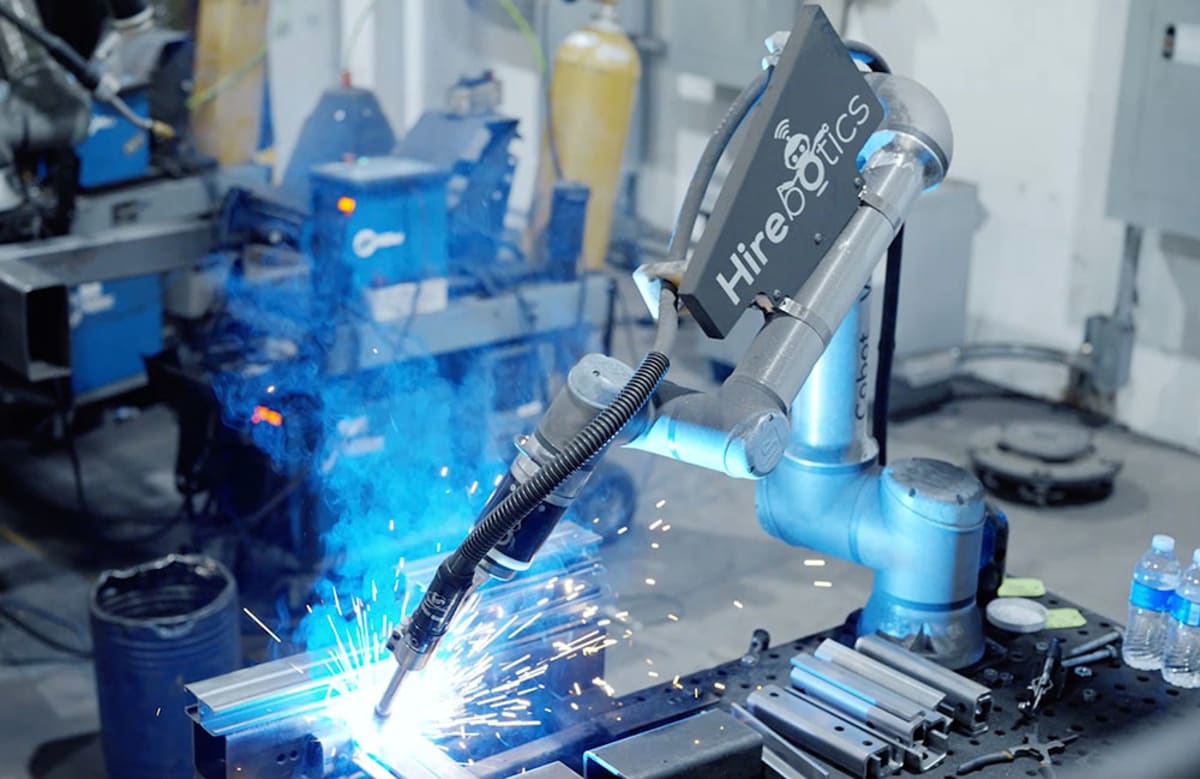
A data center infrastructure company just proved that robots and workers can thrive together. After deploying 58 collaborative welding robots across three states, Tate Inc. increased productivity twelve times while actually growing its team of human welders.
📺 Watch the full story above
For 120 years, Tate Inc. has built the structural bones of data centers across America. But as demand exploded and precision requirements tightened, the Maryland company faced a choice: scale up or fall behind.
They chose both speed and quality. In September 2023, Tate began rolling out collaborative robots that work alongside human welders at facilities in Arkansas, Virginia, and Kentucky.
The transformation happened fast. Within 30 minutes of bringing sample parts to Nashville-based Hirebotics, the robotics company had the machines welding successfully. Training human workers took just 10 to 20 minutes per person.
"It was a fantastic process to learn," said Jonathon Cook, a welding programmer at Tate. "We can manipulate and curate every single weld to be exactly how it's supposed to be, by spec, every single time."
The robots operate through a smartphone app called Beacon Pro. Workers program welding angles, heat levels, and speeds with taps and swipes. No coding required.
Tate's Arkansas plant pioneered a clever workflow where robots handle the precise tacking and pre-assembly work, feeding perfectly prepared parts to downstream production. The three facilities now share programs and settings in real time, creating consistent quality nationwide.
The results speak louder than any sales pitch. Tate reports a 12-fold increase in per-welder output on critical assemblies. Manual welding errors that once required costly rework have disappeared.
The Ripple Effect
Here's what makes this story shine: automation didn't replace workers. Tate expanded its team of certified welders while productivity soared. Veteran welders who spent entire careers doing manual work embraced the technology when they saw it made their jobs better, not obsolete.
The company now runs zero hand-welded production components. Every weld meets exact specifications because the robots execute the precision that human programmers design. It's collaboration in the truest sense.
Tate liked the system so much they became early adopters of Hirebotics' new painting robot, which uses the same easy-to-learn platform. What started as solving a welding challenge became a blueprint for how American manufacturing can compete through smart automation that amplifies human skill rather than replacing it.
When technology and people work together, everybody wins.
More Images


Based on reporting by The Robot Report
This story was written by BrightWire based on verified news reports.
Spread the positivity!
Share this good news with someone who needs it