Math Genius Wins $3M Prize for Solving Chaos Equations
French mathematician Frank Merle just won a $3 million prize for discovering hidden order in the messiest math problems in nature. His breakthrough helps scientists better understand everything from laser technology to ocean waves.
A mathematician who sees beauty in chaos just became $3 million richer for solving some of nature's trickiest puzzles.
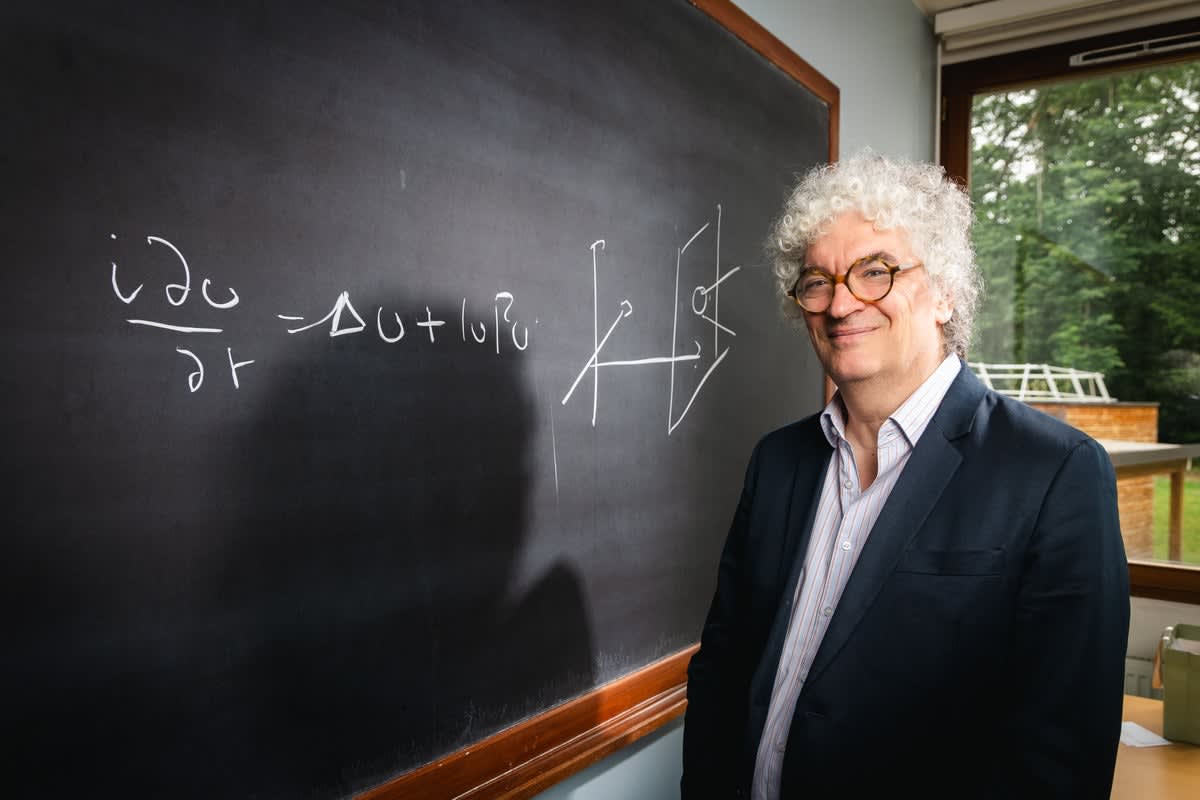
Frank Merle won this year's Breakthrough Prize in Mathematics for his groundbreaking work on nonlinear equations, the kind of math that explains tornadoes, rogue waves, and how lasers focus light. While these systems seem wildly unpredictable, Merle discovered they're actually built on hidden patterns called solitons.
Think of solitons as islands of calm in a storm. They're special mathematical structures that keep their shape and energy even as chaos swirls around them. Merle realized that all the messiness in nonlinear systems actually comes from multiple solitons interacting with each other.
"I see the world as a more catastrophic place to live," Merle told Scientific American. But that perspective turned out to be his secret weapon.
Most mathematicians before Merle tried to understand chaotic systems by starting with simple, well-behaved equations and nudging them slightly toward complexity. Merle did the opposite. He dove headfirst into the chaos itself.
His approach paid off spectacularly. Merle made major breakthroughs in understanding "blowups," moments when equations suddenly spike from zero to infinity. These blowups matter in real life: when you want to focus a laser beam as tightly as possible, you're actually looking for a controlled blowup.
The prize came as a shock to Merle, who remembers when most colleagues doubted his unconventional methods would work. "When I found this new way of seeing these problems, most people were not convinced that I could produce something interesting," he said. "Then one problem fell and then another one."
Why This Inspires
Merle's story shows the power of looking at familiar problems from completely new angles. For decades, mathematicians treated chaotic systems like dangerous animals to be approached carefully. Merle walked right up and found friends.
His discovery that infinite complexity reduces to simple, countable patterns holds a beautiful message: beneath what looks like disorder, nature often hides elegant solutions. What once seemed impossibly complicated turns out to follow rules we can understand and even predict.
The work has practical implications too, helping engineers design better lasers and scientists model fluid dynamics more accurately. But perhaps the biggest takeaway is philosophical: sometimes the best way through complexity isn't to avoid it, but to embrace it completely.
Chaos, it turns out, has been hiding simplicity all along.
More Images



Based on reporting by Scientific American
This story was written by BrightWire based on verified news reports.
Spread the positivity!
Share this good news with someone who needs it