McGill Biocomputer Uses 1 Million Bacteria as Chips
Scientists at McGill University have built a living computer that uses multiplying bacteria to solve complex math problems in parallel. This green breakthrough tackles equations that baffle silicon supercomputers while using a fraction of the energy.
Imagine a living supercomputer that grows its own microchips on demand to crack the world's toughest puzzles. Researchers at McGill University have turned that sci-fi vision into reality by creating a biocomputer powered entirely by multiplying bacteria.
Standard electronic computers tackle complex mathematics in a sequential, single-file line. For massive equations, this methodical march can take decades or even centuries of continuous processing.
Bacteria, on the other hand, naturally thrive by exploring vast environments all at once. By harnessing this instinct, the international research team constructed a computing system that navigates every possible solution at the exact same time.
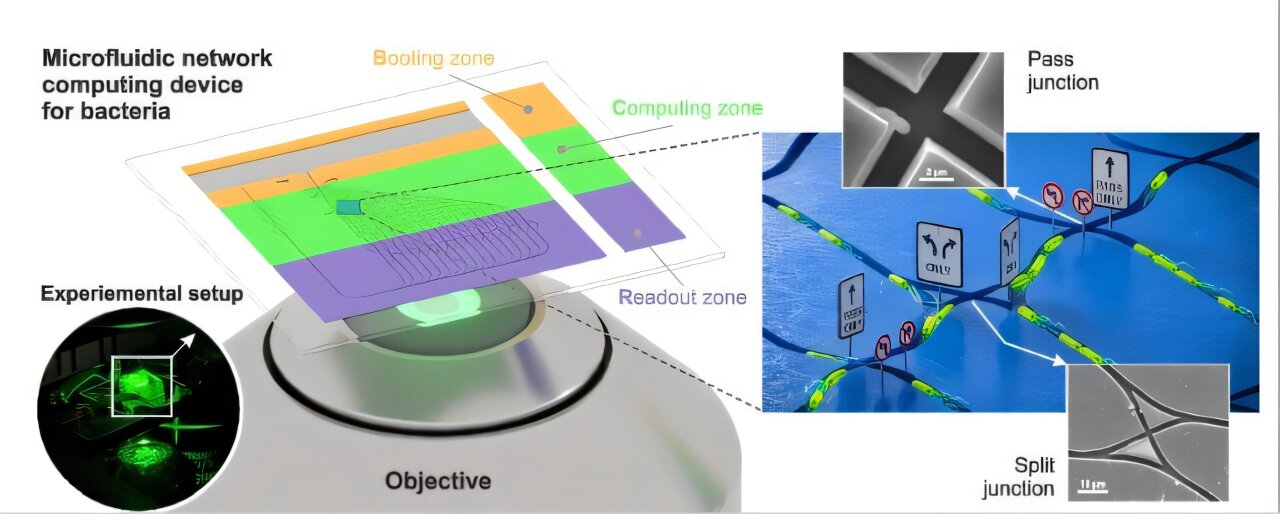
The team spent two decades creating intricate microscopic networks of fluid-filled channels that mirror complex mathematical problems. Microscopic junctions throughout the maze function as living logic gates, offering the swimming microbes distinct paths to choose from.
As the bacteria travel through these channels, they multiply rapidly and double their computational workforce. Each newly divided cell acts as an independent biological processor, automatically expanding the system's calculating power.
Senior author and bioengineering professor Dan Nicolau pointed out that bacterial division produces over one million tiny processors working in unison. While individual bacteria move at a gentle pace, their combined parallel processing resolves monumental problems at breathtaking speed.
The researchers maintain complete control over the system by adjusting the temperature, which regulates bacterial growth and prevents microscopic traffic jams. Automated cameras monitor the channels, quickly identifying the successful pathways that solve the underlying mathematical puzzle.
The Ripple Effect
This breakthrough promises to transform computing by providing an eco-friendly alternative to power-hungry data centers. Traditional supercomputers devour immense amounts of electricity, whereas living biocomputers require only modest biological nutrients and microscopic space.
The technology holds immense promise for healthcare, particularly in mapping intricate protein structures and designing customized life-saving medicines. Instead of relying on artificial intelligence to estimate outcomes from historical data, scientists can now solve physical biological puzzles directly inside these micro-networks.
Life itself has just handed humanity the blueprint for a cleaner, smarter computational future.
More Images
Based on reporting by Phys.org - Technology
Building Something New? Try the BrightWire Tech Stack Advisor
Compare modern frameworks, cloud hosting, and AI tools tailored to your project budget and scale.
Spread the positivity!
Share this good news with someone who needs it


