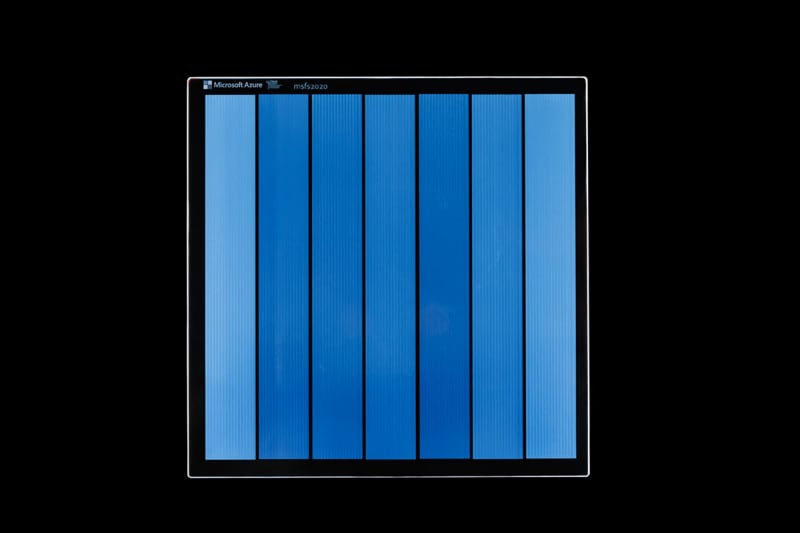
Microsoft Glass Tech Stores Data for 10,000 Years
Microsoft just perfected a way to store digital information in glass for thousands of years, potentially preserving human culture forever. The breakthrough uses lasers and ordinary glass to create nearly eternal archives.
Imagine storing your most precious memories, not for decades, but for 10,000 years.
Microsoft just made that possible with Project Silica, a breakthrough technology that uses lasers to etch data into glass. After years of development, the company announced it has completed the research phase and achieved remarkable improvements in cost and performance.
The system works by firing ultra-fast femtosecond lasers at ordinary borosilicate glass, the same material found in your kitchen cookware and oven doors. That switch from expensive fused silica to everyday glass slashed costs dramatically and removed a major barrier to making the technology practical.
The data gets stored in hundreds of layers within glass just 2 millimeters deep, creating three-dimensional pixels called voxels. Microsoft simplified the system so much that it now needs only one camera instead of three or four, making it cheaper and easier to manufacture.
The company has already tested Project Silica with images, audio, music, and spoken languages, essentially creating time capsules of human culture. Rigorous aging experiments using non-destructive optical methods confirm the glass can reliably preserve information for at least 10,000 years, possibly much longer.
Why This Inspires
In an age where digital files feel temporary and fragile, this technology offers something profound: permanence. Future generations thousands of years from now could access our stories, discoveries, and achievements exactly as we recorded them.
The implications stretch far beyond personal memories. Libraries could preserve rare manuscripts, scientists could archive crucial research data, and humanity could safeguard its collective knowledge against disasters, wars, or technological obsolescence.
Microsoft isn't rushing to sell the technology itself. Instead, the company is encouraging other organizations to transform the completed research into commercial products, opening the door for multiple companies to develop practical applications.
Other approaches to permanent storage are emerging too, like ceramic-based media from companies such as Cerabyte, showing that the race to preserve digital information forever has only just begun.
This breakthrough arrives at a perfect time as data centers struggle to manage exploding amounts of information that needs long-term storage. From government archives to cultural institutions, organizations worldwide are searching for reliable ways to preserve critical data beyond the lifespan of traditional hard drives and servers.
The science is sound, the testing is complete, and the path forward is clear: humanity now has a proven way to speak across millennia.
Based on reporting by Google News - Tech Breakthrough
This story was written by BrightWire based on verified news reports.
Spread the positivity!
Share this good news with someone who needs it