Middle East Invests $3B in Food Tech Revolution
The Middle East is turning climate challenges into opportunity, pouring billions into agricultural innovation that could feed the future. With record venture capital and fast-track regulations, the region is becoming an unexpected global leader in food technology.
When you hold just 1.4% of the world's freshwater but need to feed 6.3% of its population, innovation stops being optional and starts being survival.
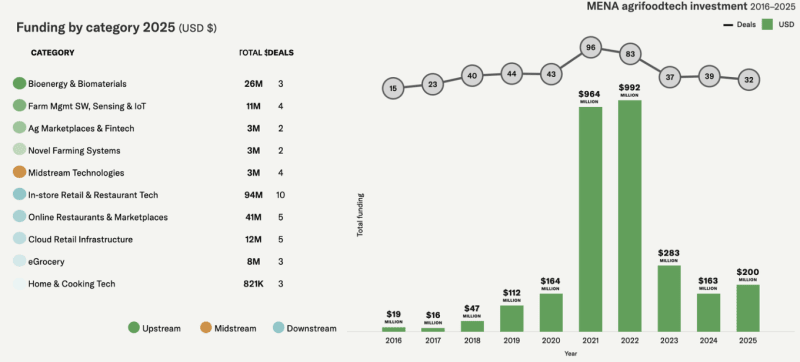
That's exactly what's happening across the Middle East and North Africa. While venture capital struggles globally, the region just hit record investment highs in 2025, with nearly $3 billion flowing into agricultural food technology over the past decade.
The numbers tell a story of urgency meeting ambition. Saudi Arabia plans to double its agricultural output by 2030. The United Arab Emirates wants to rank among the world's most food-secure nations by 2051. These aren't just goals on paper; they're backed by sovereign wealth funds pumping hundreds of billions into long-term infrastructure.
Unlike traditional venture capital that expects returns in five to seven years, these sovereign funds think in decades. That patient capital is funding the kind of moonshot projects that take time: vertical farms in the desert, cultivated meat facilities, and AI-powered agricultural systems.
The UAE already ranks second globally for AI infrastructure, with over 188,000 chips dedicated to the technology. Abu Dhabi plans to become the world's first fully AI-native government by 2027, streamlining everything from food production to water management.
Saudi Arabia's sovereign wealth fund is projected to invest $2 trillion by 2030, with $40 billion earmarked specifically for artificial intelligence. Another $100 billion will fund advanced manufacturing, while the ambitious NEOM smart city project addresses water scarcity and clean energy needs head-on.
Perhaps most importantly, these nations are rewriting the rulebook on food regulation. Abu Dhabi is cutting approval times for novel foods to just six to nine months, compared to 18 to 36 months in the US and Europe. Qatar became only the second country worldwide to approve cultivated meat sales, following its $200 million investment in GOOD Meat.
Companies are taking notice. Kitopi, a cloud kitchen startup, has raised over $800 million. Pure Harvest secured $330 million for vertical farming technology that grows fresh produce in one of the harshest climates on Earth.
The Ripple Effect
What starts in the Middle East won't stay there. As extreme heat, water scarcity, and food insecurity spread globally due to climate change, the technologies being perfected in desert conditions today could become blueprints for tomorrow's solutions worldwide.
The region's regulatory speed gives it another advantage: becoming a testing ground for innovations that might take years longer to approve elsewhere. Success stories here could accelerate adoption across markets serving 1.8 billion Muslim consumers and beyond.
When climate necessity meets financial power and regulatory courage, the result isn't just adaptation; it's a complete reimagining of how we grow, produce, and distribute food in an uncertain future.
More Images


Based on reporting by Google News - Uae Innovation
This story was written by BrightWire based on verified news reports.
Spread the positivity!
Share this good news with someone who needs it