MIT Creates Shape-Changing Smart Blocks That Stay Connected
MIT engineers invented building blocks that morph into different shapes while keeping their circuits working. These "bifur-circuits" could revolutionize everything from assistive furniture to robotic grippers.
Imagine furniture that knows when it transforms from a chair to a table, or a robotic hand that stays electrically connected no matter what shape it grips.
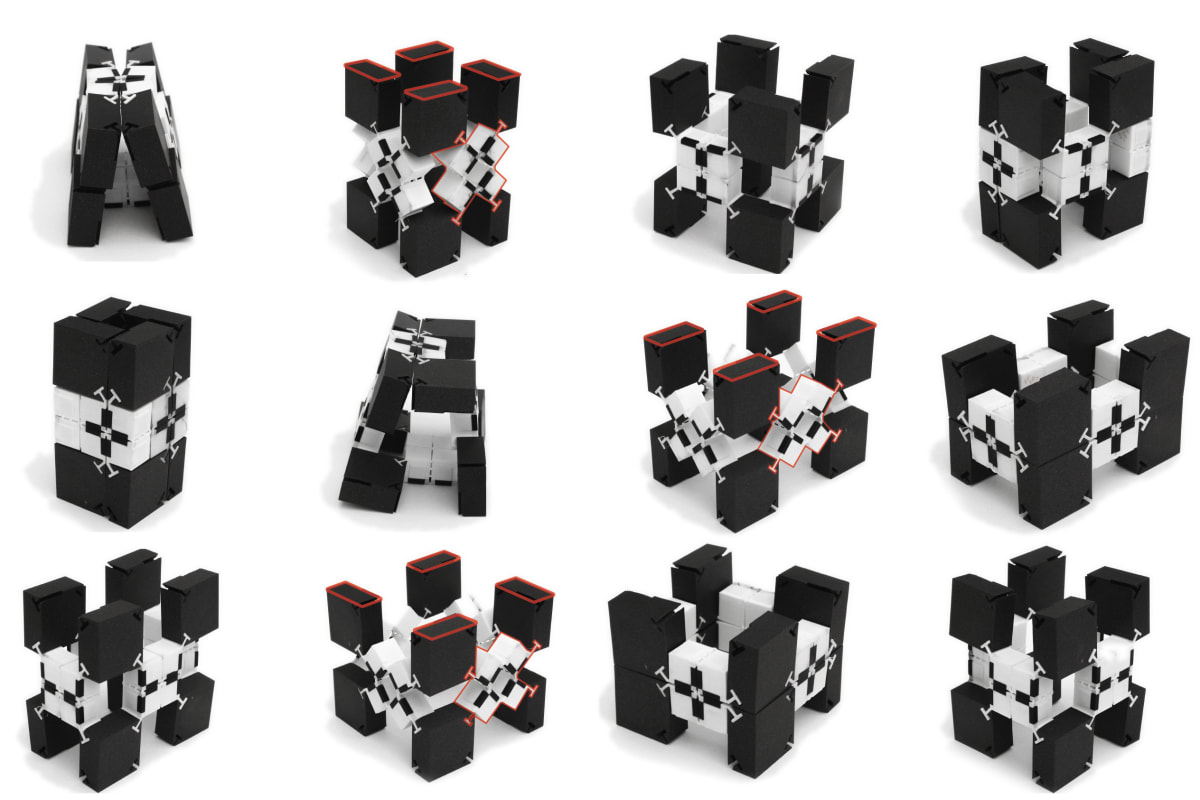
MIT engineers just made that possible with a breakthrough they call "bifur-circuits." These 3D-printed building blocks can twist, bend, compress, and stretch into countless configurations while maintaining their electrical connections throughout every transformation.
The magic lies in how conductive material is woven inside each modular unit. No matter how you rotate, press, or reconfigure the blocks, the circuits stay intact and functional. The structure actually senses what shape it has formed without needing any external wires.
Graduate student Marwa AlAlawi and her team at MIT's Computer Science and Artificial Intelligence Lab demonstrated the technology with a clever prototype. They built a piece of furniture that converts from a chair to a table with storage, then flattens completely for easy transport. The structure knows which form it has taken and displays corresponding messages on a screen.
The possibilities extend far beyond adaptive furniture. Doctors could use bifur-circuits to create customized assistive devices that help patients recovering from injuries change positions safely. Engineers could build reconfigurable robotic grippers that adapt to different tasks while staying electrically connected.
Communication technology could benefit too. These metamaterials could form antennas that reshape themselves to adjust frequencies based on changing environmental conditions, eliminating the need for bulky mechanical parts.
The Ripple Effect
Traditional metamaterials could only form three fixed shapes, severely limiting their applications. These new bifur-circuits break through that barrier by combining mechanical bifurcation (a sudden shift in behavior when force reaches a tipping point) with electrical modularity.
The innovation transforms how engineers approach interactive device design. Instead of building complex systems from scratch, they can rapidly prototype adaptable smart devices using repeating modular units. This makes sophisticated mechanical assemblies easier and cheaper to manufacture.
The research team presented their findings at the ACM Symposium on User Interface Software and Technology. Their work includes collaborators from the University of Tokyo and University of Michigan, showing how international cooperation drives innovation forward.
By embedding intelligence directly into hardware through geometry, the researchers opened doors that were previously closed. Complex adaptive systems that once required extensive engineering can now be built like high-tech LEGO sets.
The future of reconfigurable technology just got a whole lot brighter, one modular block at a time.
More Images
Based on reporting by MIT News
This story was written by BrightWire based on verified news reports.
Spread the positivity!
Share this good news with someone who needs it