MIT Nanotech Lets Scientists Watch Cancer Proteins in Action
Scientists at MIT developed glowing nanoparticles that track cancer proteins for hours instead of seconds, revealing how they behave in living cells. The breakthrough could transform drug development and help explain why some mutations cause aggressive cancers.
Scientists can now watch cancer-related proteins move and interact in real time, thanks to a breakthrough imaging method that's like upgrading from blurry snapshots to high-definition video.
A research team at MIT's Broad Institute solved a major problem that has limited cancer research for years. Traditional tracking methods using dyes only illuminate proteins for a few seconds before burning out, giving scientists just brief glimpses of how these molecules behave.
The new method uses special nanoparticles containing rare-earth ions that glow steadily under laser light for minutes, hours, or even longer. These tiny beacons attach to individual proteins and follow them throughout their entire journey across cell membranes.
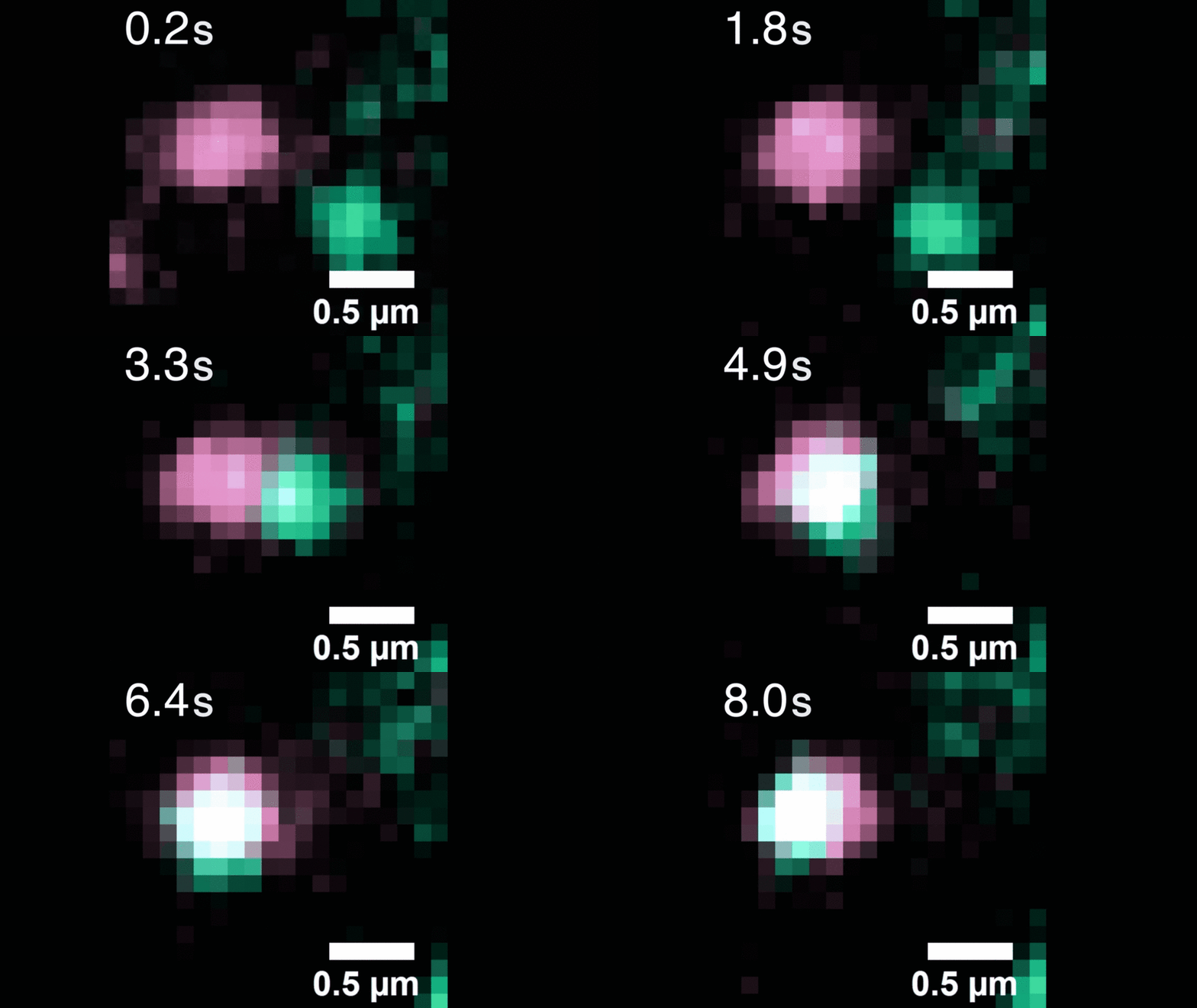
The team focused on EGFR proteins, a family of cell receptors linked to several cancers. They wanted to understand how these proteins pair up to trigger cell growth and what happens when cancer mutations enter the picture.
What they discovered was eye-opening. Normal EGFR proteins pair up for several minutes when activated, but mutated versions stay coupled much longer and can even pair up without any trigger. The more stable these pairings, the more aggressive the cancer tends to be in patients.
Lead researcher Sam Peng, an assistant professor of chemistry at MIT, says the method reveals "things that have never been observable before." His team watched proteins navigate the cell surface, finding partners, separating, and finding new partners in a constant dance.
The researchers also tracked two related proteins, HER2 and HER3, simultaneously in living human cells. They observed surprising new details about how these molecules form stable partnerships, helping explain their roles in cancer development.
Why This Inspires
This isn't just about understanding cancer better. The technique opens doors for testing new drugs by showing exactly how medications affect individual molecules over time in living cells.
Scientists can now engineer these nanoparticles to glow in different colors by adjusting the types and amounts of rare-earth ions inside them. That means tracking multiple proteins at once in a single experiment, something previously impossible with traditional methods.
The team is working to make the probes even smaller, brighter, and more colorful. They're inviting researchers from other fields to apply the method to their own questions about protein behavior.
The breakthrough represents a fundamental shift in how scientists can study molecular biology. Instead of piecing together static images, they can now watch biological processes unfold in real time with unprecedented clarity and duration.
Understanding exactly how cancer proteins behave could lead to smarter, more targeted treatments that interrupt these harmful partnerships at just the right moment.
Based on reporting by MIT News
This story was written by BrightWire based on verified news reports.
Spread the positivity!
Share this good news with someone who needs it